Cursor's Default Switch to Grok Sparks Backlash: Model Downgrade and Performance Decline Trigger User Complaints
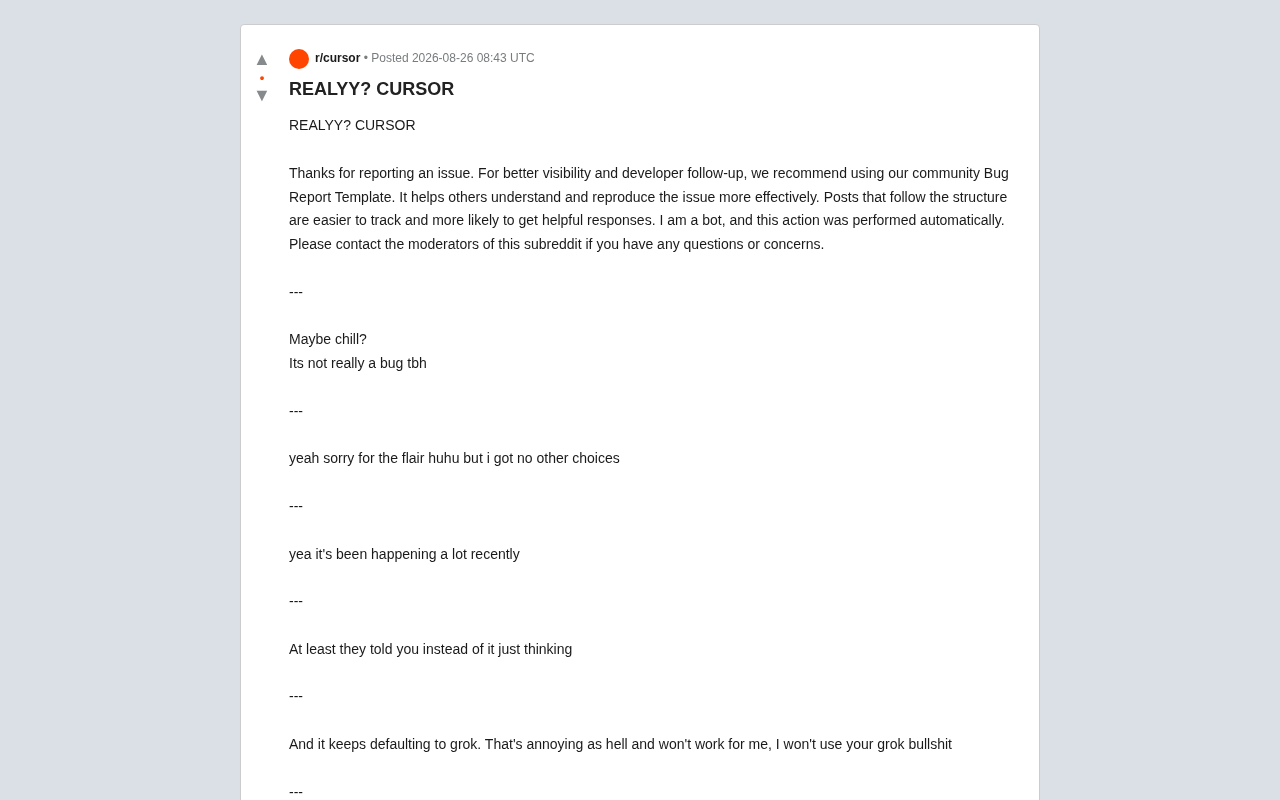
Cursor users revolt as the tool repeatedly defaults to Grok with noticeably worse performance.
Cursor users are voicing frustration on Reddit over the AI code editor's frequent default switching to Grok, along with slower response times and declining output quality. The backlash highlights deeper challenges facing AI coding tools: balancing cost optimization with user trust, maintaining service transparency, and respecting developers' established workflows in a multi-model landscape.
Background: Collective Complaints from the Cursor User Community
Recently, a wave of complaints emerged on Reddit from the user community of Cursor, the AI-powered coding tool. One user posted with the emotionally charged title "REALYY? CURSOR," which quickly attracted a flood of developers sharing similar experiences. While the post wasn't technically a proper bug report (it even triggered the community bot to recommend using the standard bug template), the issues exposed in the comments are worth paying attention to — they reflect real pain points in user experience as AI coding assistants race through rapid iteration and commercialization.
As one of the most popular AI-native code editors of the past two years, Cursor has won a large following thanks to its powerful contextual understanding and multi-model integration. However, as its user base grows and backend strategies shift, some users have begun noticing clear fluctuations in service quality.
Cursor's Default Model Forcibly Changed to Grok
The most concentrated complaint in this discussion is about changes to the default model selection behavior. Multiple users reported that Cursor's chat window now frequently defaults to Grok (the model from xAI), and this was not something they actively chose.
One user was blunt: "It keeps defaulting to Grok, and it's annoying as hell. I'm not going to use your Grok garbage." Another added: "Yeah! I hate this too. I always used auto mode and switched to Claude when needed, but now every time I open chat it defaults to Grok."
This feedback reveals a critical issue: when a tool adjusts its default model strategy on the backend without sufficiently respecting users' established habits, it easily triggers strong resentment. For developers, model selection is often a deliberate choice — different models have different strengths in code generation, logical reasoning, and context retention. Forcibly or implicitly changing the default model disrupts the workflow users have already built.
Why Does Cursor Default to Grok?
While there's no official explanation in the thread, from an industry perspective, this kind of default switching is typically related to cost control, model partnership strategies, or load balancing. Inference costs for AI coding tools are high, and vendors may optimize overall operational costs by steering users toward specific models. However, if this steering is too aggressive, it erodes the trust of paying users.
Slower Response Times and Declining Output Quality
Beyond the model switching issue, another repeatedly mentioned complaint is overall performance degradation. One user described it this way: "I get this a lot too, and the model has been really slow lately. Output quality is shockingly bad most of the time."
This feedback echoes suspicions of "model downgrading." In the AI services space, user communities often suspect that vendors quietly route requests to smaller, cheaper models during peak times or to save costs, resulting in lower output quality. While there's no definitive evidence that Cursor engages in this practice, the subjective experience of things getting "slower" and "dumber" is itself a signal that the product team needs to take seriously.
For developers who rely on AI-assisted coding, response speed and output quality directly impact daily productivity. Once a tool becomes unreliable, users will quickly migrate to competitors like Windsurf or GitHub Copilot.
Community Sentiment: Rational Voices Amid the Frustration
A small detail worth noting: despite the steady stream of complaints, there were also relatively rational voices in the community. One user commented: "At least it tells you, instead of spinning its wheels thinking forever." While somewhat tongue-in-cheek, this reflects some users' appreciation for tool transparency — compared to unresponsive freezes, at least there's a clear status indication.
Other users offered calming suggestions to the original poster's emotional expression: "Maybe chill? This isn't really a bug." These responses show that even within the community, there are differing perceptions of "what counts as an issue." The original poster also replied helplessly: "Sorry for the wrong tag, but I had no other option to choose from."
Deeper UX Challenges Facing AI Coding Tools
What appears to be ordinary community venting actually reflects several deeper challenges that AI coding tools universally face:
First, the battle over default settings. When vendors try to guide user behavior through default configurations, they must find a balance between commercial interests and user autonomy. Any forced default that isn't adequately communicated can trigger a trust crisis.
Second, transparency in service quality. Users' sensitivity to "model downgrading" is fundamentally anxiety about opaque service quality. If vendors proactively disclosed their model routing logic and performance status, they could actually build stronger user trust.
Third, choice fatigue in the multi-model era. As Claude, GPT, Grok, and other models are integrated into coding tools, users enjoy the freedom of choice but also suffer when those choices are disrupted. How to strike a balance between flexibility and stability is a key product design challenge.
Conclusion
This Reddit thread may not provide rigorous technical data, but it authentically documents the frustration of a group of Cursor users. From the default model switching to Grok, to the subjective experience of overall performance decline, these complaints remind us that competition among AI coding tools has long moved beyond just model capabilities — it's a comprehensive contest of user experience, transparency, and trust.
For a leading product like Cursor, how it responds to community feedback and balances commercial strategy with user needs will directly affect its long-term competitiveness in a fierce market. And for developers at large, staying attentive to tool behavior and providing timely feedback is an important force for driving product improvement.
Related articles

Chain of Thought Isn't Just for AI: How Humans Can Use CoT to Improve Thinking Quality
Chain of Thought isn't just a prompt trick for large models. Starting from a Hacker News discussion, this article analyzes why CoT works for human thinking too, breaks down actionable ways to transfer it, and highlights the key differences between human CoT and machine CoT.
Cloudflare Teams Up with OpenAI: Closi…
Cloudflare Teams Up with OpenAI: Closing the Loop from Vulnerability Discovery to Defense with AI
Cloudflare uses OpenAI Daybreak to investigate security vulnerabilities and generate reviewable remediation plans, while developers use Codex to boost coding efficiency and quality.

Orca Multi-Agent Orchestration in Practice: A Guide to Parallel Collaboration with Claude and Codex
Orca is Stable AI's free open-source agent workbench supporting 34 agents like Claude Code and Codex in parallel. Learn its Git worktree isolation, multi-model orchestration, and mobile management.