Cursor's Default Switch to Grok Sparks Controversy: Model Transparency Becomes Trust Focal Point for AI Coding Tools

Cursor's unlabeled Grok integration sparks debate over model transparency in AI coding tools.
A Cursor user discovered the AI coding IDE silently switched to Grok while only displaying abstract "quality" and "speed" labels instead of the model name—unlike how it presents OpenAI and Composer models. This inconsistency triggered a broader discussion about user trust, informed consent in multi-model AI tools, and the commercial tensions between promoting partner models and maintaining transparency for professional developers.
Cursor User Exposes Grok Model Labeling Gap
Recently, a user of Cursor (one of today's hottest AI coding IDEs) posted on Reddit expressing strong dissatisfaction, directly accusing Cursor of "deceptive" design in its handling of the Grok model. The post quickly sparked discussion, touching on an increasingly sensitive topic in the AI tool ecosystem: When an AI IDE integrates multiple large language models simultaneously, do users have the right to clearly know which model they're actually using?
Cursor is an AI-native coding IDE deeply rebuilt on the VS Code architecture, developed by Anysphere. Unlike plugin-based solutions such as GitHub Copilot, Cursor treats AI capability as its first-priority design principle, supporting multi-model switching (including Claude, GPT-4, Grok, and others), and has launched its proprietary Composer model. As of 2025, Cursor has become one of the fastest-growing AI coding tools in the developer community, with paid users receiving usage quotas for different models.
This user's core complaints can be summarized in two points: first, Cursor had exhibited behavior of "automatically switching to Grok"; second, and more infuriating to them — in the model dropdown menu, other models (like OpenAI's series) clearly display their model names, while Grok only shows abstract labels of "quality" and "speed" without indicating the specific model name.
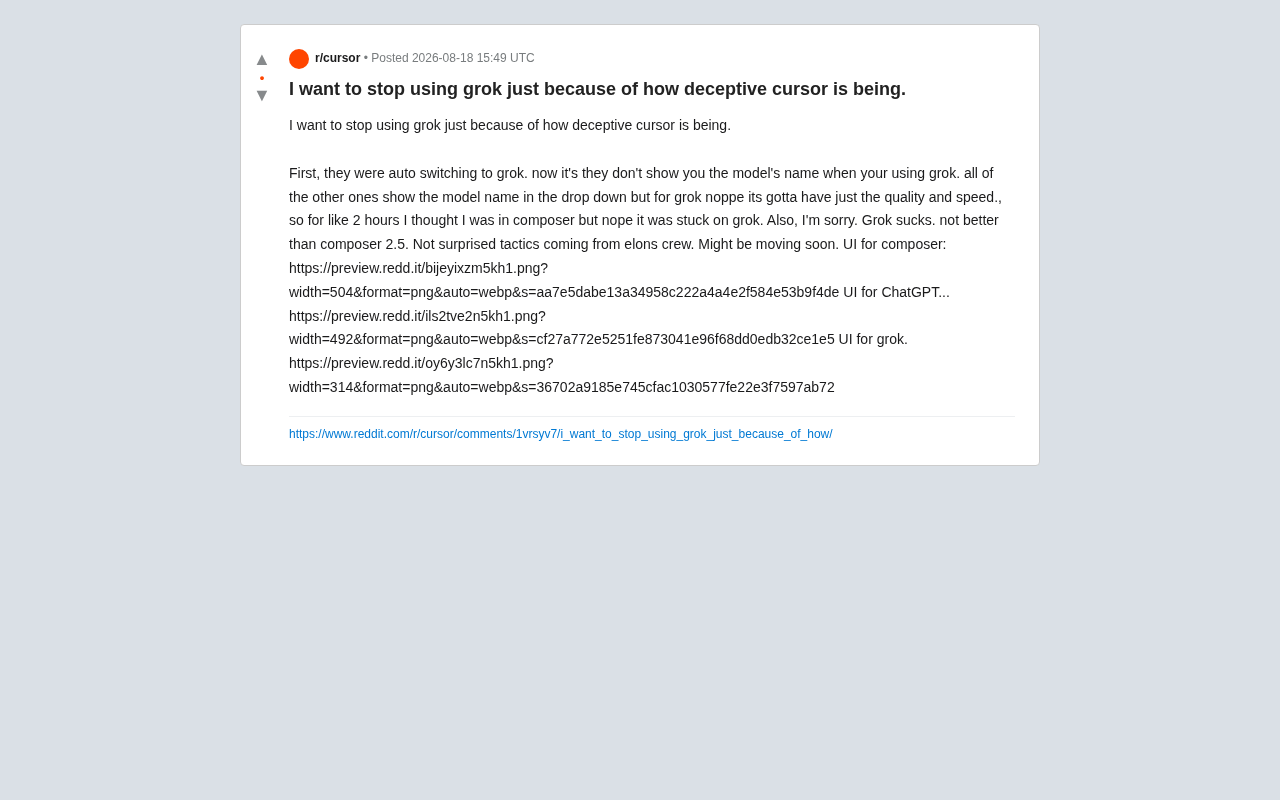
The result was that this user spent a full two hours coding, believing they were using Cursor's proprietary Composer model, when they were actually "locked" onto Grok without knowing it. In multi-model aggregation platforms, "model routing" is a core technical decision — when a user's preferred model hits rate limits, API unavailability, or quota exhaustion, the platform may automatically route requests to an alternative model. Ideally, such switches should be clearly communicated to users; but in actual products, in pursuit of seamless experience or due to commercial considerations, some platforms may choose to switch silently — and this is precisely what triggered user dissatisfaction.
Cursor's Interface Design Discrepancy: Inconsistent Model Labeling Triggers Trust Crisis
The problem is clearly visible from the comparison screenshots attached to the post. The user specifically showed how three different models are presented in Cursor's dropdown menu:
- Composer's interface: clearly labeled with the model name;
- ChatGPT (OpenAI's) interface: also explicitly shows the model name;
- Grok's interface: only presents abstract descriptions of "quality" and "speed," missing the model identifier.
This inconsistent design is the root cause of the user's feeling of "being deceived." In AI coding tools, different models vary enormously in capability, cost, and response characteristics, and developers often actively choose models based on task type. If a tool plays favorites with critical model labeling, users cannot make informed choices, and may even unknowingly consume quotas intended for other models or experience output quality that doesn't match expectations.
Current mainstream AI coding tools generally adopt a "quota-based" payment model. Taking Cursor as an example, its Pro plan typically includes a certain number of "fast requests" (using premium models like Claude 3.5 Sonnet or GPT-4o) and more "slow requests." The API call costs between different models vary enormously — GPT-4o's per-token cost can be dozens of times that of lightweight models. Therefore, when users are silently switched to an unexpected model, they may face two types of losses: one is consuming high-cost model quota they didn't intend to use, and two is receiving output quality below expectations while thinking it's their preferred model's performance, thus incorrectly evaluating model capability.
Why Model Labeling in AI Coding Tools Matters So Much
For professional developers, model selection is no trivial matter. Claude, GPT series, Composer, and Grok each have their strengths in code generation, context understanding, and debugging suggestions. A transparent model labeling system is fundamentally about respecting users' right to know and right to control. When this transparency has gaps, even without malicious intent, it's easily interpreted as deliberate steering or profit-driven design.
Specifically, Composer is Cursor's in-house AI coding model, optimized specifically for multi-file editing and complex code refactoring tasks. Unlike general-purpose large language models, Composer is designed to understand entire codebase context and excels in cross-file modifications and project-level refactoring scenarios. Many Cursor users consider it their default first choice, which is precisely why the psychological gap is particularly strong when users think they're using Composer but are actually switched to Grok.
Users Question Grok's Coding Capabilities
Beyond transparency issues, this user also bluntly expressed disappointment with Grok's actual coding performance. They stated plainly that "Grok sucks and is not better than Composer 2.5," connecting this practice to "the usual playbook of Musk's team."
Grok is a large language model series developed by xAI (founded by Elon Musk). xAI was established in 2023 and launched Grok-2 and Grok-3 versions in 2024, positioning itself as a general-purpose AI assistant while also pushing into the code generation space. Grok was initially offered primarily through the X platform (formerly Twitter) and later gradually opened API access to third-party platforms. Due to Musk's high-profile promotional style, Grok's reputation in the developer community is polarized — supporters believe its reasoning capabilities are excellent, while critics argue it's over-hyped and struggles to match competitors like Claude and GPT-4o.
To be clear, this represents a single user's subjective experience and does not constitute an objective assessment of Grok's coding capabilities. Different developers may evaluate the same model very differently across different task scenarios. But the value of this comment lies in what it reflects: when a tool "promotes" a certain model without transparency, users naturally develop resistance and may even actively abandon using that model — just as this user stated in their title, they want to "stop using Grok solely because of Cursor's deceptive practices."
This is a signal that AI tool vendors should heed: Non-transparent default settings may ultimately damage the reputation of the very model being promoted.
The Commercial Battle and User Experience Balance in Multi-Model AI IDEs
Behind this controversy lies the deeper tension in today's AI coding tool ecosystem. Multi-model aggregation IDEs like Cursor need to balance multiple aspects:
First, the trade-off between commercial partnerships and proprietary models. Cursor has launched its proprietary Composer model while also integrating third-party models. The choice of default model and the presentation priority in the interface often involve complex cost structures and business considerations. Model providers may compete for default status on aggregation platforms by lowering API pricing, offering free quotas, or directly paying promotion fees — this is hardly uncommon in the internet industry, similar to how search engines compete for default settings in browsers.
Second, the contradiction between simplifying experience and preserving user control. Replacing specific model names with abstract labels like "quality/speed" is, to some extent, meant to lower the decision barrier for average users. This design philosophy has its place in consumer-grade products — most non-technical users don't care which model is running underneath; they care more about "I need better results" versus "I need faster responses." But for professional developers, this "simplification" actually strips away the precise information they need, creating a "false assumption about user expertise."
Third, the fragility of user trust. Competition among AI tools has entered a white-hot phase, and user migration costs are decreasing. Cursor faces fierce competition from Windsurf (formerly Codeium), GitHub Copilot Workspace, and various emerging AI IDEs. Once operations like "automatic switching" or "hidden model names" occur, even if unintentional, they can trigger a trust crisis and user churn. In developer communities, word-of-mouth spreads extremely fast — a single Reddit post can influence thousands of potential users' choices.
Model Transparency Is the Trust Foundation of AI Coding Tools
While this Reddit post is just one user's complaint, the issue it touches on has universal significance. As AI coding tools increasingly become core productivity tools for developers, transparent model presentation is no longer a nice-to-have feature but foundational infrastructure for building user trust.
This issue also resonates with broader AI governance discussions. In the EU's AI Act and AI regulatory frameworks being developed across nations, "transparency" is listed as one of the core principles. While these regulations currently focus primarily on high-risk AI applications, the concept that "users have the right to know basic information about the AI system they're interacting with" is permeating into the broader AI product landscape. For AI coding tools, model labeling transparency doesn't involve safety risks, but it embodies the same spirit of user rights.
For Cursor and similar products, the lesson is clear: any information involving "which model the user is using" should maintain consistent, clear presentation. Practices like replacing model names with abstract labels or automatically switching defaults may drive usage numbers for certain models in the short term, but in the long run, they damage the product's most valuable asset — user trust.
For developers, this also reminds us to develop the habit of actively confirming the current model when using multi-model AI tools, avoiding unintended impacts on work expectations and code quality. Some practical suggestions include: checking model settings before starting important tasks, paying attention to update logs for notes about default model changes, and establishing team consensus on AI tool configurations.
Key Takeaways
Related articles

JobRunner MCP Server: AI Agents Can Now Fix Failed Java Jobs
JobRunner launches an open-source MCP server enabling AI agents to view cluster status, diagnose failures, and recover Java jobs—incident response from any cloud coding environment or existing agent.

MLAI Digital Launches 9 Security Agents: MCP Server Safeguards the Full Lifecycle of Agentic AI
MLAI Digital launches Security MCP Server with nine built-in specialized security agents covering vulnerability discovery, attack simulation, prompt injection detection, API and infrastructure assessment, and accelerated remediation—embedding security validation across the full Agentic AI lifecycle from development to production.

Running Isaac Lab on H100 GPUs: Exploring Better Approaches
Exploring optimization methods for running Isaac Lab on NVIDIA H100 GPUs, including MIG configuration, mixed precision, TensorRT acceleration, and community experience to improve robotics simulation and reinforcement learning efficiency.