Cursor's Triple Launch: Are Grokbot, Origin, and Grok 4.6 Worth Using?

Hands-on with Grokbot, Origin, and Grok 4.6 — Grok is becoming a real contender.
An AI tools blogger tests three new products from the Cursor/xAI camp. Grokbot wins points for its multi-account connector system, though it's too locked-down for power users. Origin has a compelling agent-native vision but currently feels like a GitHub API wrapper. Grok 4.6 is the biggest surprise — outscoring Sonnet 5 and Opus 5 on a custom weighted evaluation index, with fresh, non-generic design output. The overall verdict: Grok has earned serious consideration.
The battle between OpenAI and Anthropic is being shaken up by a new force. The blogger behind How I AI puts it bluntly: many people she knows are quietly becoming "Grok boys." In her view, since Cursor was acquired by SpaceX (reportedly for around $60 billion), a wave of new products from the Cursor/xAI camp has been rolling out in rapid succession — and positive feedback about Grok models in the coding space is growing louder.
This hands-on review covers three products: the multi-agent assistant Grokbot, the GitHub-rival code hosting platform Origin, and the model Grok 4.6. After a week of deep usage, the blogger delivers a verdict that's both complimentary and critical.
Grokbot: A Multi-Agent Assistant That's Almost Too Simple
Grokbot is a chat-based agent app available on both desktop and mobile. It's positioned like a "hosted OpenClawAd" — simpler and more approachable. The interface clearly takes cues from iMessage's conversation bubble style, with alternating left-right bubbles.
The blogger genuinely appreciates Grokbot's core philosophy: multi-agent specialization. She doesn't want "one agent to rule them all" — she wants each agent to have a name and a defined role. In her own account, she set up multiple Grokbots: a product manager bot called "Proddy McProd" that connects to ChatPRD, a "moneymaker bot" that chases invoices and sales, a "case study buddy" for research, and an analytics bot that monitors data trends.

The Killer Feature: Multi-Account Connectors
If she had to name one "magical" thing about Grokbot, it's the plugins system. She's long considered Cursor to be the best MCP client, and Grokbot inherits that excellent connector experience in full.
The real differentiator: a single connector can be linked to multiple accounts. Have two Gmails? Connect both. Part of seven different Slack workspaces? Plug them all in. She admits to having "approximately one million" email inboxes and Slack accounts — a pain point that neither Codex nor Claude has ever addressed. She's already connected four email accounts to Grokbot and can operate across all of them from a single interface. She calls this a "massive, massive, massive" advantage.
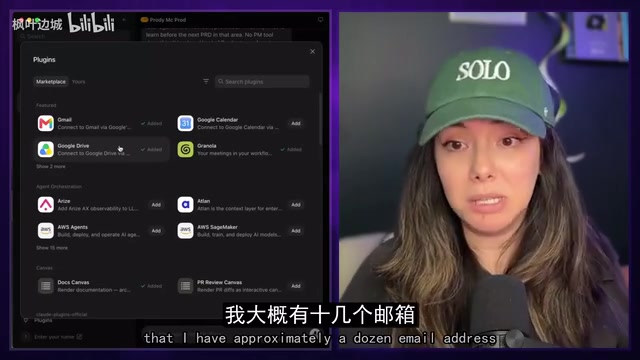
Every Grokbot also comes with its own virtual machine, capable of using Chrome, a terminal, and accessing files — essentially a lightweight open-claw. Setup is dead simple: create a bot, spin up the machine, and tell it what to do.
What is MCP? MCP (Model Context Protocol) is an open protocol proposed by Anthropic in late 2024, designed to give large language models a standardized interface for connecting to external tools and data sources — think of it as a "USB port for AI." An MCP client manages these connectors (plugins) and orchestrates model calls to external services like email, calendars, and code repositories as needed. Cursor has been widely regarded as one of the most mature MCP clients thanks to its deep support and polished connector management. Grokbot inherits this system and extends it with multi-account binding for a single connector — filling a gap that most mainstream AI assistants have yet to address.
Its Strength Is Also Its Weakness: Too Simple to Hack
The blogger's frustration with Grokbot stems precisely from its simplicity. She can't "hack" it the way she does her own OpenClaw setup — the messiness, technical complexity, and unwieldiness of those agents is actually part of the joy, giving her a sense of control and creativity. Grokbot, by contrast, works out of the box and barely needs maintenance, which means you lose that hands-on, "shaping clay" feeling.
Two more practical shortcomings: you can't choose your own model, and there's no deep control over agent configuration and personality (like a soul.md equivalent). It also runs on a third-party system — not local, not fully under your control. She also criticizes the model's "vibes" — it carries that typical "AI slop" flavor, full of "not this, not that" hedging and awkward phrasing that isn't the kind of conversational partner she's looking for.
The conclusion is clear: if you want a highly tunable, hackable, transparent agent-building experience, Grokbot isn't it — OpenClaw or Hermes would serve you better. But for enterprise Cursor customers who want to hand employees a ready-to-use all-in-one assistant out of the box, Grokbot is extremely compelling.
Origin: Cursor's GitHub Rival — Clear Vision, Still Too Early
Origin is a code hosting product announced at Cursor's annual conference and only recently entered early access beta. It's positioned as an in-product "code base." Cursor's bet isn't a simple GitHub clone — it's building an agent-native GitHub alternative.
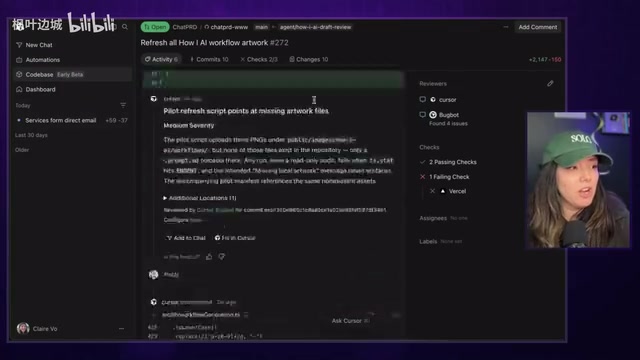
It preserves all the Git fundamentals — code, diffs, Pull Requests — but the interface and interactions are designed for agent collaboration, tightly integrated with Cursor's cloud agent, desktop client, and CLI. Agents can reply to comments, be assigned as reviewers, and there's a small set of CI/CD extensions (like building preview branches on Vercel).
Right Now: Mostly a Wrapper Around the GitHub API
The blogger's hands-on experience wasn't impressive. She (somewhat wryly) noted that Origin launched on the same day GitHub had a major outage, which caused friction when importing repositories. More critically, the current GitHub integration "looks like a shell wrapped around the GitHub API" — while there are some nice touches in how bug bot feedback and Cursor suggestions are presented, it's essentially synchronized GitHub content that actually runs a bit slower.
For users already deeply invested in the GitHub ecosystem (which is nearly everyone) — with automation, Actions, and Code Owners all living there — she doesn't think Origin makes a compelling enough case yet. "I need to see something that makes me go 'wow' before I'm willing to flip that switch."
That said, she acknowledges Cursor is laying foundations: getting your repos moved in, making the bug bot and Cursor first-class citizens in the repository. She sees this as "the very, very earliest stage of a very, very long migration" — one worth watching, since nobody is really happy with GitHub right now. Its stability is poor, and it has yet to deliver a genuinely AI-native rethink.
What Does "Agent-Native" Mean? "Agent-native" is a design philosophy that's been gaining traction in AI tooling — it means a product treats AI agents as first-class citizens at the architecture level, rather than bolting them on as an afterthought. Traditional code hosting platforms like GitHub are human-developer-centric: commits, reviews, and merges all assume a human is doing the work. An agent-native alternative tries to redesign these primitives: agents can be assigned as code reviewers, automatically respond to PR comments, and trigger CI tasks — the entire collaboration flow is equally machine- and human-friendly. The challenge is that GitHub's years of accumulated ecosystem — Actions, Webhooks, Code Owners — creates powerful network effects. A new platform needs to offer far more than a redesigned interface to actually move the needle on migration intent.
Grok 4.6: Surprisingly Strong Design Chops
The third product is Grok 4.6 — the model that's been prompting people in the blogger's circle to message her saying "I think I might actually like Grok." She noticed that Cursor has already switched some default models over to Grok, which is driving more people to give it a try.
Setting aside each vendor's self-selected benchmarks, she used her own "How I AI" evaluation method: blind-testing PRD writing, prototyping, design wireframes, and technical changes — with the design evaluation letting the model decide how to restructure a page on its own — plus a new task involving a complex interactive claims adjudication wireframe. The final Claire Weighted Index is composed of 70% her personal taste + 30% LLM judgment.
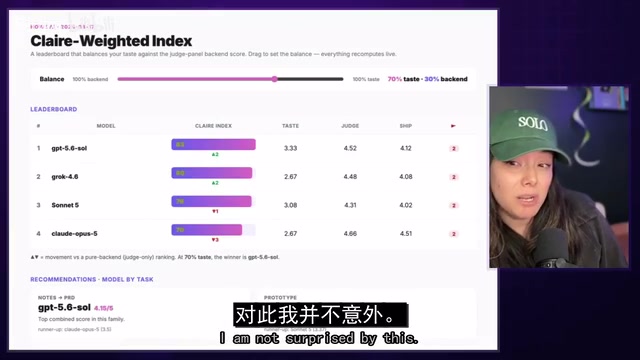
The results are interesting: Grok 4.6 closely trailed her favorite GPT-5.6, outscoring both Sonnet 5 and Opus 5 on the Claire Index. She still keeps GPT-5.6 as her default, particularly for PRD writing and dense, complex UIs. Opus 5 was rated by the LLM judge as the best performer on technical bug triage. Sonnet 5 remains number one for back-and-forth chat in OpenClaw-style agents.
Why Does She Actually Like Grok's Design?
The blogger offers an interesting explanation: she can spot GPT and Claude "slop" at a glance — GPT-5.6 loves forest green, and Claude gravitates toward brown/beige/orange combinations. Grok 4.6 brings a "breath of fresh air" — neither forest green nor that familiar palette. The coffee shop ordering system it designed was "pretty cute," and the technical incident triage app and editing page were well executed too.
Worth noting is an interesting contrast: if you strip out her personal taste and look only at the LLM judge scores (she used the stricter GPT-5.5 for grading, not an Anthropic model), the LLM "hates Grok, prefers Claude Opus and Sonnet, and dislikes GPT-5.6." In other words, models lean toward Claude, while she personally leans toward GPT-5.6 and Grok 4.6 for design.
She emphasizes this is a pure output evaluation with no conversational experience factored in. But the conclusion is clear: Grok is a genuine contender — nothing it produced was bad, and many results outperformed the out-of-the-box defaults.
What Is "AI Slop"? "AI slop" is a popular term in AI content discussions, used to describe the highly homogenized, formulaic outputs that models tend to generate — whether it's the same color palettes recycled in visual design, or text filled with templated phrases like "Certainly!" and "It's important to note that." Because large models are trained on overlapping datasets, models from different vendors often converge on similar "safe aesthetics" — like the forest green and brownish-orange tendencies mentioned above. For professional design evaluation, this stylistic convergence is a confounding factor, since evaluators' preferences can be skewed by the novelty of something unfamiliar. Part of Grok 4.6's design edge may simply come from the fact that it hasn't yet developed a widely recognizable visual fingerprint.
Wrap-Up: Maybe We Should All Become a Little Bit "Grok"
Across all three products, the blogger's takeaway is: she likes Grokbot, isn't yet convinced by Origin, and Grok 4.6 makes her willing to spend a bit more time in Cursor for coding.
Factoring in Cursor's testing harness, the polish on its connector experience, and its investment in new paradigms around design and code hosting, her judgment is: maybe now is the time for everyone to become some degree of "Grok boy." She also stays transparent — most of her time is still spent in Codex and the GPT-5.6 family of models, but Grok's performance is enough to make her reassess.
Related articles

JobRunner MCP Server: AI Agents Can Now Fix Failed Java Jobs
JobRunner launches an open-source MCP server enabling AI agents to view cluster status, diagnose failures, and recover Java jobs—incident response from any cloud coding environment or existing agent.

MLAI Digital Launches 9 Security Agents: MCP Server Safeguards the Full Lifecycle of Agentic AI
MLAI Digital launches Security MCP Server with nine built-in specialized security agents covering vulnerability discovery, attack simulation, prompt injection detection, API and infrastructure assessment, and accelerated remediation—embedding security validation across the full Agentic AI lifecycle from development to production.

Running Isaac Lab on H100 GPUs: Exploring Better Approaches
Exploring optimization methods for running Isaac Lab on NVIDIA H100 GPUs, including MIG configuration, mixed precision, TensorRT acceleration, and community experience to improve robotics simulation and reinforcement learning efficiency.