Cursor Sells to SpaceX for $60 Billion: The Life-or-Death Gamble Behind AI Coding

Cursor sold to SpaceX for $60B — a story of hypergrowth, structural losses, and AI lab warfare.
Founded by four MIT classmates, Cursor pivoted from a failed AI CAD tool to an AI-native IDE by forking VSCode, growing ARR from $1M to over $3B in roughly two years. But behind the numbers lay a structural crisis: a -23% gross margin, ~$900M in losses against $770M in 2025 revenue, eroding market share, and upstream model providers building competing products. After a self-built model controversy and a pricing backlash, Cursor found its only viable acquirer in Elon Musk's SpaceX — which needed Cursor's distribution for Grok while Cursor needed Colossus's compute to survive. The $60B all-stock deal closed in August 2026, the largest VC-backed acquisition ever.
From Failed CAD Tool to AI Coding Dark Horse
Cursor's story is a quintessential Silicon Valley narrative — four young MIT classmates who ultimately sold their company to the world's richest man for $60 billion. But the road was far more winding than the outside world imagined.
CEO Michael Truell grew up in New York, started coding at 11 to build mobile games, and co-founded an AI coding competition in high school that attracted over 10,000 participants. His three co-founders — Aman Sanger, Sualeh Asif, and Arvid Lunnemark — had similar backgrounds, competing in math and informatics olympiads as teenagers and interning at companies like Stripe and Bridgewater during college.
Interestingly, when the team started the company in 2022, they deliberately avoided the AI coding space, believing it was too competitive. Instead, they built an AI-powered computer-aided design (CAD) tool — and it failed completely. Truell later admitted to a "severe founder-market mismatch": "We're not mechanical engineers. The field felt alien to us." He described that period as "wandering in the desert."
Worth noting: of the team's initial $400,000 seed funding, $200,000 came from Sam Bankman-Fried's Alameda Research — money that was eventually recovered only at cost during FTX's bankruptcy proceedings. Had it been held through the final acquisition, the return would have been extraordinary.
An IDE (Integrated Development Environment) is the core tool developers use to write, debug, and manage code — typically combining a code editor, compiler, debugger, and version control. VSCode (Visual Studio Code) is an open-source IDE released by Microsoft in 2015 that quickly became one of the world's most popular development tools thanks to its lightweight design and extensible plugin ecosystem. GitHub Copilot, launched by Microsoft/GitHub in 2021, is an AI code-completion plugin built on OpenAI's Codex model — layered on top of existing IDEs as a plugin rather than natively integrated. This is precisely where Cursor's core product differentiation lies: rather than adding AI as a plugin, it "forked" VSCode's open-source codebase and rebuilt the entire tool with AI capabilities baked in from the ground up. This means AI can understand the entire codebase context, proactively read error messages, and anticipate developer intent — rather than merely autocompleting whatever sits at the current cursor position.
Parabolic Revenue Growth
Ironically, the team ultimately charged back into the AI coding market they'd once considered "too competitive." As heavy GitHub Copilot users, they found that what was "the best developer tool in a decade" was plagued by latency and friction — and seemed to stagnate even as underlying models improved.
In 2023, Cursor decided to take on the market head-on in a completely new way: by embedding AI directly inside the IDE rather than bolting it on as a plugin. They forked Microsoft's open-source VSCode, kept the framework, and rebuilt everything on top of it. The AI gains a private copy of the project, automatically reads error messages, and predicts the developer's next move — not just their next word.
After launching in March 2023, the product gained immediate traction. The growth curve became legendary:
- Early 2024: ~$1 million ARR
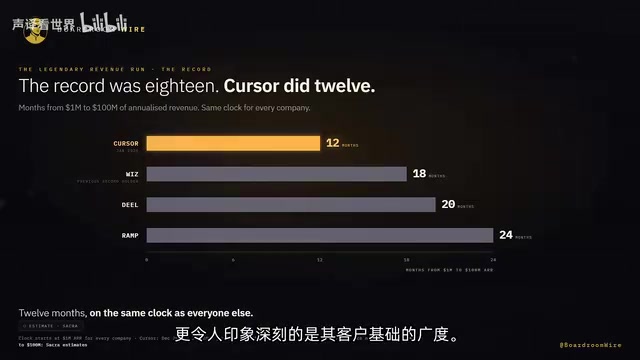
- January 2025: 100x growth to $100M ARR (in just 12 months, breaking Wiz's 18-month record)
- June 2025: $500M ARR
- November 2025: Crossed $1 billion
- May 2026: Bloomberg reported annualized sales run rate exceeding $3 billion
The business model difference was equally striking. Wiz hit $100M ARR with 260 customers paying an average of $384,000 each; Cursor scaled to 360,000 developers paying an average of just $276 — a dramatically broader customer base.
Cursor raised over $3.3 billion in cumulative funding, with its valuation approaching $30 billion at one point. The investor roster reads like a Silicon Valley who's who: led by A16Z and Thrive, with strategic investors including NVIDIA and Google.
The Structural Trap: Losing Money on Every Customer
On paper, this looked like a classic success story. But underneath the surface lurked a fatal flaw.
The appeal of traditional software businesses lies in extremely high gross margins — you bear large upfront costs to write the software, then keep 70 to 80 cents of every revenue dollar as profit. But AI isn't software; it's a resource that must be continuously produced, requiring GPUs, cooling systems, and constant energy. This makes AI usage more like a metered utility — think water or electricity bills.
Cursor provides the IDE and tooling, but users run foundation models — Claude, GPT, Gemini — underneath. It earns significant revenue from token usage, yet the vast majority flows right back to Anthropic, OpenAI, and Google. Worse, many users are on flat-rate plans, where a single heavy user can consume far more in costs than their subscription fee covers.

According to The Information, in the quarter ending January 2026 — when annualized revenue was approximately $2.7 billion — Cursor's gross margin was -23%. For every dollar earned, it spent roughly $1.23. For all of 2025, the company recognized approximately $770 million in revenue while losing around $900 million.
Competitive threats compounded the problem. Anthropic's Claude Code and OpenAI's Codex carry a structural cost advantage: they can supply their own tokens at cost, pricing at levels Cursor simply cannot match. As one venture capitalist put it bluntly: "Anthropic is trying to drown Cursor."
ARR (Annual Recurring Revenue) is the core metric SaaS companies use to measure subscription revenue scale — representing annualized revenue extrapolated from current subscription contracts, not actual recognized revenue. Gross margin reflects the percentage of revenue remaining after direct costs (here, primarily API call fees). Traditional software companies typically achieve 70–80% gross margins, while Cursor's -23% means that for every dollar of revenue, it spent $1.23 in direct costs alone — before accounting for R&D, sales, headcount, or any other operating expenses. This number reveals the structural trap facing AI application-layer companies: they are essentially "marking up" compute and reselling it, while the underlying pricing power belongs entirely to upstream model providers (Anthropic, OpenAI, Google). When those same providers are also building competing products, the application layer has virtually zero negotiating leverage.
The Paradox of Growth and Hemorrhaging Cash
Given such intense competition, how did Cursor sustain hypergrowth? The answer: the AI coding market itself was expanding exponentially.
From June 2025 to May 2026, Cursor's revenue grew from $500 million to over $3 billion. Yet during the same period, Ramp's tracking of enterprise spending on AI coding tools showed Cursor's share falling from 41% to 26%, while JetBrains data showed workplace adoption dropping from 18% to 12%.
In other words, Cursor was growing dramatically while simultaneously losing significant market share — the pie was just expanding so fast that even a one-third shrinkage in share still meant tripling in absolute terms. That's a great position to be in, until the pie stops expanding.
"Cursor is dead" even became a running joke in developer circles. Even its president, Anshul Shultz, didn't truly push back: "In a world where you can produce ten times the code, the IDE is no longer the right form factor."
A market share decline alongside absolute growth is not uncommon in rapidly expanding new markets, but it typically signals underlying risk. When the overall market is growing fast, a company's absolute revenue can look impressive even as its relative share steadily erodes — and that growth often masks a meaningful weakening of competitive position. Once market growth slows or stabilizes, share losses translate directly into absolute revenue declines. For Cursor, warning signs were already visible in 2025–2026: Ramp enterprise data showed its spending share falling from 41% to 26%; JetBrains workplace adoption dropped from 18% to 12% — two independent data sources pointing in the same direction. This is precisely why Cursor needed to maintain hypergrowth even while running negative gross margins. If the market stopped expanding, the underlying economics would immediately be exposed as unsustainable.
Pricing Disasters and the Struggle to Build Its Own Models
Gross margin has two sides — pricing and costs — and Cursor went after both.
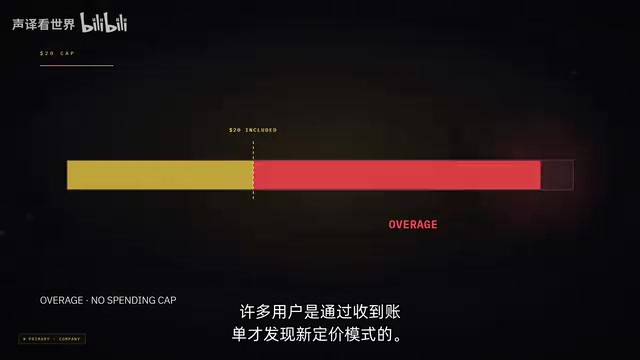
On pricing, in June 2025 Cursor revamped its Pro plan, converting the $20/month package (which had included roughly 500 requests) into "$20 of usage billed at actual model cost," while introducing a $200/month Ultra tier. Logical on paper, disastrous in practice — large numbers of users were unknowingly defaulting to usage-based billing and only discovered the change when their bills arrived. The backlash was fierce enough that Truell posted a public apology on July 4, 2025, and refunded unexpected charges from the preceding three weeks.
In explaining the situation, Cursor offered what may be the most honest sentence in the entire AI industry: "Users like per-seat pricing; it's just the cost side that makes it harder." Customers want predictable pricing; the cost structure makes predictable pricing impossible. This ultimately pushed Cursor toward enterprise — through seat-based pricing with negotiated usage limits — and enterprise grew from roughly one-quarter of revenue to 60–75% in about 18 months.
On the cost side, Cursor decided to enter the model business itself. In October 2025 it launched its first in-house model, Composer, followed in March 2026 by Composer R — priced at $0.50 per million tokens, compared to roughly $5 for Claude Opus, delivering comparable performance at one-tenth the cost.
But Cursor had no resources to train a frontier model from scratch. Composer R was built on Kimi, an open-source model developed by Chinese AI company Moonshot AI. This wasn't disclosed at launch, and the lack of transparency drew sharp criticism. Co-founder Aman Sanger later acknowledged "not saying so upfront was a mistake." Many pointed out the irony: in trying to escape dependence on American AI labs, the company had become dependent on a Chinese model.
The Musk Factor: A Marriage of Mutual Need
By April 2026, both levers were working and Cursor was edging back toward slightly positive economics. But fixing a broken business while training frontier models is extraordinarily capital-intensive, and the company moved to raise another approximately $2 billion at a $50 billion valuation.
This should have been the easiest fundraise in history. Instead, it hit resistance. Late-stage investors, reportedly including Iconic, walked away — they had already bet on OpenAI and Anthropic and didn't want to fund a competitor to their portfolio companies. The funds capable of writing checks at that scale had mostly already written checks to Cursor's suppliers.

The shortlist of viable candidates was extremely short: someone who needed to own GPUs at cost, was actively training frontier models, and had no conflicting interests with OpenAI or Anthropic. Elon Musk fit every criterion — his relationships with both OpenAI and Anthropic were acrimonious, and his own xAI was explicitly built as a competitor to both.
In January 2026, the hostility turned more personal: Anthropic cut off xAI engineers' access to Claude after discovering they were using Cursor — widely used internally at xAI — to log into Claude to help build Grok. Musk already knew Cursor's value.
After xAI merged into SpaceX in February 2026, the combined company had enormous capital, the Grok foundation model, and one of the world's largest GPU clusters — Colossus — exactly what Cursor needed to keep scaling. And Cursor had what Musk desperately needed for Grok: distribution, in the form of roughly 150 million lines of code written inside it daily. The two companies shared the same enemies and each had what the other lacked.
The deal timeline: on April 21, SpaceX received an option to acquire Cursor for $60 billion by year-end, with Cursor gaining immediate access to Colossus; SpaceX went public on June 12 and exercised the option four days later; the all-stock transaction closed on August 14, 2026, with SpaceX issuing more than 389 million shares.
Forbes estimated each co-founder's equity at approximately $2.4 billion — still the largest venture-backed startup acquisition in history. Shortly after the acquisition closed, OpenAI announced it would no longer provide model access within Cursor — a remarkable epilogue given that the OpenAI Startup Fund had written Cursor's first institutional check back in 2023.
Colossus is xAI's hyperscale GPU cluster, built in Memphis, Tennessee in 2024. Initially deployed with approximately 100,000 NVIDIA H100 chips and later expanded to over 200,000, it is one of the largest publicly disclosed single-site AI training clusters in the world. For AI companies, a GPU cluster's importance extends beyond just training frontier models — it also determines the marginal cost of inference, meaning delivering real-time responses to users. Owning your own compute means you can serve traffic at near-cost (essentially electricity and depreciation), rather than purchasing capacity from cloud providers or API vendors at market rates. This is precisely the source of Anthropic's and OpenAI's structural cost advantage over Cursor — and it is the core economic rationale for the Cursor–SpaceX/xAI combination: replacing that external $0.23 overspend on every dollar of revenue with Colossus's own compute.
Related articles

How Big Can Stars Really Get? The Physical Limits of the Largest Stars
Red supergiants are the largest stars by volume, with radii up to 2,000 times the Sun, engulfing the inner solar system. But there is no precise upper limit on stellar size—models predict up to 15,000 solar radii. The most massive blue stars are far smaller than red supergiants—biggest and heaviest are two different things.

Apple HomeView Smart Display Full Feature Breakdown: Wall-Mount or Desktop, $299
Apple launches HomeView, a $299 smart display with wall-mount and desktop options, 12MP camera for facial recognition, smart home control, music playback, and recipe step-by-step cooking. Full breakdown of watch faces, apps, privacy, and cooking integration.

Where Did the Promised New Studio Go? Craft Computing Answers After Five Years
Craft Computing's host responds to viewer questions: the new studio promised five years ago was shelved as construction costs soared from $30,000 to $75,000, and was replaced by a 168-square-foot garage conversion.