Cursor Ultra Subscription Backlash: Plummeting Usage Limits Spark Cancellation Wave

Cursor Ultra user burns 21% of monthly quota on two small tasks, suspects hidden quota rule changes.
A developer who had subscribed to Cursor Ultra for a full year posted on Reddit claiming that just two minor tasks — reordering UI elements and fixing a bug using Opus 5.5 — consumed roughly 21% of his monthly quota. He noted that just months ago his "Other Models" allowance was difficult to exhaust, but now feels "insanely small" despite no changes to his workflow or tooling. The user, who also subscribes to Claude MAX, suspects the platform quietly increased the quota weight for premium models. His experience highlights a broader frustration with subscription-based AI coding tools: opaque and unstable quota rules that leave loyal, high-paying users feeling silently downgraded.
A Long-Time Ultra User Considers Canceling
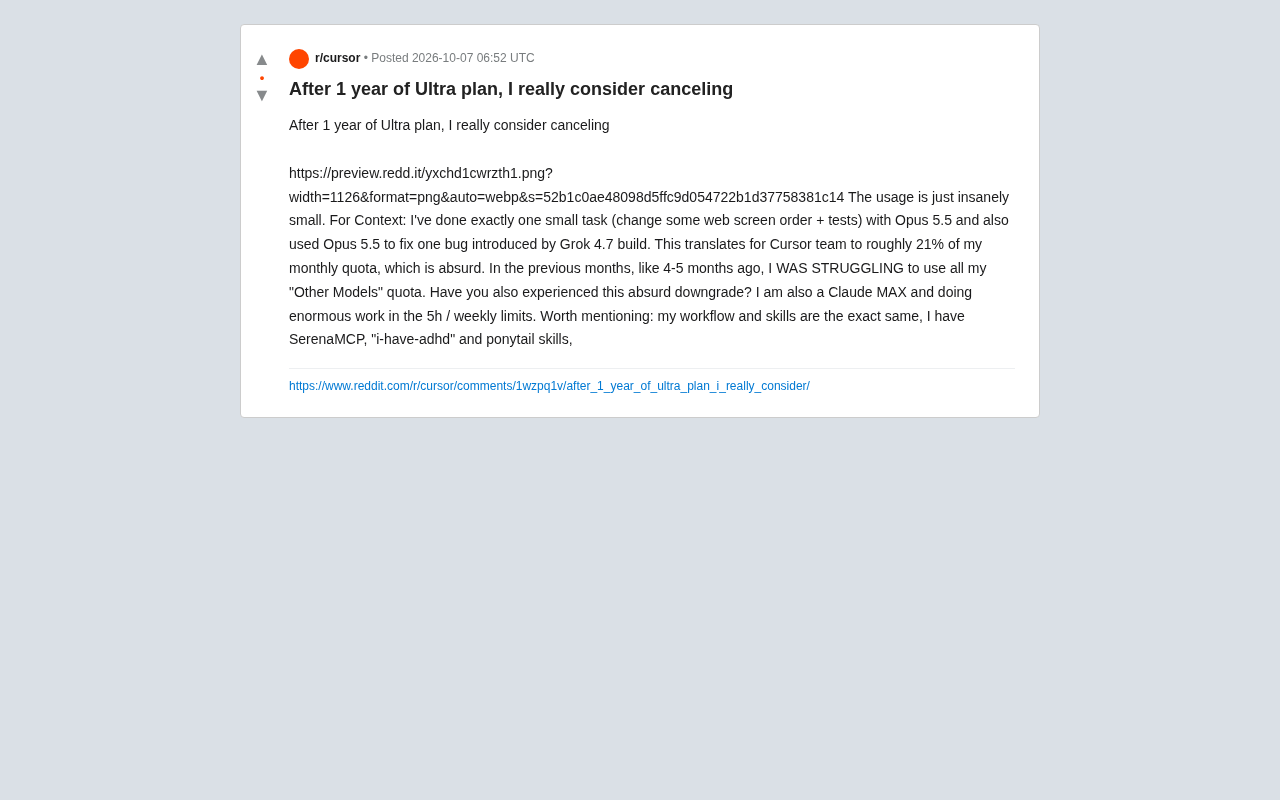
A developer who had been on Cursor's Ultra plan for a full year took to Reddit to voice serious frustration with the platform's quota system. His complaint was specific: completing a small task — reordering a few web UI elements, writing some tests, and fixing a bug introduced by Grok 4.7 using Opus 5.5 — consumed roughly 21% of his monthly quota.
He described the burn rate as "absurd." For a developer paying for the highest-tier subscription, burning through a fifth of his monthly allowance in two or three minor operations means the actual usable workload for the entire month has been dramatically compressed.
Then vs. Now: From "Can't Use It All" to "Not Enough"
The most valuable part of the post is the longitudinal comparison the user provided. According to him, just four or five months ago, he was "struggling to use all my Other Models quota" — meaning the allowance was generous, sometimes more than he could actually consume.
Now, the situation has completely reversed. Same plan, same price, but the available quota feels "insanely small." This dramatic shift over a short period is the core reason he feels he's been effectively downgraded.
Critically, the user emphasized that his workflow and usage habits have not changed at all. He still uses the same skill configurations: SerenaMCP, "i-have-adhd", and "ponytail". This means the spike in consumption didn't come from any change on his end — it more likely points to adjustments in how the platform calculates quota.
Possible Reasons Behind the Quota Shift
While the original post offers no official explanation from Cursor, a few hypotheses can be drawn from the user's description.
Higher Billing Weight for Premium Models
Top-tier models like Opus 5.5 are notoriously expensive to run. If Cursor adjusted the quota conversion ratios for different models, even a small number of calls to a high-end model could rapidly drain an allowance. Both operations the user mentioned involved Opus 5.5, which may be the direct cause of that 21% hit.
Anthropic's Claude Opus series is among the most expensive large language models on the market. At the API level, Opus 4/5-class models typically cost 5 to 15 times more per million input tokens than their Sonnet or Haiku counterparts from the same family. AI coding tools like Cursor are directly exposed to these underlying token costs, so even if the interface presents a unified "Ultra quota," it's commercially reasonable for different models to carry very different conversion multipliers. A user who selects the most powerful model without understanding the conversion rate is essentially driving a supercar without knowing the fuel consumption — the range is far shorter than expected. This also explains why, if Cursor raised the quota multiplier for the Opus series, users would suddenly feel their allowance had "shrunk" without changing their actual workload.
Tightening of the "Other Models" Quota Pool
The fact that the "Other Models" quota was once easy to exhaust but now feels scarce suggests the platform may have repartitioned or reduced this pool. Such adjustments aren't uncommon in subscription-based AI tools — as underlying model costs fluctuate and user bases grow, platforms frequently tweak resource allocation strategies dynamically.
Not an Isolated Case: Similar Experience with Claude MAX
The user also mentioned that he subscribes to Claude MAX and has been doing heavy work within Claude's "5-hour per week" usage window. This detail reveals he's a power user of AI coding tools with cross-platform exposure to different quota systems.
He closed his post with an open question: "Have you also experienced this absurd downgrade?" — essentially polling the community to determine whether this was an anomaly in his account or a platform-wide policy change.
It's worth noting that this article is based on a single Reddit post and lacks official data or broader user cross-validation. Whether the "downgrade" this user perceives genuinely reflects a platform policy change requires further evidence.
Claude MAX is Anthropic's premium subscription tier designed for heavy users, offering higher usage priority and more conversation turns than the standard Pro plan. Its "5-hour per week" limit refers to a guaranteed continuous usage window during peak demand — meaning MAX users get relatively stable access when resources are constrained, rather than a simple token cap. This developer holds both Cursor Ultra and Claude MAX, two top-tier paid subscriptions with a combined monthly cost potentially exceeding $200, making him among the highest-value users in the AI tools market. His ability to compare quota experiences across both platforms lends his feedback meaningful reference value, rather than being a purely emotional complaint about a single product.
What This Means for Subscribers of AI Coding Tools
This case reflects a pain point that subscription-based AI coding tools widely share: quota opacity and instability.
For users, choosing an AI tool shouldn't stop at the plan name and monthly fee. You need to understand how quota is actually calculated, how different models are weighted, and whether the platform reserves the right to adjust these rules dynamically. When even the highest-tier "Ultra" plan is prompting a loyal user to consider canceling, it signals that the platform has lost its footing in balancing user trust against cost control.
For platforms, high model costs are an objective reality — but when quota rules change without transparent communication, paying users churn. A developer who stuck with the Ultra plan for a full year now seriously considering cancellation is a warning sign worth heeding.
As competition in the AI coding assistant market intensifies, the cost of switching platforms continues to fall. Whoever can find a more sustainable pricing model that balances compute costs with user experience will be the one that truly retains these high-value power users.
Related articles

JobRunner MCP Server: AI Agents Can Now Fix Failed Java Jobs
JobRunner launches an open-source MCP server enabling AI agents to view cluster status, diagnose failures, and recover Java jobs—incident response from any cloud coding environment or existing agent.

MLAI Digital Launches 9 Security Agents: MCP Server Safeguards the Full Lifecycle of Agentic AI
MLAI Digital launches Security MCP Server with nine built-in specialized security agents covering vulnerability discovery, attack simulation, prompt injection detection, API and infrastructure assessment, and accelerated remediation—embedding security validation across the full Agentic AI lifecycle from development to production.

Running Isaac Lab on H100 GPUs: Exploring Better Approaches
Exploring optimization methods for running Isaac Lab on NVIDIA H100 GPUs, including MIG configuration, mixed precision, TensorRT acceleration, and community experience to improve robotics simulation and reinforcement learning efficiency.