Cursor Users Vent Frustration Post-Acquisition: Where Are the Gaps in AI Coding Tool Competition?

A Cursor user's Reddit rant reveals the trust crisis and competitive vacuum in the AI coding tool market.
A Cursor user posted on Reddit complaining that after the acquisition, the product forces model switches back to Grok while ignoring user settings, lamenting that there are almost no real competitors in the AI coding space. The article uses this as a lens to analyze the market's competitive vacuum — the moat lies not in any single model but in deep editor integration and engineering capabilities, making it hard for newcomers to catch up quickly. It argues that post-acquisition commercial moves that disrespect user control erode trust fast, and that trust gap is exactly where new competitors should strike.
A Reddit Rant That Sparked an Industry Question
In a community discussion about AI coding tools, one Cursor user fired off a frustrated question: "Competitors, where are you?" The post may look like a personal complaint on the surface, but it cuts to a structural issue worth examining in today's AI-assisted coding market — why does the leading product in this widely hyped space face almost no real competitive pressure?
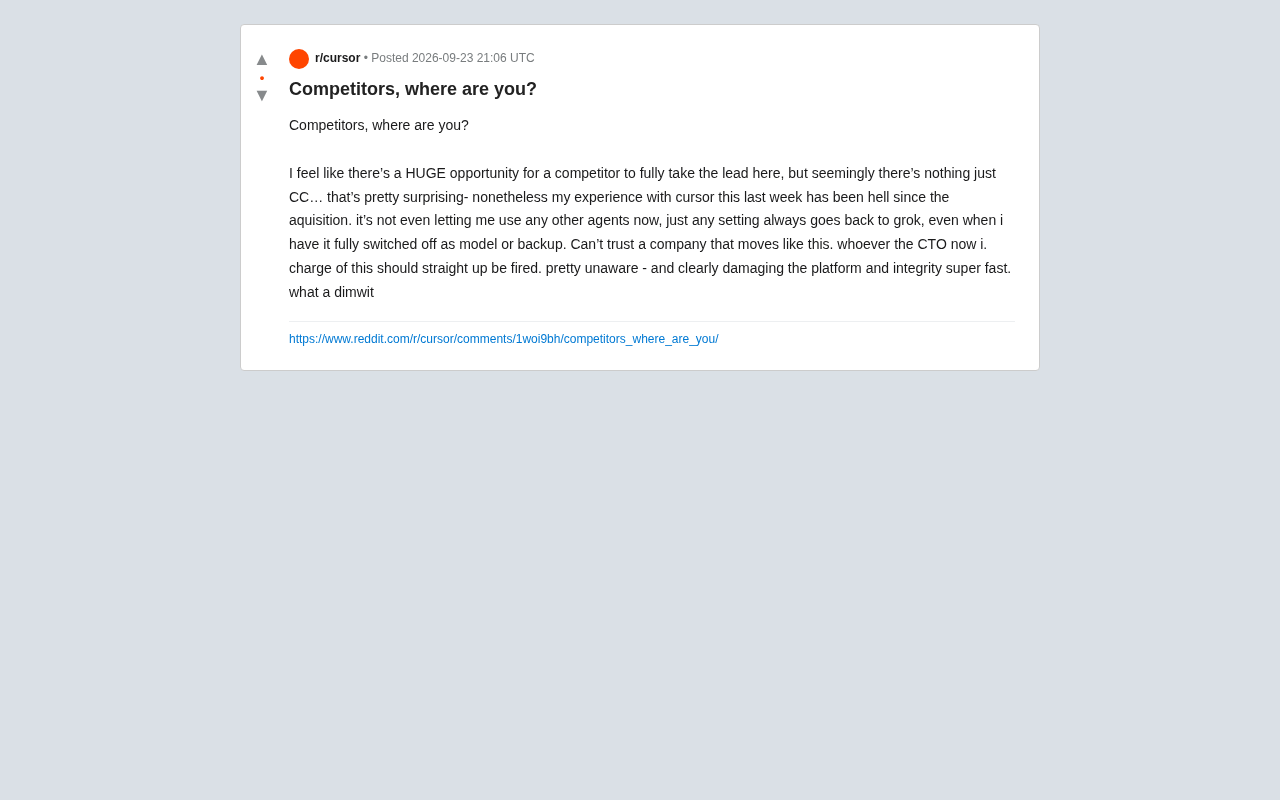
The user's frustration came from two directions: first, they believed there was a "HUGE opportunity" for a competitor to step up, yet the reality was "it seems like there's nothing except CC (Claude Code)"; second, their experience using Cursor over the past week had been so bad they described it simply as "hell."
The Post-Acquisition Product Decline
The user's complaints centered on product changes following the acquisition. The specific issue: Cursor no longer allowed them to freely use other agents. No matter how they configured the settings, the model selection kept reverting back to Grok — even after they had fully disabled it, removing it as both the primary and fallback model, the system still forced a switch back.
This "settings don't stick" experience is particularly damaging for developers who rely on the tool daily. One of the core values of an AI coding tool is the ability to freely choose the most suitable underlying model for the task at hand. When that choice is unilaterally taken away — or worse, when the product outright ignores explicit user configuration — trust in the tool collapses fast.
The user was blunt: "Can't trust a company that moves like this." They directed their criticism at the technical decision-makers steering the product post-acquisition, arguing that this approach was "rapidly damaging the integrity of the platform." The emotional tone may not be entirely fair, but the underlying erosion of trust it reflects is real.
Grok is a large language model developed by Elon Musk's xAI, deeply integrated with the X (formerly Twitter) platform. The forced Grok integration following Cursor's acquisition hints at a possible commercial partnership or traffic-routing arrangement behind the scenes — "model bundling" of this kind isn't unheard of in the AI tool industry, but it's typically presented as an option rather than something that overrides a user's explicit off settings. Notably, Cursor had long marketed itself as "model-agnostic," allowing users to plug in GPT-4, Claude, Gemini, and other models — a key part of its appeal to technical users. When that core promise gets eroded by post-acquisition commercial arrangements, the user frustration becomes representative of something far bigger than one person's bad week.
Why Does the AI Coding Market Lack Strong Competitors?
Setting aside personal feelings, the question this post raises is genuinely valuable: if a leading product shows a clear experience decline after an acquisition, users should theoretically flow toward alternatives, which in turn should fuel the rise of competitors. Yet users feel like they have nowhere to go.
A few factors likely explain this. First, the moat in AI coding tools isn't the model itself — it's the deep editor integration, context management, codebase comprehension, and overall engineering capability stack that newcomers can't catch up to quickly. Second, the cost of switching is high: rebuilding workflows, keybindings, and project configurations all take time. Third, the market has consolidated around a small number of players — Claude Code and a handful of others dominate mindshare, while products in the middle tier lack meaningful differentiation.
In other words, the "competitive vacuum" users feel is itself a sign that while the space is hot, product homogenization and entry-point lock-in are already taking hold. When one product stumbles, users should have more options — but the current market structure doesn't provide enough of a safety net.
Claude Code is Anthropic's command-line-native AI coding tool. Unlike GUI-based IDE plugins built on VSCode like Cursor, it operates primarily through the terminal and leans into an "agentic coding" workflow — letting the AI autonomously complete multi-step tasks rather than just doing code completion. This differentiated positioning has earned it a strong reputation among a segment of power users, making it the most frequently cited alternative when Cursor users go looking for options. That said, Claude Code has a steeper learning curve, and for developers accustomed to GUI-based workflows, the migration barrier is real — which explains why the post's author, despite deep frustration with Cursor, characterized Claude Code as "almost the only" rather than "good enough" alternative.
What This Case Reveals About User Trust in AI Tools
This post represents a single user's subjective experience and can't speak for all Cursor users — but it points to a broader pattern: when AI tool companies make rapid iterations or commercial adjustments (acquisitions, model partnerships), they often overlook the importance of respecting existing users' configuration rights and established workflows.
For any tool-category product, "respecting user choice" is the foundation of trust. Forcing a default model and ignoring a user's off-switch — even if there's a business deal or cost rationale behind it — gets read by users as "control" and "opacity." Once that perception sets in, users start mentally looking for a way out even if no viable alternative exists yet.
This is a wake-up call for the industry at large: as AI coding tool competition moves into deeper waters, the lasting moat may not come from model performance superiority at any given moment, but from a sustained investment in user trust. Whoever can stay technically ahead while consistently making users feel like they're in control is the one most likely to win in the long run.
Conclusion: The Opportunity Window Behind the Rant
This Reddit user's complaint is, in a sense, an open invitation to potential competitors. The pain points they describe — stripped-away model choice, post-acquisition experience decline, distrust of vendor decisions — are precisely the spaces where new entrants can make a targeted move.
Opportunities are never in short supply. What's scarce are teams that can genuinely read user sentiment and deliver on a "respect the user" promise through actual product design. For developers and founders watching from the sidelines, this post might be worth sitting with for a while.
(Note: This article is based on a single Reddit user's subjective account. The product issues described reflect personal experience and have not been officially confirmed. For reference only.)
Related articles

Chain of Thought Isn't Just for AI: How Humans Can Use CoT to Improve Thinking Quality
Chain of Thought isn't just a prompt trick for large models. Starting from a Hacker News discussion, this article analyzes why CoT works for human thinking too, breaks down actionable ways to transfer it, and highlights the key differences between human CoT and machine CoT.
Cloudflare Teams Up with OpenAI: Closi…
Cloudflare Teams Up with OpenAI: Closing the Loop from Vulnerability Discovery to Defense with AI
Cloudflare uses OpenAI Daybreak to investigate security vulnerabilities and generate reviewable remediation plans, while developers use Codex to boost coding efficiency and quality.

Orca Multi-Agent Orchestration in Practice: A Guide to Parallel Collaboration with Claude and Codex
Orca is Stable AI's free open-source agent workbench supporting 34 agents like Claude Code and Codex in parallel. Learn its Git worktree isolation, multi-model orchestration, and mobile management.