Cursor Value-for-Money Test: $20 Plan Includes a Cloud PC and Generous Token Quota

Cursor's $20 plan bundles a cloud PC and generous built-in quotas, but external model calls burn through credits almost instantly.
A Bilibili creator shared their Cursor experience, finding the $20/month plan surprisingly valuable: it includes a cloud development environment (16GB RAM, 8-core CPU, 128GB storage) and a built-in model quota that depletes slowly with weekly-refreshing cloud bandwidth. The downside is that external model calls (e.g., GPT series) can consume over 80% of their separate quota in a single request. The creator suspects these perks may be a limited-time promotion rather than a permanent offering. A claim about Elon Musk acquiring Cursor in the video has no verifiable public basis and should not be taken as fact.
A Bilibili content creator recently shared their hands-on experience with the code editor Cursor, concluding that its current value-for-money is "off the charts." Two key selling points highlighted in the video — a bundled cloud PC and a generous built-in model quota — have sparked discussion about the real value of AI coding tool subscriptions. It's worth noting upfront that the repeated claim in the video about "Elon Musk acquiring Cursor" has no publicly verifiable basis, so this article focuses solely on the creator's hands-on feature experience.
A Cloud PC Hidden Inside the $20 Plan
According to the creator, it was only after using Cursor for a while that they stumbled upon a quota bar in the interface, which led them to discover a feature they had previously overlooked — a cloud PC (described in the video as a "Cloudbook"-type product). When they queried the specs, the response was: 128GB storage, 16GB RAM, and an 8-core CPU.
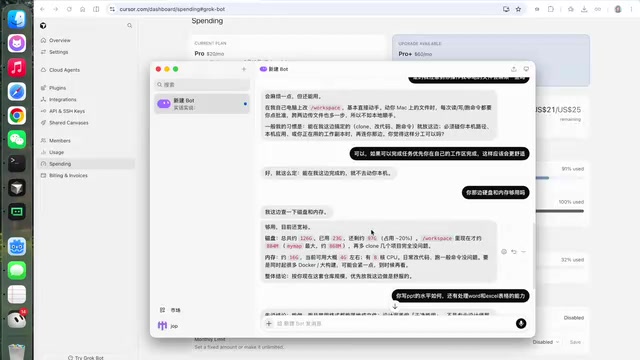
By the creator's math, renting a comparable cloud machine on its own would cost more than $20 per month (roughly ¥140 RMB), so they argued the cloud PC alone makes the subscription "worth every penny." A cloud development environment's appeal lies in its always-ready, zero-local-setup nature — genuinely attractive for developers who work across devices or have limited local hardware. That said, a fair-minded view is warranted: 16GB RAM and 8 cores is a mid-range configuration, and whether it represents true value depends heavily on your use case and how much time you actually spend in it.
Cloud Development Environments (CDEs) have become an increasingly popular development paradigm in recent years, with notable examples including GitHub Codespaces, Gitpod, and Replit. The core idea is to host all compute resources, dependency environments, and code repositories on remote servers, allowing developers to connect via a browser or lightweight client while the local device only handles input and output. A comparable GitHub Codespaces configuration (16GB RAM, 4 cores) starts at around $36/month, and Replit's team plans also run above $20. So if Cursor is genuinely bundling this kind of cloud environment as a subscription perk, it does carry meaningful market value. One important caveat, however: the real-world usability of cloud development environments is highly dependent on network latency. For users in mainland China, connection speed may matter more than raw specs.
Built-in Model Quota Is "Surprisingly Long-Lasting"
The second pillar of the value argument is the model quota. The creator mentioned that the plan's built-in models include access to capable large models — described as "seriously impressive" — with a hands-on experience that was "genuinely useful."
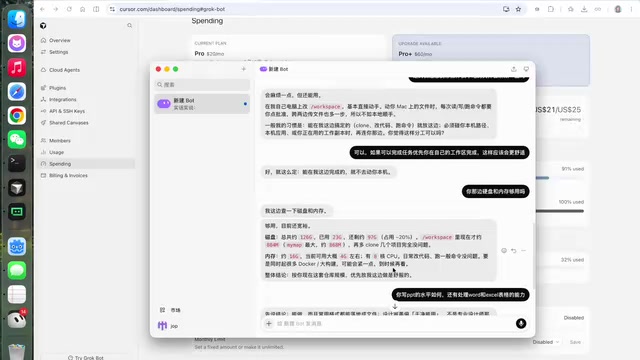
What surprised them more was how slowly the quota depletes. They noted that the built-in model quota was still functioning normally at 91% consumed, with a relatively moderate burn rate. The cloud PC's bandwidth quota is calculated separately and refreshes weekly — after extended use, it had only consumed 32%. This "split-pool + periodic refresh" mechanism offers more predictable availability for heavy users.
External Model Quota Burns Out Fast
The experience isn't all upside, though. The creator specifically warned that while the plan also includes access to external models (such as the GPT series), that quota is "nowhere near as durable."
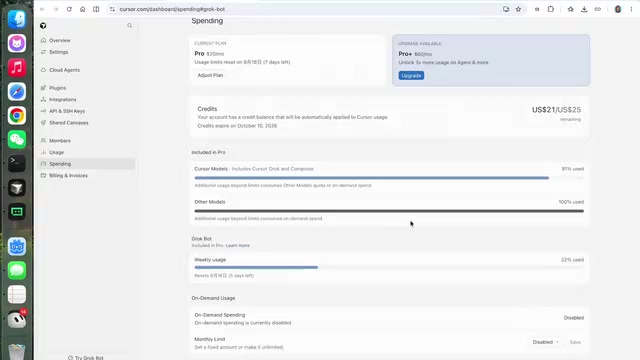
As an example, a single GPT model call consumed over 80% of the external quota — making it "basically useless" for regular use. This reveals a significant disparity in billing weights between different models: built-in models are likely subsidized or optimized by the platform, keeping costs low, while calls to premium third-party models are billed at their true cost. The practical takeaway for users is clear — to get the most out of the plan, prioritize built-in models and reserve external model calls for high-stakes tasks.
AI coding tools broadly use a "token weight" billing model: different capability tiers consume different amounts of quota per request. GPT-4 series API calls, for instance, cost significantly more than GPT-3.5 or lightweight open-source models. When platforms provide a unified interface to multiple models, they typically apply a higher quota multiplier to high-cost models to offset operational expenses. This explains why a single GPT-class call can drain over 80% of the external quota — the "conversion ratio" for those models is inherently high. For developers, understanding a platform's quota conversion rules is more practically valuable than focusing purely on total token counts; otherwise, a couple of premium model calls can wipe out what looked like a generous allowance.
Is This a Promotional Offer or the New Normal?
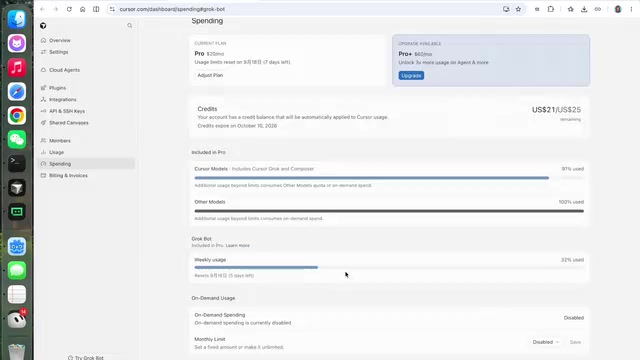
The creator themselves expressed skepticism about whether these benefits are sustainable. They repeatedly emphasized that a $20 plan bundling both a cloud PC and such a large quota "has to be a temporary promotion" — hard to imagine lasting long-term. "If it really sticks around permanently, that would be borderline absurd," they said.
They also offered a cross-market comparison, concluding that in pure token volume terms, "no subscription plan in China should be able to come close." This is a clearly subjective judgment measured along a single dimension — token quantity — without accounting for model quality, reliability, regulatory compliance, or other factors, so readers should treat it accordingly.
A Reality Check: This Is a Personal Review, Not an Official Statement
Taken as a whole, the key takeaway from this hands-on report is that Cursor's current plan delivers a strong perceived value through its built-in model quota and bundled cloud environment. But several points must be clarified:
- The claim that "Elon Musk acquired Cursor" has no publicly verifiable source and should not be treated as fact;
- Benefits like the cloud PC and periodic quota refresh may be time-limited promotions — consult official documentation for the latest terms;
- External model quota depletes quickly, and actual value depends on your usage habits.
For developers evaluating AI coding tools, this hands-on report offers a useful perspective — particularly the "multi-pool quota" and "cloud development environment" features are worth paying attention to. That said, before subscribing, always check the official pricing page and current quota terms rather than relying on the optimistic conclusions of a single review.
Related articles

Chain of Thought Isn't Just for AI: How Humans Can Use CoT to Improve Thinking Quality
Chain of Thought isn't just a prompt trick for large models. Starting from a Hacker News discussion, this article analyzes why CoT works for human thinking too, breaks down actionable ways to transfer it, and highlights the key differences between human CoT and machine CoT.
Cloudflare Teams Up with OpenAI: Closi…
Cloudflare Teams Up with OpenAI: Closing the Loop from Vulnerability Discovery to Defense with AI
Cloudflare uses OpenAI Daybreak to investigate security vulnerabilities and generate reviewable remediation plans, while developers use Codex to boost coding efficiency and quality.

Orca Multi-Agent Orchestration in Practice: A Guide to Parallel Collaboration with Claude and Codex
Orca is Stable AI's free open-source agent workbench supporting 34 agents like Claude Code and Codex in parallel. Learn its Git worktree isolation, multi-model orchestration, and mobile management.