Cursor vs. Claude Code vs. Qwen Code 1.0: A Side-by-Side Review of Three AI Coding Agents

Comparing the form differences and selection logic of Cursor, Claude Code, and Qwen Code AI coding agents.
Based on a YouTube comparison video, this article outlines the core differences among three AI coding agents: Cursor, Claude Code, and Qwen Code 1.0. Qwen Code 1.0 released a preview on November 11, takes an open-source route, is a terminal agent with native apps for three platforms, requires no Node.js, and supports multi-model access, session resumption, and scripted execution—but is still in preview. Claude Code is Anthropic's all-entry agent covering terminal, IDE, desktop, and browser, capable of reading code, editing files, and executing commands, tightly bound to the Anthropic ecosystem. Cursor covers desktop, CLI, Slack, and GitHub reviews, connects to multiple models, and has the richest collaboration touchpoints but higher governance complexity. The article argues selection should return to the workflow itself: first clarify open-source and self-hosting needs, model binding strategy, and the entry points the agent must cover, then work backward to the tool rather than relying on leaderboards.
Three AI Coding Agents, Each With a Different Positioning
A comparison video on YouTube put Cursor, Claude Code, and Qwen Code 1.0 side by side. All three call themselves "AI coding agents," but their forms and boundaries differ markedly, making it easy to confuse them when choosing. The video isn't especially dense with information, but it does highlight each one's core difference: Qwen Code 1.0 has just released a preview and takes the open-source route; Claude Code is Anthropic's terminal-native agent; Cursor spreads its agent across desktop, CLI, Slack, and GitHub entry points.

To understand how these three differ, the key question isn't "which one is smarter" but "where the agent lives, which models it uses, and how it plugs into your workflow."
Qwen Code 1.0: An Open-Source Terminal Newcomer That Skips Node.js
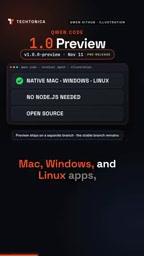
According to the video, Qwen Code 1.0 Preview was released on November 11. It's a terminal agent that also offers native apps for Mac, Windows, and Linux. Its most direct barrier reduction is that it doesn't require Node.js—for developers who don't want to maintain a JS runtime on their machines, this saves considerable environment setup overhead.
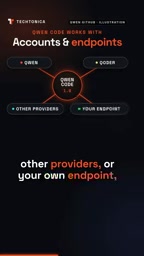
For connectivity, it supports Qwen and Coder accounts, other model providers, or your own endpoint. That means it doesn't force a single model ecosystem, and teams running their own services can plug in. On the feature side, it supports resuming sessions and running as scripts, making it suitable for embedding the agent into automation flows rather than just interactive conversation.
It's worth emphasizing that the video explicitly states 1.0 is still a preview, features may change, and adoption in production should be carefully evaluated.
Terminal Agent refers to an AI agent that uses the command-line interface as its primary interaction medium, capable of directly reading files, executing shell commands, and modifying codebases in the user's local terminal. Unlike traditional IDE plugin-style completion, terminal agents typically have fuller "hands-on" permissions: they can autonomously plan multi-step operations, such as searching code, running tests, and iterating on fixes based on errors. Representative tools in this category include Anthropic's Claude Code and the open-source Aider. The advantage of the terminal form is that it stays close to developers' existing command-line workflows and is easy to script and integrate with CI, but it also means broader permission boundaries—commands the agent executes may modify the filesystem or access the network, so sandbox isolation and operation confirmation mechanisms are key items to evaluate.
Node.js is a JavaScript runtime built on Chrome's V8 engine that lets JavaScript run outside the browser, both server-side and locally. A large number of modern CLI tools (including many AI coding tools) are distributed as npm packages, so users must first install Node.js and a package manager to use them. Not requiring Node.js means the tool is provided as a native binary or standalone installer, eliminating runtime version management, dependency conflicts, and global package permission issues—especially friendly for enterprise environments or developers on non-JS stacks.
Claude Code: Anthropic's All-Entry Terminal Agent
The video describes Claude Code as Anthropic's agent for terminal, IDE, desktop, and browser. Its core capabilities are reading code, editing files, and executing commands—a typical "hands-on" coding agent rather than just code completion.
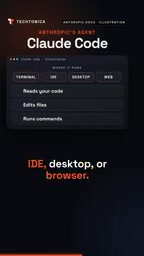
Its distinguishing feature is projecting the same set of agent capabilities across multiple interfaces: running in the terminal, usable in the IDE, and reachable on desktop and in the browser. For teams already using Anthropic's model ecosystem, this consistency reduces switching costs; but for teams wanting to mix multiple models, the binding relationship needs to be thought through in advance. The video doesn't elaborate on its selectable model range, so this should be confirmed separately when choosing.
Model Lock-in and Technology Selection: Claude Code is developed by Anthropic, and its underlying capabilities rely primarily on the Claude series of models, so "whether it's bound to a single model ecosystem" is a core trade-off in selection. The benefits of binding are tool-model co-optimization, high behavioral consistency, and simple configuration; the cost is a lack of flexibility when teams need to switch models based on cost, latency, or compliance requirements. Conversely, tools that support custom endpoints or multiple model providers (such as Qwen Code and Cursor) offer more freedom in multi-model strategy, but teams must bear the costs of prompt adaptation, capability difference assessment, and governance themselves. When evaluating, confirm whether the tool supports routing to other models through an API gateway or proxy layer, and whether such routing loses the agent's distinctive tool-calling capabilities.
Cursor: A Collaborative Agent With Multiple Models and Multiple Touchpoints
Cursor's agent covers the desktop app, CLI, Slack, and GitHub code review, and connects to models from multiple AI labs. This is the most "team-oriented" of the three in terms of touchpoints: Slack means the agent can enter communication flows, and GitHub reviews mean it can participate in code review—not just be a developer's local tool.
Multiple selectable models is another of Cursor's cards. Teams can switch models by task type or cost considerations without being locked to a single vendor. The cost is increased configuration and governance complexity—the more entry points, the more permissions, auditing, and consistency policies need to be designed in advance.
Multi-Touchpoint Agents and Governance Costs: When an AI agent appears simultaneously on desktop, CLI, Slack, and GitHub, it effectively becomes part of the team's collaboration infrastructure rather than just a personal development tool. This brings two new kinds of problems: first, permissions and auditing—which channels the agent can read in Slack, whether it can directly submit changes in GitHub reviews, and whether different entry points share the same set of credentials all require explicit policies; second, behavioral consistency—the same task may produce different output quality, context scope, and operational permissions across different entry points, so teams need to establish unified prompt specifications and acceptance criteria. The more entry points there are, the more access control, log retention, and rollback mechanisms need to be designed in advance; otherwise, collaborative convenience turns into security and compliance risk.
How to Choose: Look at Your Workflow, Not the Leaderboard
The distinctions among the three tools come down to three questions:
- Do you require open source and self-hosting? Qwen Code 1.0's open-source nature and custom endpoint support are more attractive to teams that are data-sensitive or want deep customization.
- Are you deeply bound to a single model ecosystem? Claude Code is tightly coupled with the Anthropic ecosystem, while Cursor emphasizes multiple models.
- Which entry points does the agent need to appear in? Writing code only in the terminal versus needing to enter Slack communication and GitHub review are completely different requirements.
The question the video ends with is "which one fits in your tech stack," which is actually the correct starting point for selection—first map out the team's workflow and collaboration surface, then work backward to the tool, not the other way around. Qwen Code 1.0 is still in preview, making it better suited as an exploration and experimentation option in the short term; Claude Code and Cursor are more mature, but their respective ecosystem lock-in and governance costs need to be calculated clearly before adoption.
Related articles

RePlan-VLA: Progress-Aware Replanning Breakthrough for Long-Horizon Robotic Manipulation
The RePlan-VLA framework converts VLA models' short-horizon capabilities into reliable long-horizon execution through progress-aware adaptive replanning, improving success rates by 21.9% and 10.4% on RoboCasa365 and CALVIN, and validating real-world deployment on a Franka Research 3 robot.

Geometric Bridge Flow Matching: A New Breakthrough in Blind Rigid Motion Correction
Geometric bridge flow matching enables blind rigid motion correction in head CBCT, achieving 37.1 dB PSNR and 0.27 mm RPE on simulated data in ~9.1 minutes, outperforming existing methods.

Google Releases Gemini 4 Hydrogen: 2.5x Faster Without Sacrificing Intelligence
Google releases the lightweight Gemini 4 Hydrogen: 2.5x faster task completion, AA Intelligence Index of 54 beating its flagship sibling, 7.3s single-step on Agent Arena faster than Claude and GPT rivals, four thinking levels with pay-as-you-need pricing, now available across AI Studio and more.