Cursor vs Windsurf: Code Review or Direct Apply — Which Fits You Better?

Cursor reviews via diff first; Windsurf applies directly. The control-vs-speed trade-off decides your tool.
The article compares how Cursor and Windsurf, two AI coding assistants, differ in core interaction logic: Cursor shows a diff before modifying code so developers can review each line and accept or reject it, while Windsurf writes changes directly to files for instant visibility. Using the analogy of a chef who shows the recipe versus one who serves the dish, the author notes neither approach is right or wrong — what matters is your habits: the former offers fine-grained control and lowers the risk of accidental changes, suiting refactoring and critical logic; the latter buys speed and flow, suiting rapid iteration and prototyping. It also mentions Cursor 2.0's Composer multi-agent mode, which can run up to 8 agents in parallel, and suggests switching flexibly between modes by scenario, with the control-vs-speed trade-off as the basis for choice.
AI coding assistants are reshaping developers' workflows, and Cursor and Windsurf, two popular tools, have taken sharply different directions in their core interaction logic. This difference may seem subtle, but it directly determines the rhythm and sense of control you have while writing code.
The Core Difference: Review First or Apply First
When Cursor's AI modifies code, it first shows a diff — a side-by-side comparison view of old and new code — letting you review each change line by line before deciding to accept or reject it. Windsurf is different: it writes changes directly into your files, and you see the result immediately.
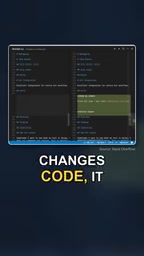
This difference is vividly compared to two chefs: Cursor is like a chef who shows you the recipe first, while Windsurf is like one who cooks the dish and serves it for you to taste. According to analysis in the original YouTube video, neither approach is right or wrong — what matters is your working habits.
diff (difference comparison view) is a foundational concept in version control and code review, referring to displaying changes line by line in a side-by-side or top-to-bottom comparison: added lines are usually marked green, deleted lines red, and unchanged parts are retained as context. diff originated from the Unix diff command and is now built into Git, GitHub Pull Requests, and various IDEs. In the context of AI coding assistants, diff has shifted from "post-hoc review" to "pre-confirmation" — after the AI generates changes, they are first presented as a diff, and the developer accepts or rejects them block by block before the changes are actually written to disk. This mechanism turns the AI's output into auditable patches, preserving a human confirmation step for every code change, and it is also the technical basis for Cursor's sense of control.
Why This Difference Matters
For developers accustomed to checking line by line, Cursor's diff mode offers fine-grained control. Every change passes before your eyes, reducing the risk of accidentally introducing errors. This is especially reassuring during refactoring or when handling critical logic.
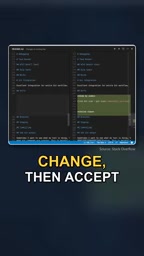
Windsurf's direct application, in turn, buys speed and flow. You don't need to stop and click accept after every change; the AI's edits take effect instantly, making it suitable for rapid iteration and prototyping. If you value a smooth coding experience, Windsurf's rhythm will feel more in tune with you.

Flow was proposed by psychologist Mihaly Csikszentmihalyi and refers to a state in which a person is fully immersed in an activity, highly focused, and loses track of time. In programming, flow is especially fragile: a single context switch (such as interrupting to click confirm, switching windows, or regrouping your thoughts) takes on average more than ten minutes to recover from. Windsurf's design of applying changes directly is essentially about reducing these interruption points — the AI's edits take effect immediately, and the developer stays within the editor and their train of thought. This also explains why "speed" is not just about saving operations, but about protecting cognitive continuity; correspondingly, Cursor's diff review trades a controlled brief pause for certainty about where the code is heading.
Selection Advice: Match the Tool to Your Habits
If you like to control where every line of code goes and enjoy the certainty that the review process brings, Cursor is the more natural choice. If you pursue speed and want the AI to act directly like a well-synced partner, Windsurf's instant feedback will feel more convenient.

Interestingly, the two modes are not mutually exclusive. In some scenarios, you can switch to review mode when you need fine-grained control, and enjoy the efficiency of direct application during exploratory coding. A tool's design philosophy ultimately serves your workflow.
Cursor's Multi-Agent Capabilities
Beyond diff review, Cursor 2.0 also introduces Composer — a multi-agent mode that can run up to 8 AI agents simultaneously. This means complex tasks can be split among multiple agents for parallel processing, further expanding the boundaries of AI-assisted programming. For scenarios that require advancing multiple modules at once or large-scale code generation, this parallel capability may bring significant efficiency gains.
Multi-Agent refers to an architecture in which multiple AI agents with independent contexts and tools collaborate to complete a task. Common patterns include: an orchestrator decomposing tasks and dispatching them, sub-agents processing independent modules in parallel, and a aggregation step merging the results. Its advantage lies in parallelizing large serial tasks and giving each agent a more focused context window, reducing information dilution in long conversations. The challenges lie in conflict merging between agents, result consistency, and debugging costs. Composer running up to 8 agents simultaneously is exactly this idea implemented at the product level, suitable for engineering scenarios with clear module boundaries that can be advanced in parallel.
Conclusion
The core divergence between Cursor and Windsurf is the trade-off between control and speed. There is no absolute better or worse — only whether it matches your development habits. Understanding this difference can help you make a clearer judgment when choosing AI programming tools.
Related articles

World's First Humanoid Robot Company Agility Lists on Nasdaq: Buy or Not?
Agility becomes the world's first pure-play humanoid robot company to list on Nasdaq. This article analyzes what the landmark event means for the industry and investors, unpacking the commercialization test and investment framework for the pure humanoid robot sector.

Agent-Browser: A Browser Automation CLI for AI Agents
Vercel Labs open-sources agent-browser, a Rust-built browser automation CLI designed for AI agents, with over 45,000 GitHub stars and command-line-first browser control.

LZ4: The Open-Source Benchmark for Blazing-Fast Compression
Explore the LZ4 blazing-fast compression algorithm: its design philosophy, performance advantages, and wide use in the Linux kernel, databases, and more. How a 12k+ star open-source project became the speed benchmark.