Curvature Mismatch: Hidden Errors of Linear Probes in Galaxy Property Estimation

Linear probes suffer curvature mismatch errors on curved manifolds; correcting them improves galaxy property estimation.
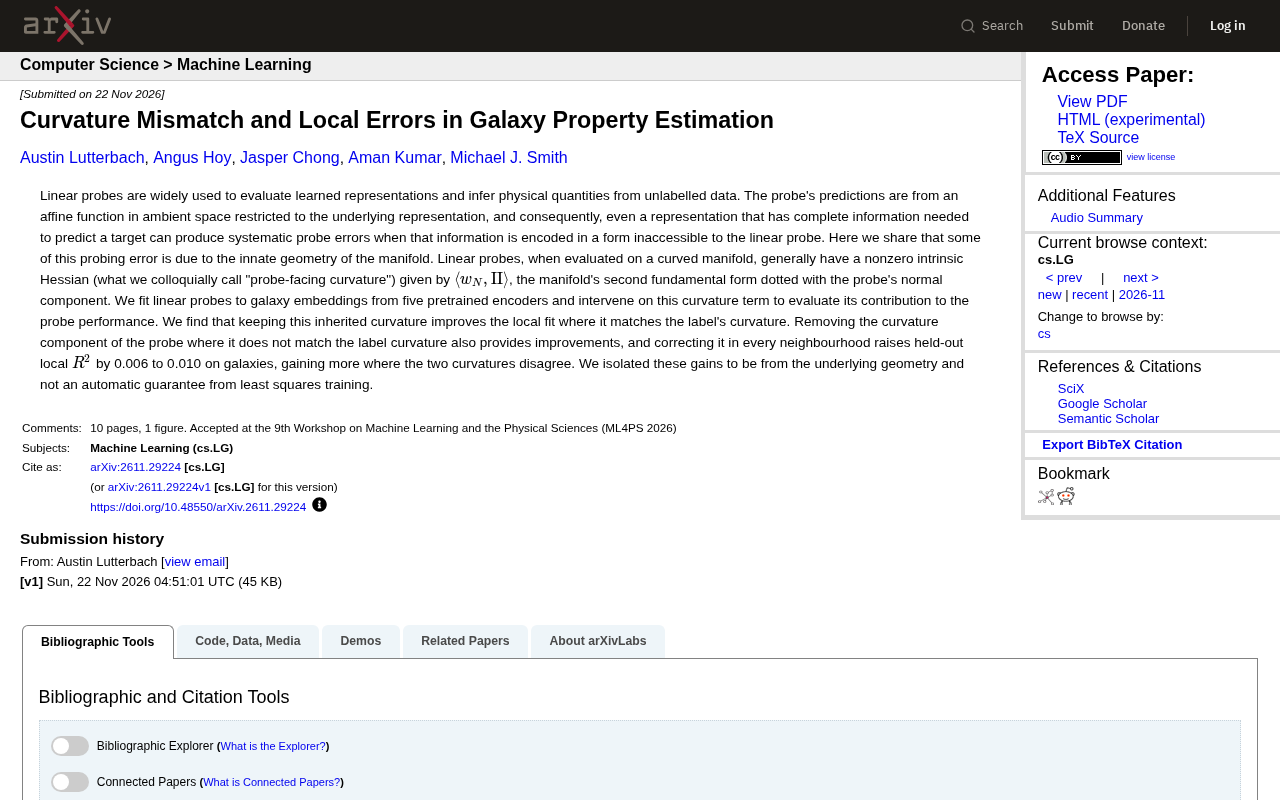
Linear probes are common for evaluating representations and inferring physical quantities, but their affine assumption causes systematic errors on curved manifolds. A recent study attributes this to the dot product of the manifold's second fundamental form with the probe's normal component. Correcting the curvature term improved held-out local R² by 0.006–0.010 on galaxy embeddings, with larger gains when curvatures mismatched. The gains stem from underlying geometry.
Linear probes are a common tool for evaluating learned representations and inferring physical quantities from unlabeled data, but their predictions are based on affine functions in the ambient space. When the form of information encoding is inaccessible to a linear probe, systematic errors arise even if the representation contains complete information. A recent study reveals that part of this error stems from the intrinsic geometry of the manifold—curvature mismatch.
Geometric Limitations of Linear Probes
A linear probe predicts a target variable from a representation by fitting an affine function, and its effectiveness depends on a linear relationship between the representation and the target. However, when the representation lies on a curved manifold, the linear probe's predictions introduce inherent error. The researchers attribute this error to the dot product of the manifold's second fundamental form with the probe's normal component—the "probe-facing curvature."
This curvature term reflects the influence of the manifold's local bending on the linear fit. Even if the representation contains all the information needed to predict the target, a linear probe may still be biased if the information is encoded nonlinearly. This study is the first to formalize this error source and quantify its impact on galaxy property estimation.
The second fundamental form is a tool in differential geometry that describes how a submanifold embeds into the surrounding space. For a manifold embedded in an ambient space, the second fundamental form measures how much the manifold bends in the normal direction at each point: it is essentially the projection of the second derivative of the manifold's position map onto the normal space. If the manifold is flat (such as a hyperplane), the second fundamental form is zero; the greater the curvature, the larger the value of the second fundamental form. In this context, the manifold in representation space (formed by data points) is embedded in a high-dimensional ambient space, where the linear probe fits an affine function, and the second fundamental form characterizes the extent to which the manifold deviates from its tangent plane. The probe's predictions rely only on information in the tangent plane direction and cannot capture variations caused by normal bending. Therefore, the dot product of the second fundamental form with the probe's normal component directly quantifies the systematic bias of the linear probe due to manifold curvature. This formalization links geometric curvature to statistical fitting error, providing a rigorous mathematical framework for analyzing the limitations of linear probes.
Experimental Design and Intervention Methods
The researchers extracted galaxy embeddings from five pretrained encoders and fitted linear probes. By intervening on the curvature term, they evaluated the contribution of curvature to probe performance. Specifically, retaining the inherited curvature that matches the label curvature improved local fitting; removing the mismatched curvature component also brought gains.
On galaxy data, correcting the curvature of each neighborhood improved the held-out local R² by 0.006 to 0.010, with more pronounced gains when the two curvatures were inconsistent. The researchers further isolated these gains, confirming they arise from the underlying geometry rather than the automatic guarantees of least-squares training.
Local R² is a variant of the coefficient of determination R² computed over local neighborhoods. Standard R² measures the proportion of variance in the overall data explained by the model, whereas local R² computes goodness of fit within a small neighborhood around each data point and then averages or aggregates the neighborhood results. This metric is more sensitive to local geometric structure: when the manifold bends differently in different regions, global R² may mask deficiencies in local fitting, while local R² can reveal systematic errors caused by curvature mismatch. In this paper, after curvature correction, the held-out local R² improves by 0.006 to 0.010. Although the numerical value appears small, on high-dimensional galaxy embeddings and large-scale samples, this improvement is statistically significant and practically meaningful, especially when the two curvatures (the manifold's intrinsic curvature and the label curvature) are inconsistent, indicating that local R² can effectively capture the fitting improvement brought by geometric correction.
Implications for Galaxy Property Estimation
Galaxy property estimation often relies on representations extracted from image or spectral data, and linear probes are widely used to infer physical quantities such as stellar mass and star formation rate. The existence of curvature mismatch error means that even with sufficient representational information, linear probes may underestimate or overestimate properties, especially in regions where the manifold bends significantly.
This study suggests that considering manifold geometry when constructing probes can improve estimation accuracy. For astronomical data processing, this means more careful handling of the nonlinear structure of representation space is needed, rather than simply relying on the default output of linear probes.
Pretrained encoders refer to neural networks trained via self-supervised learning on large-scale unlabeled data, whose goal is to map raw inputs (such as images or spectra) into low-dimensional embedding vectors that retain information useful for downstream tasks. In galaxy property estimation, encoders typically extract representations from galaxy images or spectra, and then the encoder parameters are frozen while a linear probe is trained on its outputs to predict physical quantities such as stellar mass and star formation rate. This paradigm is popular because it avoids retraining deep networks for each property and can assess the information content of the representation itself. However, the embedding space output by the encoder often has a complex nonlinear geometric structure, and the affine assumption of the linear probe may not match the actual manifold shape, thereby introducing curvature mismatch error. The five pretrained encoders used in this paper cover different training objectives and architectures, and the geometric differences in their embedding spaces provide a diverse testing ground for studying curvature effects.
Broader Implications for Representation Learning
This finding applies not only to galaxy property estimation but also has implications for any field that uses linear probes to evaluate representations. In deep learning, the geometric properties of representation space are often overlooked, and curvature mismatch error may be widespread. Future research could explore how to incorporate geometric correction into probe design or develop evaluation methods insensitive to curvature.
This work highlights the close connection between representation geometry and probe performance, offering a new perspective for understanding the limitations of linear probes.
One-line Summary
Linear probes suffer from curvature mismatch error on curved manifolds, and correcting it improves the accuracy of galaxy property estimation.
Paragraph Summary
Linear probes are a common tool for evaluating representations and inferring physical quantities, but their affine assumption produces systematic errors when representations lie on curved manifolds. A recent study attributes this error to the dot product of the manifold's second fundamental form with the probe's normal component—the "probe-facing curvature." On galaxy embeddings from five pretrained encoders, correcting the curvature term improved the held-out local R² by 0.006 to 0.010, with more pronounced gains when the manifold's intrinsic curvature and the label curvature were inconsistent. The gains arise from the underlying geometry rather than the automatic guarantees of least-squares training. This finding has implications for galaxy property estimation and representation learning evaluation more broadly, suggesting that considering manifold geometry when constructing probes can improve estimation accuracy.
Related articles

From 0 to 1: Vibe Coding an AI Knowledge Base — A Practical Retrospective and Tech Stack Breakdown
A retrospective on building the AI knowledge base OilBook from scratch with Vibe Coding: Next.js+Neon stack, Oil Dev Skill workflow, Stripe paywall security, interview-style writing, AI-flavor control, and Vercel deployment.

GLM-5.4 Hands-On: Native Vision Meets a New Vibe Coding Workflow
Hands-on with Zhipu GLM-5.4: native vision tested across a 3D product demo, pure-code video generation, and remote-control Vibe Coding, compared with GPT-6.2 and Gemini Neon.

AI and Humans Claim to Prove the Riemann Hypothesis: Machine-Verified, Yet Nobody Can Understand It
Anthropic mathematician and AI Claude claim to prove the Riemann Hypothesis with 17 million lines of Lean code, machine-verified but unreadable by humans. This article analyzes the event, the zero proportion record from 41.6% to 67.2%, and the gap between machine verification and human understanding.