CutCat: A New Netflix Viewing Assistant That Skips or Mutes Flagged Scenes

CutCat is a free Chrome extension that crowdsources flags and skips or mutes sensitive scenes in Netflix.
CutCat is a free Chrome extension designed for Netflix on desktop that lets users skip or mute scenes flagged by the community as containing sex, nudity, gore, or profanity. Its core advantage is user-selectable filter types for personalized control. It relies on crowdsourced flags, so coverage and accuracy depend on participation, and it only supports Netflix on Chrome. Despite limitations, it offers a lightweight, free solution for parents and sensitive viewers.
Netflix's vast content library inevitably includes scenes that some viewers find uncomfortable—whether it's graphic violence, nudity, or profanity. For parents, this awkwardness is especially pronounced when watching with their children; for ordinary viewers, certain scenes can also disrupt the viewing experience. CutCat, a Chrome extension that recently ranked No. 11 on Product Hunt, was created precisely to address this pain point.
Core Feature: Choose What to Skip or Mute
CutCat is a free Chrome extension that lets users skip or mute scenes flagged by other viewers as containing sex, nudity, gore, or profanity. The key is "you choose which ones"—users can flexibly decide which types of content to filter based on their own comfort level. For example, parents might want to skip all sex and nudity scenes entirely, while only muting gory scenes; ordinary viewers might only want to block profanity. This fine-grained control distinguishes CutCat from one-size-fits-all filtering tools.
According to developer Shivam Prajapati, CutCat runs entirely in the browser and is designed specifically for Netflix on desktop. It is not affiliated with Netflix and is a third-party tool. This means users don't need to worry about account security or terms of service issues, but they may also face compatibility challenges caused by Netflix interface updates.
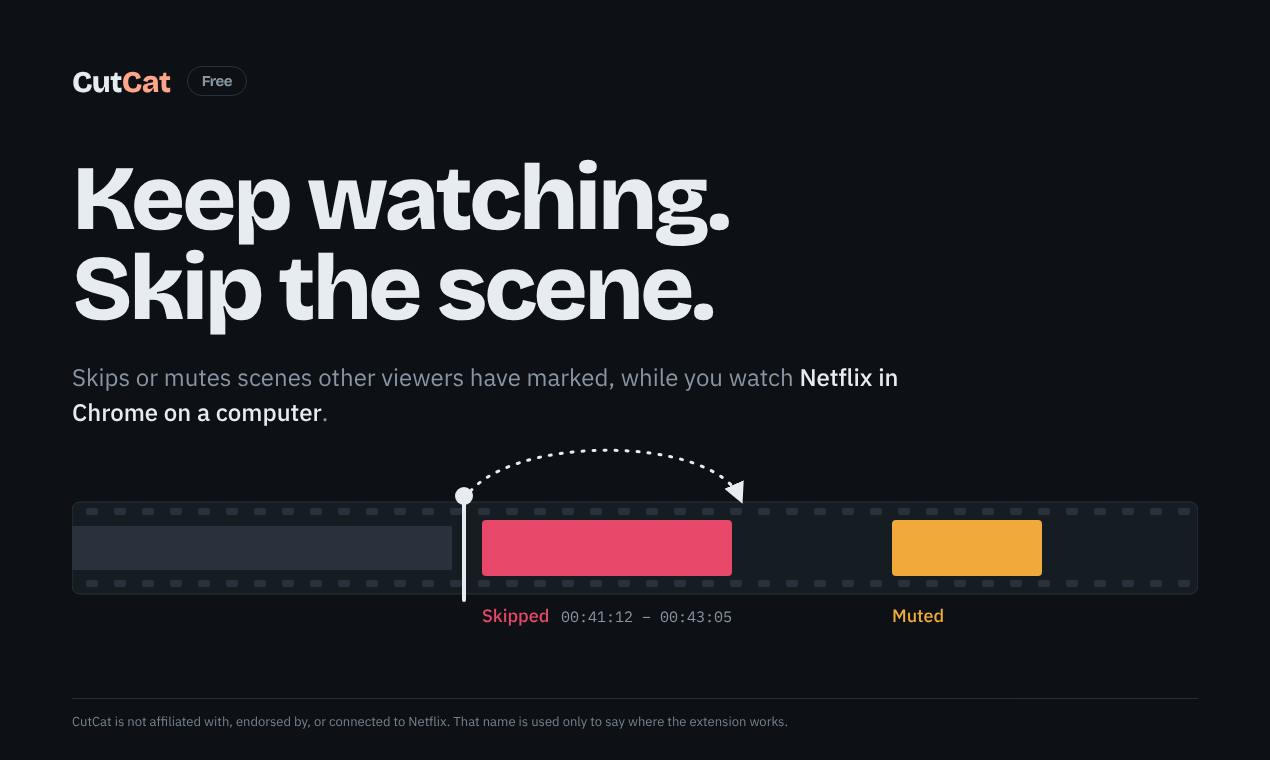
How It Works: Crowdsourced Flagging and Real-Time Filtering
CutCat's operation relies on the power of the community. Viewers can flag scenes while watching, and this flag data is aggregated for use by other users. When other users enable filtering, the extension detects the current playback position and automatically skips or mutes the flagged scenes. The advantage of this crowdsourcing model is broad coverage—as the user base grows, flagged scenes become increasingly comprehensive. The downside is that flag accuracy may vary, and new or obscure content may have insufficient flags.
Based on the product page, CutCat currently has 74 votes and 4 comments, ranking No. 11 for the day. This indicates it has attracted some attention but has not yet generated large-scale discussion. Developers typically launch on Product Hunt to gather early user feedback and build word-of-mouth.
Crowdsourcing is a model in which a service is built through the collective contributions of a large number of users. In CutCat's case, each viewer flags specific scenes (such as violence or nudity) while watching, and these flags converge into a shared database. When other users enable filtering, the extension queries this database and performs skip or mute operations. The core advantage of crowdsourcing is scalability: the more users participate, the broader the content coverage of flags. However, its quality depends heavily on the self-discipline and consistency of the community—different users may define "gore" or "profanity" differently, leading to inconsistent flagging standards. In addition, the crowdsourcing model suffers from a "cold start" problem: newly launched or obscure films may lack sufficient flags, thereby affecting filtering effectiveness. CutCat has not publicly disclosed its flag moderation mechanism, so accuracy remains a potential risk.
Use Cases and Limitations
Typical CutCat users include: parents who want to filter inappropriate content for their children, viewers sensitive to specific content, and ordinary users who want a cleaner viewing experience. It is particularly suited to family viewing scenarios—parents can set filtering rules in advance, avoiding the scramble to fast-forward during playback.
However, CutCat also has clear limitations. First, it only supports Netflix on the Chrome browser and cannot cover mobile devices, smart TVs, or other streaming platforms. Second, it relies on user flags, so its effectiveness may be limited for content with insufficient flags. In addition, skipping scenes may cause plot discontinuity, and users need to weigh the balance between filtering and the viewing experience.
Alternatives and Future Prospects
Similar tools already exist on the market, such as VidAngel (which requires payment and involves legal controversy) and Netflix's built-in parental controls (but only for children's profiles). CutCat positions itself as free, lightweight, and user-selectable, giving it some differentiated advantages. In the future, if it can expand to more streaming platforms, add automatic flagging capabilities (such as using AI to identify scenes), or offer more fine-grained filtering options (such as adjustments along the timeline), it may attract a broader user base.
Currently, as a free Chrome extension, CutCat offers a simple and easy-to-use option for users who care about their viewing experience. Its crowdsourcing model and user autonomy are highlights, but its reliance on flag accuracy and coverage remains an area that needs continuous optimization. For viewers who frequently use Netflix on a computer, it may be worth a try.
VidAngel is a service that entered the content filtering market relatively early. Its model is to have users purchase films and then provide filtered versions (by deleting or muting specific scenes). However, VidAngel was sued by Hollywood studios for allegedly modifying works without copyright holders' permission, and eventually reached a settlement with Disney and others in 2020 and adjusted its business model. This legal controversy highlights the copyright compliance risks faced by third-party filtering tools. In contrast, CutCat, as a browser extension, does not modify the film itself but skips or mutes in real time, which may reduce legal risk, though attention should still be paid to Netflix's terms of service restrictions on third-party plugins. Netflix's built-in parental controls only allow content ratings to be set for children's profiles and cannot provide fine-grained filtering for adult accounts, so CutCat's differentiation lies in giving adult users the power of choice.
One-line Summary
CutCat is a free Chrome extension that crowdsources flags and skips or mutes sensitive scenes in Netflix.
Paragraph Summary
CutCat is a free Chrome extension designed for Netflix on desktop that lets users skip or mute scenes flagged by the community as containing sex, nudity, gore, or profanity. Its core advantage is that users can choose which types of content to filter, enabling personalized control. The extension relies on crowdsourced flags, so coverage and accuracy depend on user participation, and it only supports Netflix on the Chrome browser, unable to cover mobile devices or other platforms. It currently has 74 votes and 4 comments on Product Hunt, ranking No. 11. Despite limitations such as insufficient flags and plot discontinuity, CutCat still provides a lightweight, free solution for parents and sensitive viewers, and in the future it may improve its usefulness by expanding platforms or introducing AI recognition.
Related articles

AI Tools Quietly Altering Settings: Postman Silently Installs Plugin, Codex Sharing Option Auto-Resets
AI Daily reports: Postman silently installs a Mac plugin and self-approves startup hooks, logged as auto-existing upgrade; Hacker News developers say Codex data-sharing opt-out flips back. Plus Simon Willison's raw float weight experiment with QEN 3.8-27B.

AI Learns to Rewrite AI: MIT's "Weightspace Programming" Redraws the Path to Recursive Self-Improvement
MIT team proposes weightspace programming: GPT-6 Astra reads and edits AI model weights directly. Math scores jump several-fold, hand-written networks beat trained models. Eight experiments analyzed, plus Anthropic's same-day warning and the real boundaries of recursive self-improvement.

Running Qwen 3.8 on a Laptop to Read Raw Weights: 46 Minutes Per Answer
Simon Willison reproduced weight space programming with Qwen 3.8 27B on a laptop: a 17GB model file, 46 minutes per answer, 43,506 reasoning tokens, Pong over an hour, Freeway failed. Suited for interpretability researchers.