CUTLASS Python: NVIDIA's New Tool for Accelerating GPU Kernel Development

NVIDIA's CUTLASS Python lowers the barrier to writing peak-performance GPU kernels for both developers and AI agents.
NVIDIA engineer Güray presented the latest updates to CUTLASS for Python, a stack enabling developers to write "speed of light" GPU kernels in Python. New features include Qt extensions, CUTLASS primitives, a Pythonic Agile toolchain, and improved compiler diagnostics — all aimed at making peak GPU performance accessible beyond just CUDA experts. Notably, the toolchain explicitly targets AI agents as users, with static checks that intercept errors before kernel launch. A full presentation is planned for the PyTorch Conference on October 20th.
What Is CUTLASS Python
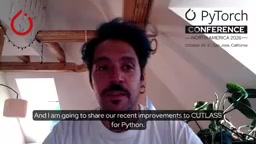
NVIDIA compiler engineer Güray recently shared the latest developments in CUTLASS for Python — a technology stack designed for writing "speed of light" kernels on the latest GPU generations. It already powers many of today's most important AI workloads under the hood, supporting the performance of large-scale model training and inference.
For those unfamiliar with the term, GPU kernels are computational functions that run on graphics cards, directly determining the execution efficiency of core operations like matrix multiplication and attention computation. Writing kernels that approach the hardware's theoretical peak performance has historically been a high-barrier endeavor, requiring developers to have deep knowledge of GPU architecture, memory hierarchy, and parallel scheduling. CUTLASS aims to abstract this capability into reusable, composable components.
CUTLASS (CUDA Templates for Linear Algebra Subroutines and Solvers) is a C++ template library that NVIDIA open-sourced in 2017, purpose-built for high-performance linear algebra operations on GPUs. It encapsulates the hardest parts of CUDA programming — including shared memory tiling, register-level software pipelining, Tensor Core scheduling, and asynchronous memory copies — into hierarchical, composable templates. Developers can select appropriate "tile shapes," "thread block layouts," and "data types" like building blocks, letting the compiler generate machine code that approaches theoretical peak performance. CUTLASS Python builds on top of this foundation as a Python frontend, using DSL (domain-specific language) and compiler technologies so developers can define high-performance kernels without writing C++ template metaprogramming directly — while still compiling down to efficient CUDA code that runs on the GPU.
New Features for Developer Productivity
The focus of the presentation was a series of new capabilities aimed at improving developer efficiency. Güray highlighted several directions:
- Qt extensions: Richer programming interfaces and extensibility for kernel development.
- CUTLASS primitives: Common high-performance computation patterns packaged as ready-to-use building blocks, reducing the effort required to write from scratch.
- Pythonic Agile toolchain: A more agile development workflow that aligns with how Python developers work.
- New compiler diagnostics: Clearer error messages and static analysis feedback.
Together, these features address a central question — how to make writing "speed of light" kernels a skill accessible to a broader developer audience, rather than the exclusive domain of a small group of experts.

Empowering Both Humans and Agents
One notable framing worth highlighting: CUTLASS Python's goal is to serve not just human developers, but also "your agents." This reflects a growing trend in AI engineering — an increasing number of code generation and performance optimization tasks are being delegated to AI agents.
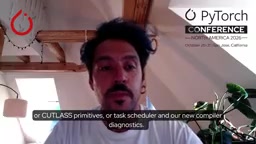
In this context, the value of static checks is amplified. Güray emphasized that the new toolchain can catch potential errors ("foot-guns" — easy-to-make mistakes) before a kernel is actually launched. For kernel code automatically generated by agents, this ability to "surface problems before runtime" is especially critical — it can intercept misconfigurations and unsafe patterns without consuming expensive GPU resources.
"Static checks" carry particular importance in GPU kernel development. Many errors in traditional CUDA kernels — such as shared memory out-of-bounds access, warp divergence, and illegal memory accesses — only crash or produce silent incorrect results when the GPU actually executes, making debugging extremely costly. Static checks move part of the validation earlier, to compile time or Python runtime — for example, verifying that tensor dimensions match the kernel configuration, that data types are supported, or that tiling parameters satisfy hardware constraints. For kernel code automatically generated by AI agents, this mechanism acts as a "guardrail": agents can rapidly generate large numbers of candidate kernels, static checks filter out obviously invalid configurations, and only verified versions are actually submitted to the GPU for execution — significantly improving the efficiency and safety of automated optimization workflows.
Implications for AI Infrastructure
From a broader perspective, the evolution of CUTLASS Python reflects a trend toward making AI's underlying infrastructure more software-driven and democratized. As model scale continues to grow, a significant portion of training and inference costs depends on the efficiency of low-level kernels. Lowering the barrier to high-performance kernel development means more teams can squeeze peak performance out of their hardware without relying on dedicated CUDA experts.
At the same time, Python — the de facto dominant language in the AI field — gaining high-performance GPU programming capabilities further shortens the path from algorithm prototype to production-grade, high-performance kernels. Combined with compiler diagnostics and static checks, developers can iterate faster, catch issues earlier, and achieve what the talk's title describes as "High-Velocity Kernel Authoring."
Closing Thoughts
Güray announced that a more complete presentation on these topics will be delivered at the PyTorch Conference on October 20th. For practitioners focused on high-performance GPU computing, AI systems engineering, and AI-assisted programming, this batch of CUTLASS Python updates is well worth following.

Note: This article is based on a preview shared by an NVIDIA engineer. Specific technical details should be confirmed against official releases and the PyTorch Conference presentation.
Related articles

VKORE: Inference-Only NPUs Complete LLM Pretraining with 0.99 Loss Correlation
VIDRAFT Lab's VKORE software layer enables 32 inference-only NPUs to pretrain a 46M-parameter model from scratch with 0.99 loss correlation. We analyze how it works, benchmark data, scaling limits, and availability.

Agentic AI Tool Design: The More Critical Piece Than Prompts
In Agentic AI deployment, tool design matters more than prompts. This article analyzes core practices such as tool naming, description writing, concise return values, error message design, idempotent retries, and external constraints to help developers systematically improve AI Agent stability.

RAG Retrieval Optimization in Practice: Hybrid Search, Reranking, and Recall Evaluation
RAG wrong answers often stem from retrieval failure. Learn to quantify retrieval quality with recall@k and MRR, then optimize chunking, hybrid search, RRF fusion, cross-encoder reranking, and metadata filtering.