CVSS 9.8! Analysis of the Linux TCP Use-After-Free Vulnerability

Linux TCP stack exposes a critical UAF vulnerability with CVSS 9.8, raising community concerns about kernel concurrency security.
This article focuses on CVE-2026-98432, a use-after-free (UAF) flaw in the Linux IPv4 TCP protocol stack with a CVSS score of 9.8, rated Critical. It first explains the typical characteristics of UAF and its causes within the TCP state machine, identifying races between timer callbacks and connection destruction in concurrent scenarios as the main root cause. It then analyzes the attack surface and trigger conditions, emphasizing the possibility of remote exploitation and the role of mitigations such as SMEP/SMAP and KASLR. The community reaction section reviews the high-profile discussion on Hacker News, reflecting the value of transparency and coordinated disclosure for infrastructure-level vulnerabilities. Finally, it offers remediation advice: promptly apply kernel patches, and limit exposure as a stopgap before patches are available. The article concludes that concurrency and memory lifecycle management in the TCP stack remain security weak points, and enterprises should establish rapid response processes.
Vulnerability Overview: A High-Severity UAF in the TCP Stack
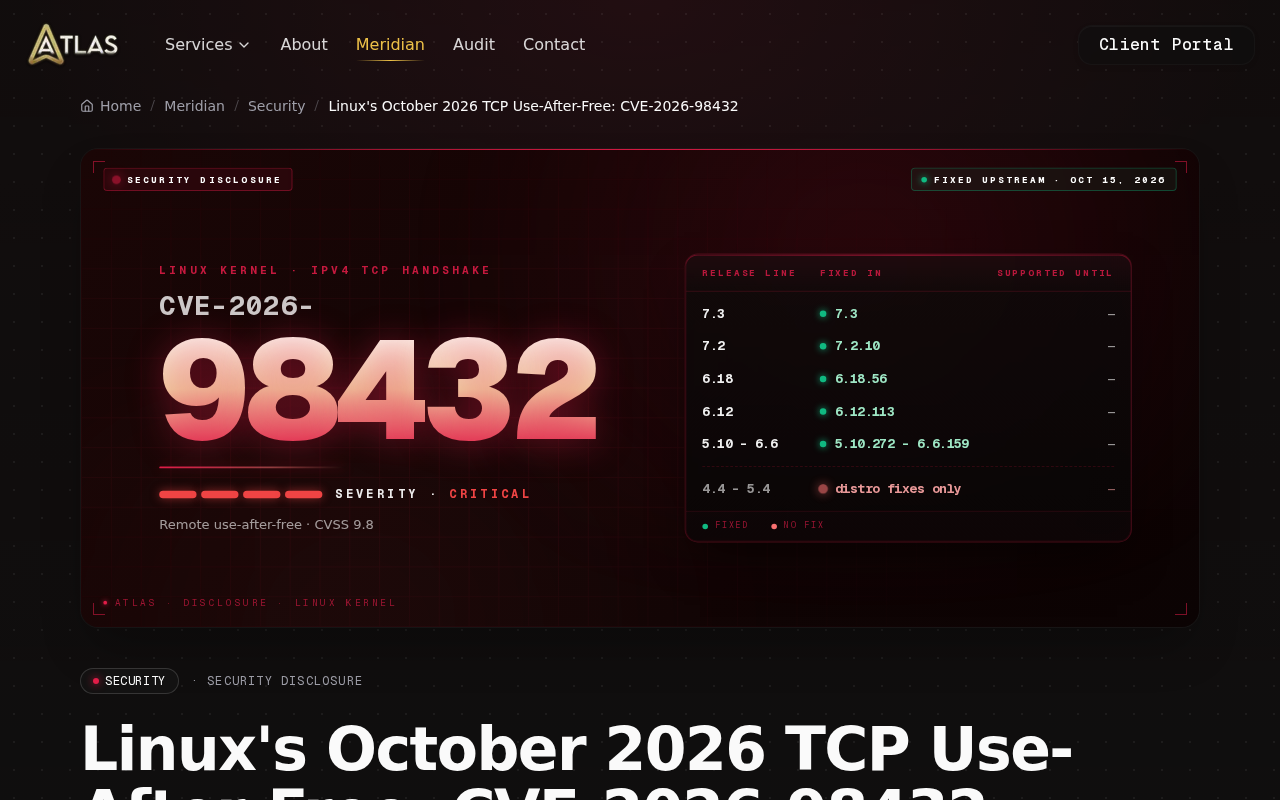
Recently, the security research community disclosed a Use-After-Free (UAF) vulnerability affecting the Linux IPv4 TCP protocol stack, tracked as CVE-2026-98432. According to public information, the vulnerability carries a CVSS score of 9.8, placing it in the "Critical" category. On Hacker News, the related discussion thread received 221 points and 104 comments, underscoring the high level of attention from developers and security practitioners.
The defining characteristic of a UAF vulnerability is that a program frees a block of memory but retains a pointer to it and continues to use it. If an attacker can control the reallocation of the freed memory, they may achieve arbitrary code execution or kernel privilege escalation. For a core subsystem like TCP that carries massive volumes of network traffic, the potential impact of such a vulnerability cannot be underestimated.
Technical Principles: Lifecycle Management Flaws in the TCP State Machine
How UAF Arises in the Protocol Stack
The lifecycle of a TCP connection involves multiple data structures, including sockets, request blocks, and TIME_WAIT timers. When a connection closes or is abnormally terminated, the kernel frees the associated objects; however, if some asynchronous path (such as a timer callback or softirq handler) still holds a reference to an already-freed object, a UAF is triggered.
Such flaws often occur in concurrent scenarios: one CPU core is handling connection destruction while a network softirq or timer on another core is still accessing the same structure. Because the TCP stack is extremely performance-sensitive, even a slight lapse in coordinating lock granularity with lock-free mechanisms like RCU can leave a race window open.
RCU (Read-Copy-Update) is a synchronization mechanism widely used in the Linux kernel. Its core idea is to allow lock-free reader access in "read-mostly" scenarios, with writers ensuring reader safety by deferring the release of old versions. Specifically, a writer first creates a new copy of the data and atomically replaces the pointer, while the release of the old copy is deferred until all existing readers have left the critical section (via the grace period mechanism). In the TCP stack, high-frequency read paths such as route caching and socket lookup rely heavily on RCU. However, the concept of the RCU "grace period" is easily misunderstood: it only guarantees that readers will not access freed memory; it does not guarantee that object lifetimes are fully synchronized with the protocol state machine. If code mistakenly holds an object pointer outside an RCU critical section, or accesses an object through a timer callback after it has been freed, a UAF will result. Understanding RCU grace periods and the timing of call_rcu() callbacks is key to analyzing such concurrency flaws.
Attack Surface and Trigger Conditions
Based on public discussion, the vulnerability lies in the IPv4 TCP processing path. An attacker may trigger it by crafting specific TCP packet sequences or connection state transitions. However, the specific trigger details should be based on the official advisory and fix patch. It is important to emphasize that a CVSS score of 9.8 typically means the vulnerability can be exploited remotely without authentication, but actual exploitability still depends on factors such as kernel configuration and mitigations (e.g., SMEP/SMAP, KASLR).
SMEP (Supervisor Mode Execution Prevention) and SMAP (Supervisor Mode Access Prevention) are hardware mitigation features provided by x86 processors. SMEP prevents kernel-mode code from executing instructions on user-mode pages, while SMAP prevents the kernel from directly reading or writing user-mode memory. Together, they can significantly increase the difficulty of exploiting UAF vulnerabilities: an attacker cannot simply place shellcode in user space and induce the kernel to jump to it, nor can they easily forge kernel data structures through user-mode memory. KASLR (Kernel Address Space Layout Randomization) randomizes the base addresses of kernel code and data on each boot, making it difficult for attackers to locate ROP/JOP gadgets or key kernel objects. These mitigations are not impossible to bypass, but they do raise the exploitation bar from "script kiddie" level to requiring information leaks and fine-grained control over memory layout. When assessing the actual risk of CVE-2026-98432, one must consider the target system's kernel configuration (such as CONFIG_RANDOMIZE_BASE and whether the CPU supports SMEP/SMAP) in a comprehensive judgment.
Community Reaction: Why This Vulnerability Warrants Caution
The 104 comments on Hacker News reflect the security community's complex sentiments. On one hand, TCP is at the core of internet infrastructure, and any protocol stack vulnerability could affect a large number of servers and endpoint devices; on the other hand, UAF-class vulnerabilities have a high exploitation bar, requiring precise control over memory layout, which to some extent reduces the likelihood of direct exploitation by "script kiddies"—but that does not mean one can afford to be complacent.
Some commenters noted that code review and fuzzing efforts for the Linux kernel network stack have been continuously strengthened in recent years, and the very fact that such vulnerabilities can be discovered shows that defenders are making progress. At the same time, others worry that as kernel functionality continues to expand and state machine complexity grows, similar concurrency flaws may not be isolated incidents.
Remediation and Defense: Actions Users Should Take Immediately
For operations and development personnel, the most direct measure is to monitor security updates for Linux kernel stable and long-term support releases and promptly apply patches that include the fix. Since the vulnerability ID and details have been made public, services exposed to the public internet should be prioritized for inspection.
Before a patch is available, mitigation options to consider include: limiting unnecessary exposure of TCP services, enabling kernel address space layout randomization and related hardware mitigation features, and filtering anomalous packets at the network layer. However, these are only stopgap measures; the fundamental solution still depends on the official fix.
Final Thoughts
CVE-2026-98432 once again reminds us that even for a TCP protocol stack that has been battle-tested at massive scale, concurrency and memory lifecycle management remain weak points in security. For enterprises, establishing a rapid response process for kernel vulnerabilities is more important than relying solely on any single patch. The high level of attention from the security community also demonstrates that transparency and coordinated disclosure mechanisms for infrastructure-level vulnerabilities are working.
Related articles

AI Tools Quietly Altering Settings: Postman Silently Installs Plugin, Codex Sharing Option Auto-Resets
AI Daily reports: Postman silently installs a Mac plugin and self-approves startup hooks, logged as auto-existing upgrade; Hacker News developers say Codex data-sharing opt-out flips back. Plus Simon Willison's raw float weight experiment with QEN 3.8-27B.

AI Learns to Rewrite AI: MIT's "Weightspace Programming" Redraws the Path to Recursive Self-Improvement
MIT team proposes weightspace programming: GPT-6 Astra reads and edits AI model weights directly. Math scores jump several-fold, hand-written networks beat trained models. Eight experiments analyzed, plus Anthropic's same-day warning and the real boundaries of recursive self-improvement.

Running Qwen 3.8 on a Laptop to Read Raw Weights: 46 Minutes Per Answer
Simon Willison reproduced weight space programming with Qwen 3.8 27B on a laptop: a 17GB model file, 46 minutes per answer, 43,506 reasoning tokens, Pong over an hour, Freeway failed. Suited for interpretability researchers.