Dageno AI 2.0: See Why AI Recommends Your Competitors Instead of You

Dageno AI 2.0 tracks brand recommendations and sources across 10 AI models.
Dageno AI 2.0 is an AEO/GEO platform for brands and agencies that shows whether 10 AI models including ChatGPT, Gemini, and Perplexity recommend a brand or its competitors, and traces the sources driving those answers. Its standout feature is permanently free market lookup covering 12,000+ niche markets and 3M+ brands, with payment only required to track specific prompts. It ranked #1 on Product Hunt with 162 votes and 16 comments, signaling that AEO/GEO tools are becoming an emerging martech category. However, the original does not disclose recommendation accuracy, data update frequency, or the specific boundaries of the free tier, so reliability still needs verification.
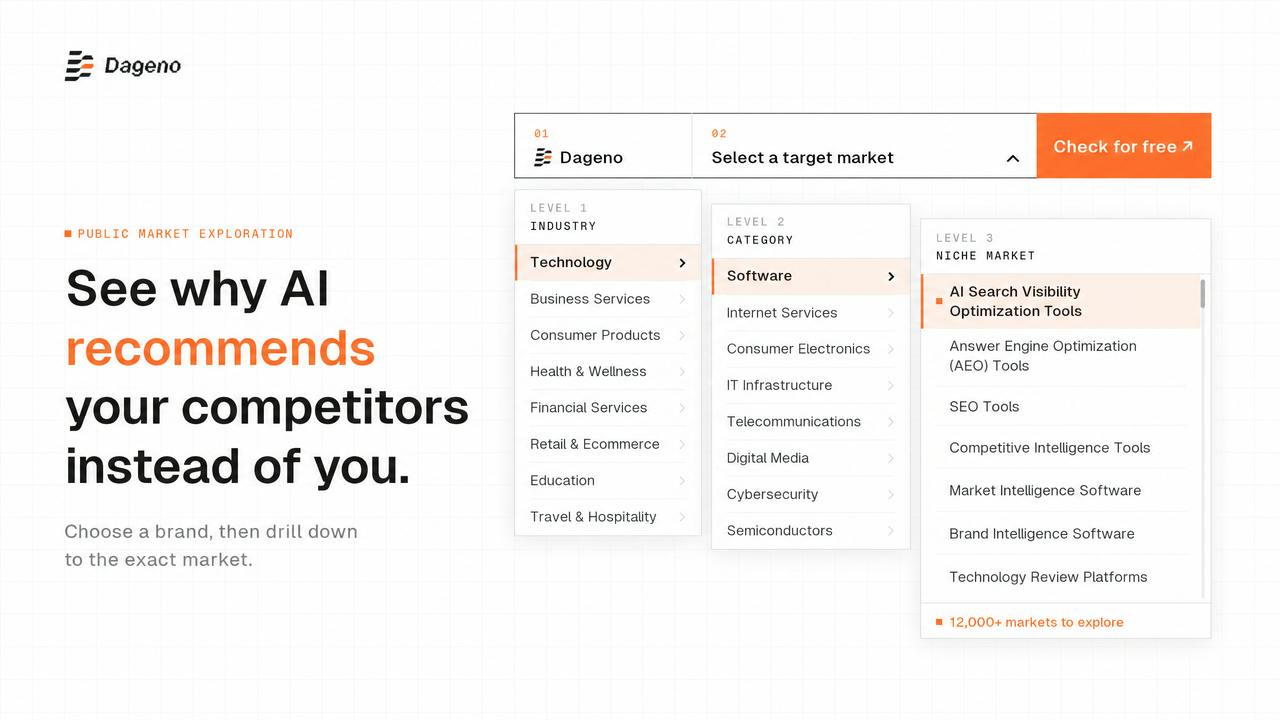
When users ask questions in ChatGPT, Gemini, or Perplexity, the brand recommendations the AI provides are becoming a new traffic gateway. But most brands don't know: who are these AI models actually recommending, and why are they recommending them. Dageno AI 2.0 aims to answer this question—it is an AEO/GEO platform that shows whether 10 AI models including ChatGPT, Gemini, and Perplexity recommend you or your competitors, as well as which sources drive those answers.
Why AI Recommendations Are Worth Tracking
The original article's positioning is direct: "AI is now choosing brands for your customers." This statement highlights the backdrop against which AEO (Answer Engine Optimization) and GEO (Generative Engine Optimization) are emerging. Traditional SEO focuses on search rankings, while AEO/GEO focuses on whether brands are mentioned and recommended by AI in generative answers.
Dageno AI 2.0 covers 10 AI models (the original states "ChatGPT, Gemini, Perplexity and 7 more"), which means brands can compare how different models recommend them side by side, rather than focusing on just one platform.
The distinction between AEO (Answer Engine Optimization) and GEO (Generative Engine Optimization) is worth clarifying. AEO focuses more on getting content directly adopted by "answer-type" interfaces such as voice assistants and featured snippets, typically providing concise answers to a specific question; GEO targets generative models like ChatGPT and Gemini, with the goal of getting brand information into the model's generated long-form answers and naturally mentioned. The two share some practices (such as structured content and authoritative source building), but GEO relies more on model training corpora, web pages captured in real time by retrieval-augmented generation (RAG), and the weight of cited sources. Understanding this difference helps brands determine whether they should optimize their own website content or influence third-party reviews, forums, and rankings.
Free Market Lookup: Lowering the Barrier to Entry
A notable feature of Dageno AI 2.0 is "Look up any market for free, forever"—permanently free market lookup for any market. Users can see top brands, buyer questions, and high-frequency cited sources across 12,000+ niche markets and 3M+ brands.
This design is valuable for both brands and agencies: agencies can quickly diagnose the AI recommendation landscape in a client's market before pitching, while brands can understand their AI visibility in their niche. Users only need to upgrade to a paid plan when they want to track their own specific prompts.
From "Being Recommended" to "Knowing Why You're Recommended"
Dageno AI 2.0 doesn't just show recommendation results—it also shows "which sources drive those answers," i.e., which sources drive the AI's answers. This traceability capability is key: if the AI cites a particular review, a forum discussion, or an industry ranking, brands can optimize those sources in a targeted way rather than guessing blindly.
The original positions the product as "Built for brands and agencies," indicating it targets teams with clear business goals rather than general SEO enthusiasts.
Market Signals and Limitations
On Product Hunt, Dageno AI 2.0 received 162 votes and 16 comments, ranking #1 for the day in the Marketing, SEO, and Search categories. The Maker is Tim Lin. This traction indicates that AEO/GEO tools are becoming an emerging category in the marketing technology space.
That said, the original does not disclose technical details such as the specific accuracy of recommendation results across AI models, data update frequency, or source coverage. For teams that need to rigorously evaluate tool reliability, this information still requires further verification. In addition, the specific boundaries of "permanently free lookup" (number of queries, depth of market coverage) are not clarified in the source material.
Who Should Pay Attention
If brand exposure in AI Q&A is part of your marketing KPIs, or if you're an agency that needs to provide AEO/GEO diagnostic services to clients, Dageno AI 2.0's free market lookup and cross-model comparison capabilities are worth trying. Its core value lies in breaking down the black-box question of "why AI recommends competitors" into observable brand lists and source lists.
Background
"Source tracing" technically typically relies on retrieval-augmented generation (RAG) mechanisms: many AI search engines retrieve web pages in real time before answering and include citation links in their answers. The "sources driving answers" that Dageno displays are likely these URLs or domains cited by the models. For brands, this means the optimization path isn't just about getting your own pages retrieved—it also includes getting third-party pages (review sites, Reddit discussions, industry rankings) to mention and positively describe your brand. However, retrieval strategies and citation transparency vary greatly across models, and some models do not publicly cite sources, so the completeness of traceability results will vary by model.
One-line Summary
Dageno AI 2.0 tracks brand recommendations and sources across 10 AI models.
Paragraph Summary
Dageno AI 2.0 is an AEO/GEO platform for brands and agencies that shows whether 10 AI models including ChatGPT, Gemini, and Perplexity recommend a given brand or its competitors, and traces the sources driving those answers. Its standout feature is permanently free market lookup covering 12,000+ niche markets and 3M+ brands, letting users view top brands, buyer questions, and high-frequency cited sources; payment is only required when tracking specific prompts. The product received 162 votes and 16 comments on Product Hunt and ranked #1 for the day, showing that AEO/GEO tools are becoming an emerging category in marketing technology. However, the original does not disclose recommendation accuracy, data update frequency, or the specific boundaries of the free tier, so reliability still needs verification.
Related articles
Hermes Agent in Depth: From Deployment to Skills, MCP, and Hooks
A complete walkthrough of Hermes Agent based on a YouTube deep-dive: VPS deployment, soul.md and user.md memory layering, auto-generated skills, MCP and connectors for Notion, multiple profiles and sub-agent delegation, gateway and shell hooks, and voice call configuration essentials.

Codependency in Addiction: Let Go of the Rope So the Other Person Can Move Toward Recovery
Stanford addiction expert Dr. Anna Lembke explains how codependency sustains addiction: when families stop over-intervening, attend Al-Anon, and let go, addicted individuals are more likely to recover.

Where Does Autonomous Driving Training Data Come From? Cosmo 3 Uses Scene Graphs to Generate Multi-Sensor Data
Cosmo 3 offers a generative solution for autonomous driving training data: controlled generation via world scene graphs, synchronized RGB and LiDAR output, and continuous generation for closed-loop simulation, now open for developer trials.