DAPO: The Open-Source LLM Reinforcement Learning System from ByteDance and Tsinghua

ByteDance and Tsinghua jointly release DAPO, an open-source RL system for reproducible LLM training.
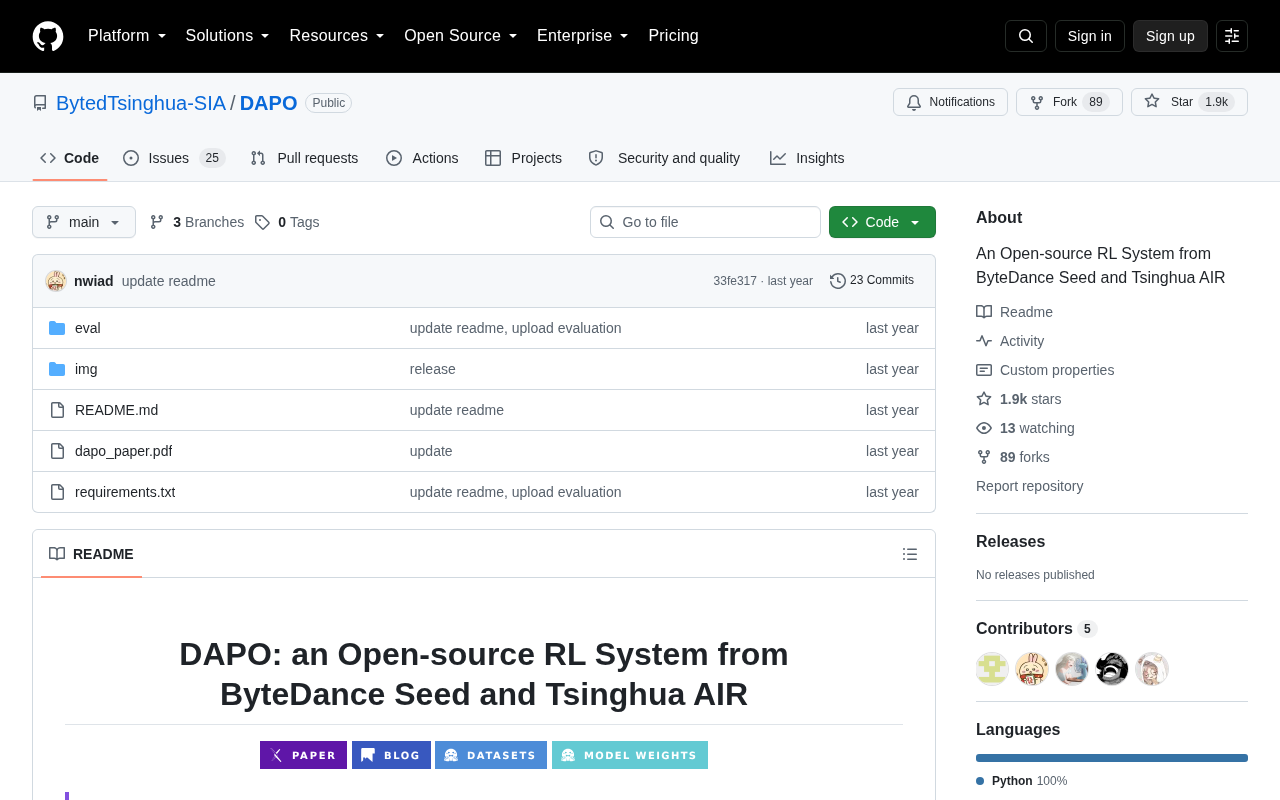
DAPO is an open-source reinforcement learning system jointly released by ByteDance's Seed team and Tsinghua University's AIR, focused on alignment and reasoning training for large language models. It addresses the widespread challenge of irreproducible RL training and closed-source toolchain dependency by integrating data processing, reward design, distributed training, and evaluation into a transparent, end-to-end pipeline. Building on mainstream algorithms like PPO and GRPO, DAPO targets pain points such as entropy collapse, gradient instability, and sparse rewards in long sequences. For teams working on reasoning models, code generation, and math tasks, DAPO offers a unified, ready-to-use baseline that can significantly reduce redundant engineering effort.
What Is DAPO
DAPO is an open-source reinforcement learning (RL) system jointly developed by ByteDance's Seed team and Tsinghua University's AIR (Institute for AI Industry Research), focused on alignment and reasoning capability training for large language models. As RLHF (Reinforcement Learning from Human Feedback) and the newer generation of verifiable-reward-based RL methods have become critical drivers of LLM capability improvements, a reproducible and scalable open-source RL framework holds real value for the research community.
In terms of its name and background, DAPO follows the iterative trajectory that the academic community has taken with mainstream RL algorithms like PPO and GRPO, aiming to deliver a more complete solution in terms of training stability, sample efficiency, and engineering reproducibility. The project attracted attention after being shared on Hacker News, reflecting the developer community's ongoing demand for open-source RL infrastructure.
Why Open-Source RL Systems Matter
RL training for large models has long faced a high barrier to entry: while there is no shortage of algorithm papers, open-source implementations that can actually run end-to-end with reproducible results are relatively rare. Many cutting-edge results rely on internal, closed-source toolchains that outside researchers cannot verify or build upon.
The collaboration between ByteDance Seed and Tsinghua AIR is designed to lower exactly this barrier. Combining industry-scale training experience with academic algorithmic innovation tends to produce results that balance both performance and rigor. For teams looking to do RL training on tasks like reasoning models, code generation, and math problem-solving, a transparent reference implementation can significantly reduce the cost of reinventing the wheel.
Relationship to Mainstream Methods
The dominant approaches in LLM RL training today include PPO (Proximal Policy Optimization) and GRPO (Group Relative Policy Optimization), among others. These methods commonly face challenges such as entropy collapse, gradient instability, and sparse rewards over long sequences. DAPO's value as a system-level solution lies not just in offering a single algorithm, but in integrating data processing, reward design, distributed training, and evaluation into a usable engineering pipeline.
PPO (Proximal Policy Optimization) is a classic RL algorithm introduced by OpenAI in 2017. It constrains the magnitude of each policy update via a clipped objective function, striking a balance between stability and sample efficiency. It served as a core component in early RLHF pipelines such as InstructGPT. GRPO (Group Relative Policy Optimization) is an improvement proposed by the DeepSeekAd team for LLM reasoning scenarios. Its core idea is to sample a group of outputs for the same prompt and use intra-group relative rewards instead of absolute value estimates, thereby eliminating the need to train a separate Critic network — reducing memory usage and improving training efficiency. DeepSeek-R1's success widely validated GRPO's effectiveness on math and code reasoning tasks, making it the direct technical backdrop against which DAPO positions itself. Entropy collapse refers to the phenomenon where a model's output distribution converges too early, causing the model to lose exploratory capability and get stuck in local optima. This is particularly pronounced in long chain-of-thought training, where reward signals are only provided at the end of the reasoning chain, leaving gradient signals extremely sparse throughout the intermediate steps.
RLHF (Reinforcement Learning from Human Feedback) is the mainstream technique for making large language models follow instructions and align with human preferences. Systematized by the InstructGPT paper, it has since been widely adopted by models like ChatGPT and Claude. The basic pipeline involves: training a Reward Model on human-annotated data, then using that model's scores as signals to fine-tune the language model via RL. In recent years, researchers have begun exploring "verifiable-reward RL" — for tasks like math and coding that have objectively correct answers, using rule-based answer verification instead of a reward model. This reduces annotation costs and avoids the risks of reward model bias and reward hacking. This direction is the shared starting point for recent work including DeepSeek-R1 and DAPO.
Significance for the Research Community
The greatest value of an open-source RL system lies in reproducibility and scalability. Researchers can conduct fair comparisons against a unified baseline, while engineering teams can rapidly customize reward functions and training strategies on top of an existing framework. The ByteDance–Tsinghua combination also suggests the project is likely to receive sustained compute support and algorithmic updates.
It should be noted that this article is based on the brief information shared on Hacker News. For specific algorithmic details, performance benchmarks, and code structure, the official repository and technical report should be treated as authoritative sources. For developers focused on LLM alignment and reinforcement learning, open-source projects led by top-tier institutions like this one are worth adding to your technical watch list.
Summary
DAPO represents yet another collaborative effort between industry and academia on large model RL infrastructure. As RL increasingly becomes a core tool for enhancing model reasoning capabilities, open, transparent, and reproducible training systems will continue to drive progress across the field. Interested readers are encouraged to consult the project's official documentation for complete technical information.
Related articles

Chain of Thought Isn't Just for AI: How Humans Can Use CoT to Improve Thinking Quality
Chain of Thought isn't just a prompt trick for large models. Starting from a Hacker News discussion, this article analyzes why CoT works for human thinking too, breaks down actionable ways to transfer it, and highlights the key differences between human CoT and machine CoT.
Cloudflare Teams Up with OpenAI: Closi…
Cloudflare Teams Up with OpenAI: Closing the Loop from Vulnerability Discovery to Defense with AI
Cloudflare uses OpenAI Daybreak to investigate security vulnerabilities and generate reviewable remediation plans, while developers use Codex to boost coding efficiency and quality.

Orca Multi-Agent Orchestration in Practice: A Guide to Parallel Collaboration with Claude and Codex
Orca is Stable AI's free open-source agent workbench supporting 34 agents like Claude Code and Codex in parallel. Learn its Git worktree isolation, multi-model orchestration, and mobile management.