Data Center Backlash Could Become a New Variable in Florida Elections

Community backlash against data centers in Florida could influence elections, prompting some Republican voters to cross party lines.
The article examines Patti Zirhut, a lifelong Republican in Florida who voted for Trump repeatedly but cast a 'mixed ballot' this year due to community backlash over data centers, supporting Republicans as well as independent and Democratic candidates. It notes that data centers, as core AI and cloud infrastructure, are triggering local resistance over land use, power, water, and noise, and could become an electoral issue. If this trend creates pressure in key states like Florida, tech companies may face stricter siting reviews, higher community engagement costs, and more complex approvals. However, the source material is limited, and one case is insufficient to judge the trend's scale and durability.
Title
Data Center Backlash Could Become a New Variable in Florida Elections
Meta Description
A lifelong Republican voter in Florida breaks with party voting habits over the data center issue, suggesting that community backlash against data centers could become a new electoral variable and pose local political risks for tech companies.
Article Content
Patti Zirhut, a lifelong Republican voter in Florida, has spent recent weeks studying her ballot. She enthusiastically voted for Donald Trump in 2016, 2020, and 2024, but this year she is no longer following the party line entirely.
"My ballot is mixed," she said. She voted for some Republicans, some independent candidates, and even a few Democrats.
Zirhut still [...]
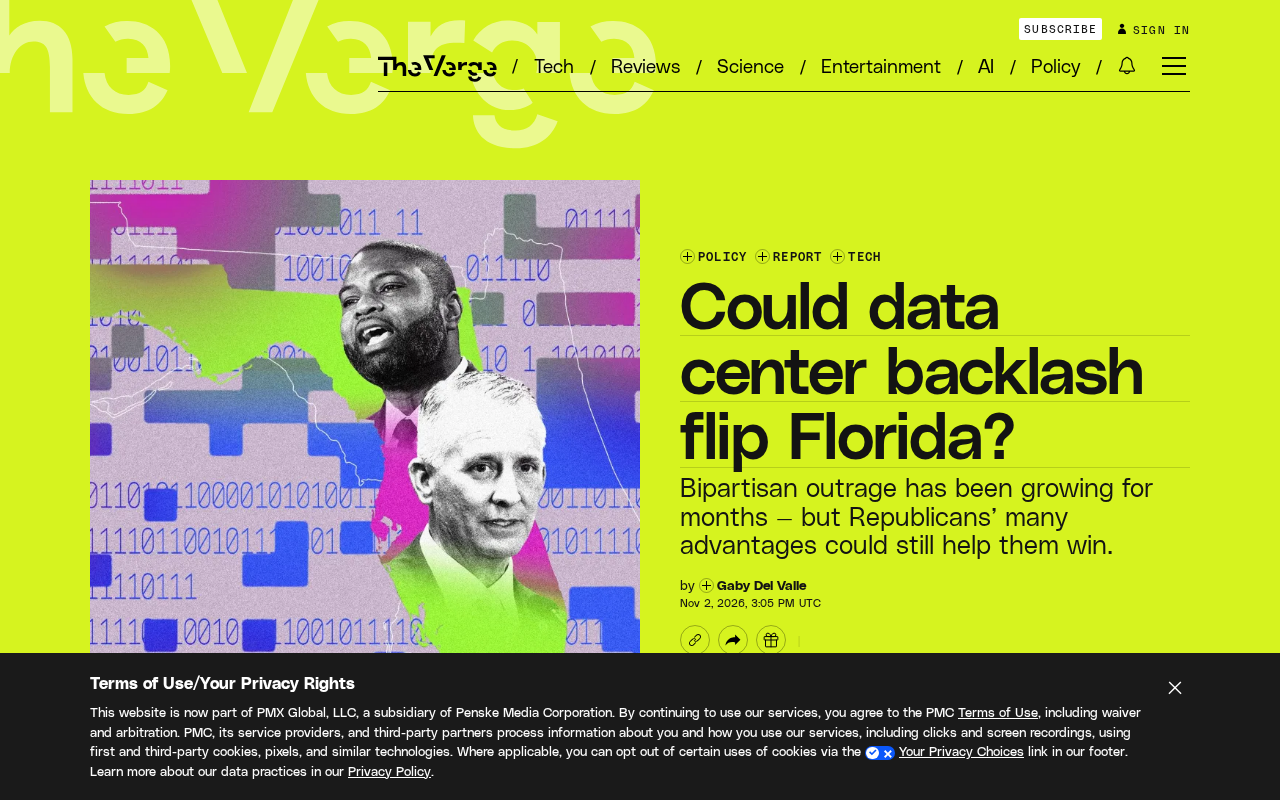
The original RSS source material cuts off here. From what is visible, the report points to a trend worth watching: community backlash triggered by data centers may be emerging as a new variable in Florida electoral politics, potentially influencing the voting behavior of some long-time Republican voters.
Why the Data Center Controversy Is Entering Electoral Politics
Data centers are the core infrastructure for AI and cloud computing, but their construction often comes with issues such as land use, power consumption, water usage, and noise. When these impacts hit specific communities, local residents—including voters who traditionally support industrial development and low-regulation policies—may push back.
The example of Zirhut in the source material shows that this backlash can be enough to make a Republican who has repeatedly supported Trump break with party voting habits and turn to independent or even Democratic candidates. This suggests that the data center issue is no longer just a matter for local planning commissions but could rise to become a factor affecting election outcomes.
Data centers are physical facilities specifically designed for centralized storage, processing, and distribution of digital information, densely packed with servers, storage devices, and networking equipment, and requiring continuous power supply and cooling. In recent years, with the explosive growth of demand for AI training and inference, cloud computing, and streaming media, the number and individual scale of hyperscale data centers have grown rapidly. Such facilities typically occupy vast areas, consume electricity comparable to tens of thousands of households, and their cooling systems also consume large amounts of water and generate continuous low-frequency noise. As a result, data center siting often sparks disputes over land use, energy quotas, water allocation, and community environment. In the United States, data center construction also involves complex processes such as local zoning approvals, tax incentive negotiations, and grid interconnection queues, and community backlash can directly affect project timelines and operating costs.
Potential Impact on the Tech Industry
If data center opposition creates electoral pressure in key states like Florida, tech companies may face stricter siting reviews, higher community engagement costs, and more complex approval processes. For AI companies relying on large-scale computing expansion, local political risk is becoming an operational variable that cannot be ignored.
Currently, the source material only provides a single voter's case and a report headline, which is not enough to judge the scale and durability of this trend. But Zirhut's "mixed ballot" at least suggests that in areas with dense data center deployment, environmental and community issues may cross traditional party lines and reshape voters' priorities.
In American politics, a "swing state" refers to a state where support for the two parties is close and election outcomes are difficult to predict in advance. Florida was once a typical swing state in presidential elections, and although it has leaned red overall in recent years, it remains competitive in local elections and on specific issues. "Party line" in electoral politics means that voters typically vote according to their party's nomination, while "independent candidates" are political figures running outside the major parties. When a single issue (such as data center siting) triggers strong community backlash, it may prompt some long-time party voters to cross party lines in local elections or support independent candidates—a phenomenon known as issue voting. For the tech industry, this means project approvals are no longer just technical or economic matters but may also be drawn into election cycles and community mobilization, increasing siting uncertainty and compliance costs.
One-line Summary
Community backlash against data centers in Florida could influence elections, prompting some Republican voters to cross party lines.
Paragraph Summary
Starting from the case of Patti Zirhut, a lifelong Republican voter in Florida who has voted for Trump multiple times but cast a "mixed ballot" this year due to community backlash over data centers—supporting Republicans as well as independent and Democratic candidates—the article notes that data centers, as core infrastructure for AI and cloud computing, are triggering local community resistance over land use, power consumption, water usage, and noise, and could rise to become an electoral issue affecting election outcomes. If this trend creates electoral pressure in key states like Florida, tech companies may face stricter siting reviews, higher community engagement costs, and more complex approval processes. However, the original source material is limited, and a single case is insufficient to judge the scale and durability of the trend.
Related articles

DeepSeek Harness in Detail: DIY Your Own Software Like Building with LEGO
What is DeepSeek Harness? Using the metaphor of a car assembly platform, this article explains this equipment system of freely combinable functional modules, analyzes its spatiotemporal composability technical foundation, and shows how ordinary users can DIY exclusive software that does not exist on the market at extremely low cost.

DeepSeek Harness Step-by-Step Tutorial: Master DSH and Its Plugin Ecosystem in 50 Minutes
DeepSeek Harness step-by-step install tutorial: from Node.js environment setup to client installation, covering three plugin install methods — chat, marketplace, and command line — plus practical uses of local file access and plugin extensions.

DeepSeek Open-Sources Super-agent Architecture: A Turning Point for Proactive AI
DeepSeek's open-source Super-agent architecture proposes a new proactive AI paradigm: a central Agent dispatches tasks, sub-Agents execute autonomously, and humans only decide and accept. This article analyzes the watershed between passive and proactive AI, and the implementation logic of proactive Agents in scenarios like short-video lead generation.