Data Centers Flood into Rural America: Industrial Transformation and Community Tensions in the AI Boom

AI computing demand drives data centers into deindustrialized rural America, bringing capital but not jobs.
As AI computing demand explodes, American tech giants are shifting data center site selection toward rural areas with abundant land and cheap electricity. The conversion of a closed paper mill in Jay, Maine into a data center represents the broader trend of industrial transformation from traditional manufacturing to tech infrastructure. However, the capital deepening characteristic of data centers means a factory that once employed 1,500 people requires only dozens of staff after conversion — bringing tax revenue and capital inflows but struggling to truly solve rural employment and economic revival challenges.
From Paper Mills to Data Centers: Rural America's Industrial Transformation
In Jay, Maine — a rural town about 67 miles northwest of Portland — the former Androscoggin paper mill employed roughly 1,500 workers at its peak. However, in 2020, a pulp digester exploded, forcing the plant to permanently close. In 2023, the 1.4-million-square-foot facility was acquired through a joint venture by JGT2 Redevelopment and its partners.
The Androscoggin paper mill's history dates back to the late 19th century. The Androscoggin River basin in Maine, blessed with abundant hydropower and timber resources, was once one of North America's most important papermaking regions. The paper industry is a classic resource-intensive heavy industry, dependent on large quantities of wood pulp, water, and energy. Once established, these factories became deeply intertwined with their local communities. The systematic decline of the American paper industry began in the early 2000s, as China's large-scale entry into global paper markets under the WTO framework drove down prices worldwide, while the "paperless office" wave brought by internet adoption continuously eroded demand from the consumption side. The 2008 financial crisis further accelerated industry consolidation, with numerous small and medium-sized mills closing over the following decade.
The fate of the Androscoggin paper mill was no accident. Since the 2000s, traditional papermaking towns across the American Northeast have fallen into distress due to the impact of low-cost Chinese paper imports, declining paper demand from digital office adoption, and persistently rising energy costs. Maine, upstate New York, Wisconsin, and other traditional paper belt regions lost tens of thousands of manufacturing jobs. This wave of deindustrialization caused not only economic losses but profoundly affected community identity — many small towns had long built their economic and cultural lives around a single factory, and a plant closure often meant the collapse of an entire community ecosystem. Jay's case is thus highly representative: it's not an isolated incident but rather a microcosm of the Rust Belt extending into the Northeast.
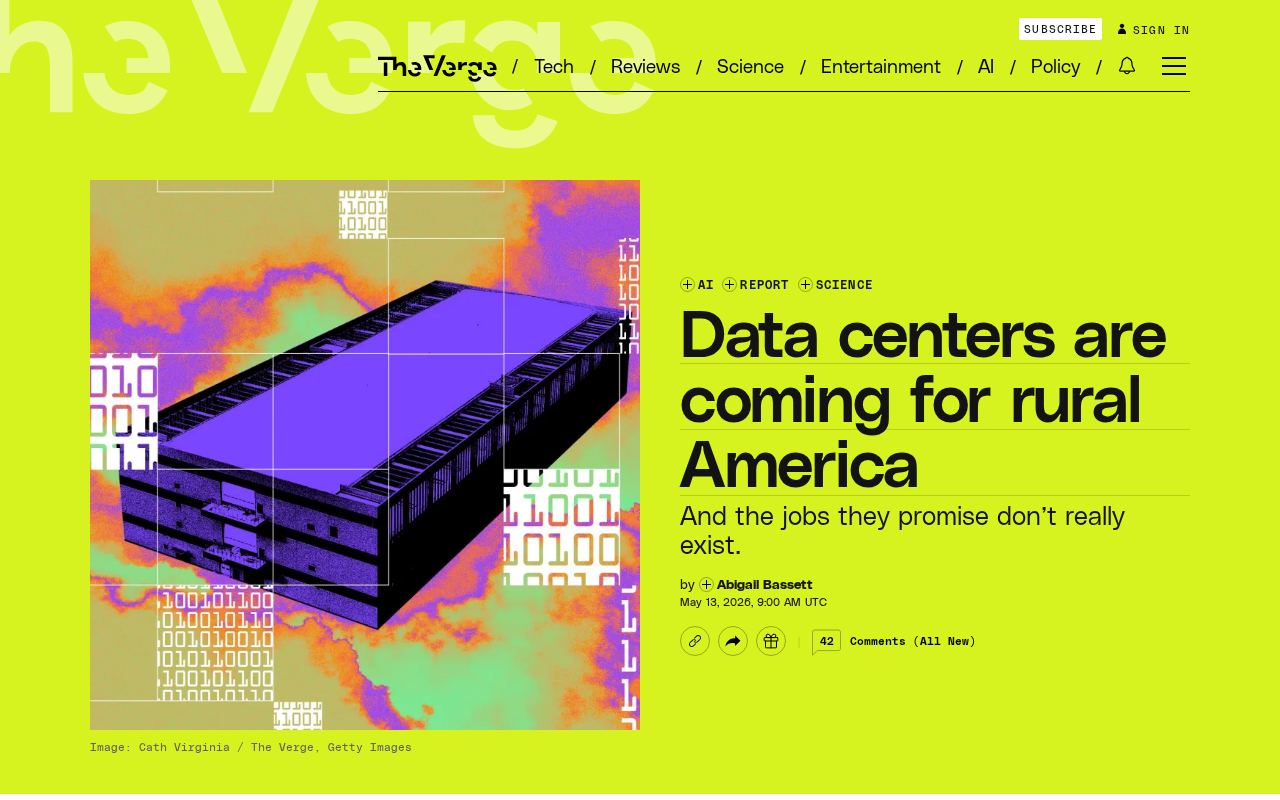
This case reflects a trend accelerating across rural America — data centers are entering rural communities that were once dominated by traditional manufacturing and agriculture on a massive scale.
The AI Computing Demand Explosion: Why Data Centers Are Targeting Rural Areas
With the explosive growth of artificial intelligence, tech giants like Microsoft, Google, Amazon, and Meta are seeing exponential increases in computing demand. Land, power, and water resources in urban areas and their surroundings are becoming increasingly strained, forcing companies to look toward more remote regions.
The scale of computing power required for AI large model training and inference far exceeds public intuition. Taking GPT-4-class large language models as an example, a single complete training run consumes computing power equivalent to thousands to tens of thousands of A100 GPUs running continuously for months, with energy consumption reaching tens of gigawatt-hours (GWh). The International Energy Agency (IEA) 2024 report predicts that global data center electricity consumption will double by 2026, with AI workloads being the primary source of incremental demand. Microsoft, Google, Amazon, and Meta collectively announced more than $200 billion in data center capital expenditure in 2024. Driving this demand are not just conversational AI applications, but also AI video generation, drug discovery, autonomous driving model training, and large-scale deployment of enterprise AI assistants. Computing infrastructure has evolved from an internal cost center for tech companies into a strategic asset that determines the competitive landscape of AI.
Data centers are essentially physical facilities that centrally deploy servers, storage equipment, and networking equipment at massive scale. Their site selection logic is determined by several hard constraints. Hyperscale data centers are a new generation of infrastructure designed specifically for cloud computing and AI workloads, fundamentally different from traditional enterprise data centers in both scale and architecture. These facilities typically employ modular designs, scaling horizontally using standardized "data halls" as basic units, with a single campus capable of housing hundreds of thousands of servers. A hyperscale data center typically has a power capacity between 100 and 500 megawatts — equivalent to the electricity needs of a mid-sized city — and therefore must be located near high-capacity grid connection points.
Cooling systems are one of the most critical engineering challenges for hyperscale data centers: traditional air-cooling solutions maintain server room temperatures through large numbers of air conditioning units, while next-generation liquid cooling solutions direct coolant directly into server racks or even onto chip surfaces, reducing PUE (Power Usage Effectiveness) from above 1.5 in traditional setups to near 1.1. Water cooling tower solutions rely on evaporative heat dissipation, consuming thousands of gallons of fresh water per day for every megawatt of power consumed, giving water-rich regions a significant advantage in site selection competition. Fiber optic network latency constraints on data center siting are gradually weakening — for batch processing workloads like AI model training, network latency of hundreds of milliseconds does not constitute a substantive barrier, providing a feasibility basis for remote area site selection.
Rural areas happen to possess several key conditions required for data center siting:
- Large tracts of available land: Abandoned factories, farms, and undeveloped land provide ample construction space
- Relatively cheap electricity: Some areas are located near hydroelectric stations or renewable energy facilities
- Abundant water resources: Water supply for cooling systems
- Relaxed regulatory environments: Compared to urban areas, approval processes are more streamlined
Hopes for Economic Revival vs. the Reality of High Investment, Low Employment
For communities like Jay that have experienced the pain of deindustrialization, the arrival of data centers is seen as an opportunity for economic revival. Abandoned industrial facilities find new purpose, local governments can receive tax revenue, and the construction phase brings some employment opportunities.
However, data centers differ fundamentally from traditional manufacturing. A paper mill that once employed 1,500 people may require only a few dozen employees for long-term operations after being converted into a data center. This "high investment, low employment" characteristic is not a subjective corporate choice but a structural phenomenon determined by the technical nature of data centers. A data center with a $1 billion investment occupying hundreds of thousands of square feet typically requires only 50 to 200 full-time employees during stable operations, primarily including network engineers, security personnel, and facilities maintenance staff. Server deployment, monitoring, and troubleshooting rely heavily on remote management software, with physical operations compressed to a minimum.
The economic concept of "capital deepening" describes the trend where capital input relative to labor input continuously increases in production processes, resulting in ever-rising amounts of capital allocated per unit of labor. Labor productivity rises, but job growth is limited or even declines. Data centers are an extreme case of capital deepening: their core assets are high-value hardware such as servers, storage arrays, network switches, and cooling equipment, rather than human capital. Data center operations are highly dependent on automated monitoring systems — thousands of parameters including temperature, humidity, power load, and network traffic are monitored in real-time by software, with anomalies pushed to remote engineers via alert systems, and physical inspection frequencies kept extremely low. This technical characteristic determines data centers' inherent limitations in creating direct employment. However, supporters point out that indirect economic effects cannot be ignored: engineering contracts during construction, equipment procurement, local supply chains, and improvements in public services from tax revenue may produce multiplier effects several times greater than direct employment. Nevertheless, the distribution of these indirect benefits is often uneven and shrinks significantly after the construction phase ends.
Related articles
Meta Muse Hits 900K Downloads in Six D…
Meta Muse Hits 900K Downloads in Six Days: The AI Agent Era Has Officially Arrived
Meta's AI agent Muse hit 902K downloads in 6 days, topping US App Store and Google Play charts above ChatGPT and Claude. A deep dive into Muse's capabilities and the AI Agent race.
 Industry Insights
IRS Fully Embraces Claude AI, Accelerating Federal Government's AI Adoption
The IRS is recruiting staff with 24/7 Claude AI access, marking Anthropic's breakthrough into the federal government. Explore the strategic implications and tax use cases.
 Industry Insights
The IRS Mobile App Debate: A Trust Crisis in Government Digital Transformation
The IRS's proposed mobile app has sparked heated debate. This article analyzes the core arguments, exploring data security, privacy, and the trust crisis in government digital transformation.