Data Fusion Tackles Measurement Error: A Deep Dive into the Fuse-EIV Method

Fuse-EIV corrects measurement error in target studies by borrowing repeated measurements from heterogeneous external populations.
Fuse-EIV is a data fusion method for the errors-in-variables (EIV) problem, designed for settings where the target study has only a single error-prone proxy measurement while an external heterogeneous population provides repeated measurements. Its theoretical foundation is a conditional transportability assumption that enables legitimate use of external repeated measurements even when the two populations differ in distribution and errors are heteroscedastic. The estimator combines conditional deconvolution, flexible nuisance estimation, and orthogonal correction inspired by double/debiased ML. A unified spectral theory covers both diffuse- and finite atomic-spectrum target functionals. NHANES analysis shows that accounting for population heterogeneity and error heteroscedasticity materially changes empirical conclusions.
The Real-World Challenge of Measurement Error
In epidemiology, economics, and public health research, investigators frequently encounter a frustrating obstacle: the variable they actually want to study — the exposure of interest — cannot be directly observed. All they have are error-prone proxy measurements. Dietary intake, long-term blood pressure levels, environmental pollution exposure — these are often approximated through one-time questionnaires or single-point tests. When the "errors-in-variables" (EIV) problem is handled poorly, regression coefficient estimates become systematically biased, distorting the ultimate scientific conclusions.
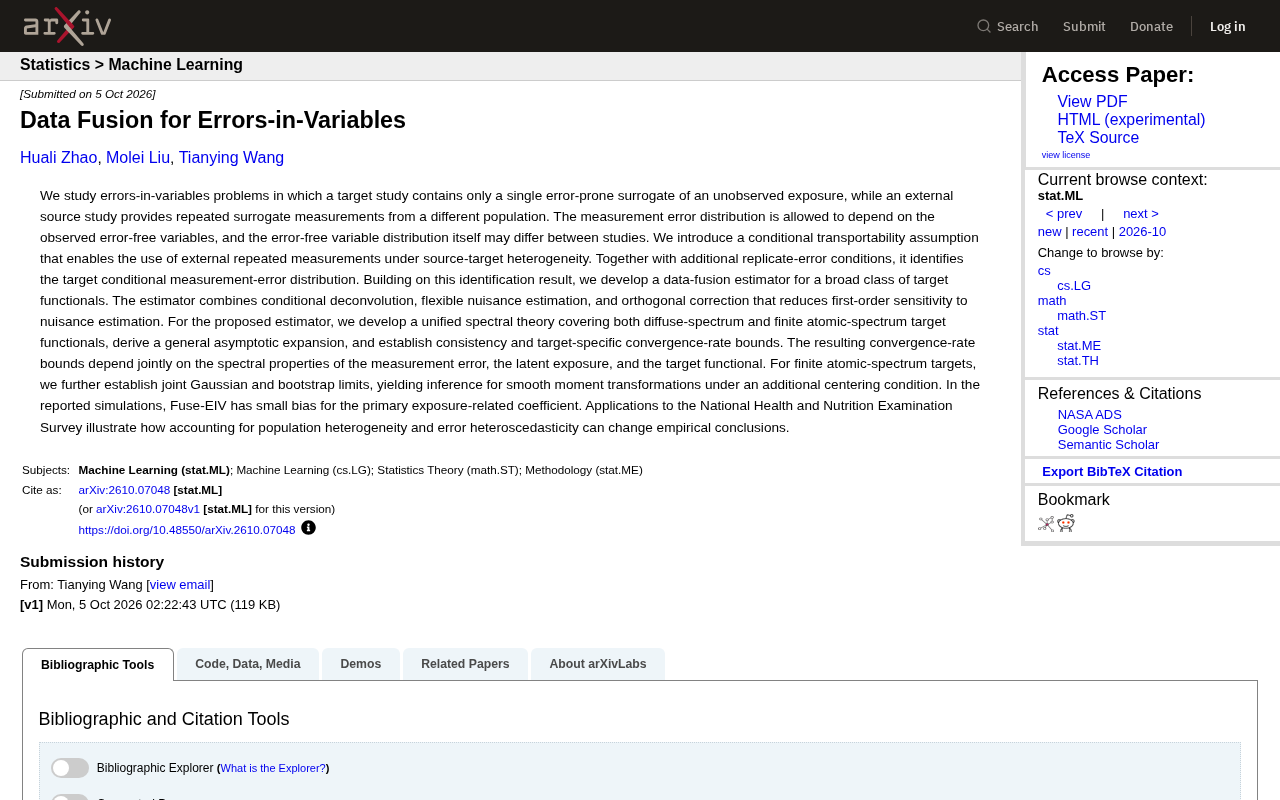
A new study posted on arXiv (arXiv:2610.07048) proposes a data fusion method called Fuse-EIV to address this challenge. Its core scenario is highly relevant in practice: each individual in the target study has only a single error-prone proxy measurement, while an external source study drawn from a different population provides repeated measurements. The key question is how to leverage those external repeated measurements to correct for measurement error in the target study.
Conditional Transportability: The Key Assumption for Cross-Population Borrowing
One of the most valuable contributions of this work is its honest acknowledgment that the two studies come from different populations. Traditional error-correction methods typically assume that external validation samples are drawn from the same distribution as the main study. In reality, external data often come from a different group — the distribution of the error-free variable itself may differ, and the distribution of measurement error may depend on those observable error-free variables (i.e., heteroscedastic errors).
The paper introduces a conditional transportability assumption that permits the legitimate use of external repeated measurements even when the source and target populations are heterogeneous. Combined with an additional repeated-error condition, this assumption enables identification of the conditional measurement error distribution in the target population. This is the theoretical cornerstone of the entire estimation framework — without identifiability, estimation and inference are impossible.
Transportability is a systematic framework in causal inference for handling mismatches between a study population and the target population, developed by Pearl, Bareinboim, and others in the early 2010s. The fundamental question is: under what conditions can a causal effect or distributional feature estimated in the source population be legitimately "transported" to the target population? General transportability relies on explicitly modeling selection differences between the two populations on observable covariates, and eliminating distributional shifts through reweighting or regression adjustment. The "conditional transportability assumption" in Fuse-EIV is a tailored application of this idea to the measurement error setting: it does not require the two populations to share the same exposure distribution. Instead, it assumes that, conditional on observable error-free covariates, the mechanism generating measurement error is consistent between source and target populations — allowing repeated measurements from the source to inform the conditional error distribution in the target. This assumption is considerably weaker than full distributional equivalence, but still requires researchers to carefully evaluate its plausibility in each specific context.
Three Technical Pillars of the Estimator
Building on the identification result, the authors construct a data fusion estimator applicable to a broad class of target functionals. It integrates three key technical components:
Conditional deconvolution: Recovering the true distribution of the latent exposure from the observed, error-contaminated distribution.
Flexible nuisance estimation: Allowing the use of modern machine learning and other flexible methods to estimate intermediate quantities, rather than relying on rigid parametric models.
Orthogonal correction: Reducing the first-order sensitivity of the estimates to errors in nuisance parameter estimation. This approach is in the same spirit as the recently developed double/debiased machine learning (double/debiased ML) framework — it allows the estimator to retain good properties even when nuisance parameters converge slowly.
Double/Debiased Machine Learning is an important advance at the intersection of econometrics and statistics, systematically formalized by Chernozhukov and colleagues in 2018. Its central insight is this: when estimating a target parameter that depends on several nuisance parameters (such as conditional mean functions or propensity scores), naively plugging machine-learning estimates of those nuisance parameters into the target estimand causes bias to accumulate in hard-to-control ways. Double/debiased ML addresses this by constructing estimation equations that are "Neyman orthogonal" with respect to the nuisance parameters, reducing the bias of the target parameter estimate from linear dependence on nuisance estimation error to quadratic dependence. This allows nuisance parameters to converge at slower rates while the target parameter still achieves parametric-rate convergence and satisfies a central limit theorem. The orthogonal correction in Fuse-EIV draws directly on this framework, ensuring that even when flexible machine learning methods are used in intermediate steps like conditional deconvolution, the final functional estimate retains reliable statistical properties.
A Unified Spectral Theory and Convergence Rates
On the theoretical side, the paper develops a unified spectral theory covering both "diffuse-spectrum" and "finite atomic-spectrum" target functionals. The authors derive general asymptotic expansions and establish consistency as well as convergence rate bounds tailored to specific targets.
Notably, these convergence rate bounds are not determined in isolation — they jointly depend on the spectral properties of three components: the measurement error itself, the latent exposure, and the target functional. This means that estimation difficulty is governed by the overall structure of the problem, not any single factor. For finite atomic-spectrum targets, the authors further establish joint Gaussian limits and bootstrap limits, providing workable statistical inference tools for smooth moment transformations under additional centering conditions.
Spectral methods in the measurement error literature rest on a key observation: the characteristic function of an error-contaminated observed variable equals the product of the characteristic functions of the true variable and the error. Consequently, the deconvolution problem in the frequency (Fourier) domain reduces to a division operation, and its difficulty depends directly on the decay rate of the error distribution's characteristic function — the faster the decay (as with supersmooth errors), the harder identification and estimation become. The distinction between "diffuse-spectrum" and "finite atomic-spectrum" corresponds to how a target functional's energy is distributed in the frequency domain: finite atomic-spectrum targets (such as moments of finite mixture distributions) depend on information at only finitely many frequency points, enabling more refined theoretical analysis and joint Gaussian limits; diffuse-spectrum targets require integration over a continuous range of frequencies, with convergence rates often constrained by the degree of supersmoothness of the error. The contribution of this unified framework is to bring what would otherwise require case-by-case treatment under a single theoretical umbrella, yielding comparable rate bounds across settings.
Simulations and Empirical Results: Why Heterogeneity Matters
Beyond theory, the paper uses simulation experiments to validate the method's performance: Fuse-EIV exhibits small bias in estimating the primary exposure-related coefficients, confirming that the error correction is effective.
Even more compelling is the application to data from the National Health and Nutrition Examination Survey (NHANES). The study demonstrates that empirical conclusions change meaningfully once population heterogeneity and error heteroscedasticity are properly accounted for in the analysis. This is particularly important for applied researchers — it signals that ignoring differences between the external data population and the main study population, or assuming constant error variance, can introduce systematic bias into conclusions.
Implications for Empirical Research
Fuse-EIV represents a pragmatic direction in the intersection of causal inference and measurement error correction: rather than demanding the idealized assumption that external data perfectly match the main study, it designs an estimable, identifiable, and inferentially valid framework that explicitly accommodates heterogeneity. For the large class of observational studies that rely on proxy measurements and can only draw on heterogeneous external datasets, this type of approach offers a more robust analytical path.
It is worth noting that this is a theoretically demanding statistical methodology paper. Practical implementation still requires researchers to have the appropriate modeling expertise and to carefully verify whether key assumptions — such as conditional transportability — are plausible in their specific context.
Related articles

JobRunner MCP Server: AI Agents Can Now Fix Failed Java Jobs
JobRunner launches an open-source MCP server enabling AI agents to view cluster status, diagnose failures, and recover Java jobs—incident response from any cloud coding environment or existing agent.

MLAI Digital Launches 9 Security Agents: MCP Server Safeguards the Full Lifecycle of Agentic AI
MLAI Digital launches Security MCP Server with nine built-in specialized security agents covering vulnerability discovery, attack simulation, prompt injection detection, API and infrastructure assessment, and accelerated remediation—embedding security validation across the full Agentic AI lifecycle from development to production.

Running Isaac Lab on H100 GPUs: Exploring Better Approaches
Exploring optimization methods for running Isaac Lab on NVIDIA H100 GPUs, including MIG configuration, mixed precision, TensorRT acceleration, and community experience to improve robotics simulation and reinforcement learning efficiency.