Databricks and SAP Join Forces: End-to-End Data and AI Capabilities Aim to Solve Enterprise Transformation Challenges

Databricks and SAP join forces to connect business data with AI development pipelines, competing for the enterprise AI infrastructure entry point.
The article notes that enterprise AI's bottleneck has shifted from model capability to the disconnect between data and business. Databricks and SAP have partnered to shorten that pipeline with end-to-end data and AI capabilities. SAP provides the data foundation and process semantics of enterprise business systems, while Databricks offers lakehouse, model training, and deployment capabilities, aiming to build AI directly on real business data and reduce data movement and 'translation.' The article argues the real barrier to enterprise AI transformation lies in engineering issues like data permissions, compliance auditing, and model governance, and the partnership is essentially a contest over the right to define enterprise AI infrastructure. However, the announcement discloses limited detail on product forms and rollout timelines, so implementation results remain to be seen.
Enterprise AI's bottleneck is no longer model capability—it's the disconnect between data and business. Databricks and SAP have announced a partnership aimed at bridging this gap with end-to-end data and AI capabilities.
Strong Models, Distant Business
Today's AI models are more powerful than ever, yet they still lack a genuine understanding of business. This is the core contradiction highlighted at the opening of the Databricks-SAP partnership announcement. Models can write code, summarize, and generate reports, but they often fail to answer a simple question: what does this decision actually mean in the context of a company's real data?
The root of the problem isn't algorithms—it's the data pipeline. A company's most critical operational data is typically buried in ERP, finance, and supply chain systems, while the feature engineering, vectorization, and experiment management required for AI training and inference happen in an entirely different tech stack. Moving, cleaning, and aligning data between these two systems consumes enormous engineering resources and makes it hard for AI projects to move from demo to production.
The Databricks-SAP partnership is aimed squarely at shortening that pipeline.
ERP (Enterprise Resource Planning) is one of the most critical business systems in any enterprise, typically covering finance, procurement, production, inventory, and sales modules, centralizing the transactions and master data generated by day-to-day operations. SAP is one of the world's leading ERP vendors, and its systems hold vast amounts of business-semantically rich data—entity relationships among customers, materials, orders, and cost centers, for example. This data is characterized by rigorous structure and consistent definitions, but it is often scattered across multiple modules and years of history, requiring complex extraction and alignment before it can be used for AI training. Precisely because ERP data carries the real operating logic of the enterprise, whether AI can understand it directly determines whether model outputs can feed into business decisions—this is the technical backdrop for the "distant business" observation.
What End-to-End Capabilities Actually Mean
In this context, "end-to-end" refers to the complete path from business data generation through data governance and model development to AI application deployment. SAP provides the data foundation and business process semantics of enterprise-grade business systems, while Databricks provides the lakehouse, model training, and AI deployment capabilities. Together, they point toward building enterprise AI capabilities directly on real business data—not on copies that have gone through multiple rounds of export.
The value of this approach lies in reducing the "data translation" layer. When AI systems can directly understand entity relationships and process semantics in business systems, the interpretability and actionability of model outputs improve accordingly. For large enterprises long plagued by data silos, this is more practically meaningful than swapping in yet another stronger model.
A data lakehouse is an architecture that combines the open storage of a data lake with the management and query capabilities of a data warehouse. Data lakes excel at storing raw, diverse, low-cost massive data, while data warehouses excel at structured queries and transactional consistency; the lakehouse attempts to satisfy both on a single platform, supporting SQL analytics, machine learning, and stream processing. Databricks is one of the primary drivers of the lakehouse architecture. For enterprise AI, the significance of the lakehouse is that it reduces the repeated movement of data between the warehouse and the machine learning platform, allowing feature engineering, model training, and inference to use the same governed data nearby—this is the key technical premise for understanding the two companies' "end-to-end" proposition.
The Real Barrier to Enterprise AI Transformation
The phrase "level up enterprise AI transformation" in the announcement title deserves a closer look. The hard part of enterprise AI transformation has never been purchasing a tool—it's embedding AI into existing business processes and governance frameworks. Data permissions, compliance auditing, cost attribution, model version management—these seemingly mundane engineering issues are what determine whether AI projects can scale.
The Databricks-SAP partnership is fundamentally a contest over the right to define enterprise AI infrastructure. Whoever holds both ends—business data and AI development—has a better chance of becoming the default entry point for enterprise AI transformation. This judgment matters more for understanding why the two companies are joining forces now than the partnership details themselves.
Metadata is data about data, including table structures, field meanings, data lineage, update frequency, ownership, and access policies. In enterprise systems, metadata integration means the AI platform can recognize business entities and their relationships in SAP systems, rather than just seeing isolated tables. Permission model alignment involves mapping row-level and column-level access controls to business roles, ensuring AI applications don't access sensitive data beyond their authority. These two engineering efforts determine whether "end-to-end" can move from demo to production, and they represent the most easily underestimated implementation challenges behind the capability descriptions in the announcement.
Implementation Still Needs Watching
It's worth noting that the original announcement offers limited detail on specific product forms, integration depth, and rollout timelines, remaining largely at the level of capability direction. Whether the promise of end-to-end data and AI capabilities can be fulfilled depends on actual progress at the engineering level—metadata integration, permission model alignment, and hybrid cloud deployment. When evaluating, enterprise users should focus on verifiable integration capabilities rather than the wording of the partnership announcement.
For enterprises currently advancing AI implementation, the signal from this partnership is clear: the center of gravity in AI competitiveness is shifting from the model layer to the data and business layer. When choosing a tech stack, the completeness of the data pipeline deserves as much weight as model capability.
One-line Summary
Databricks and SAP join forces to connect business data with AI development pipelines, vying for the enterprise AI infrastructure entry point.
Paragraph Summary
The article notes that the bottleneck in enterprise AI has shifted from model capability to the disconnect between data and business. Databricks and SAP have announced a partnership aimed at shortening that pipeline with end-to-end data and AI capabilities. SAP provides the data foundation and process semantics of enterprise business systems, while Databricks provides lakehouse, model training, and deployment capabilities, with the goal of building AI directly on real business data and reducing data movement and "translation." The article argues that the real barrier to enterprise AI transformation lies in engineering issues such as data permissions, compliance auditing, and model governance, and that the partnership is fundamentally a contest over the right to define enterprise AI infrastructure. However, the announcement discloses limited detail on product forms and rollout timelines, so implementation results remain to be seen.
Related articles

VERS: Editing Activation Explanations to Halve Reasoning Model Tokens
VERS guides reasoning models by editing activation explanations, cutting 45.8% of tokens on GSM8K with only a 0.82 pp accuracy drop and transferring to larger models, but losing accuracy on competition problems.

Finding Errors Is Not Enough: Selective Model Escalation for Entity-Targeted Sentiment Analysis
This study explores selective model escalation for entity-targeted sentiment analysis, comparing data collection ordering, uncertainty-driven re-examination, and model routing—finding that minority-class priority only helps at very small data volumes, the oracle upper bound far exceeds actual gains, and escalation must be tailored to each dataset.
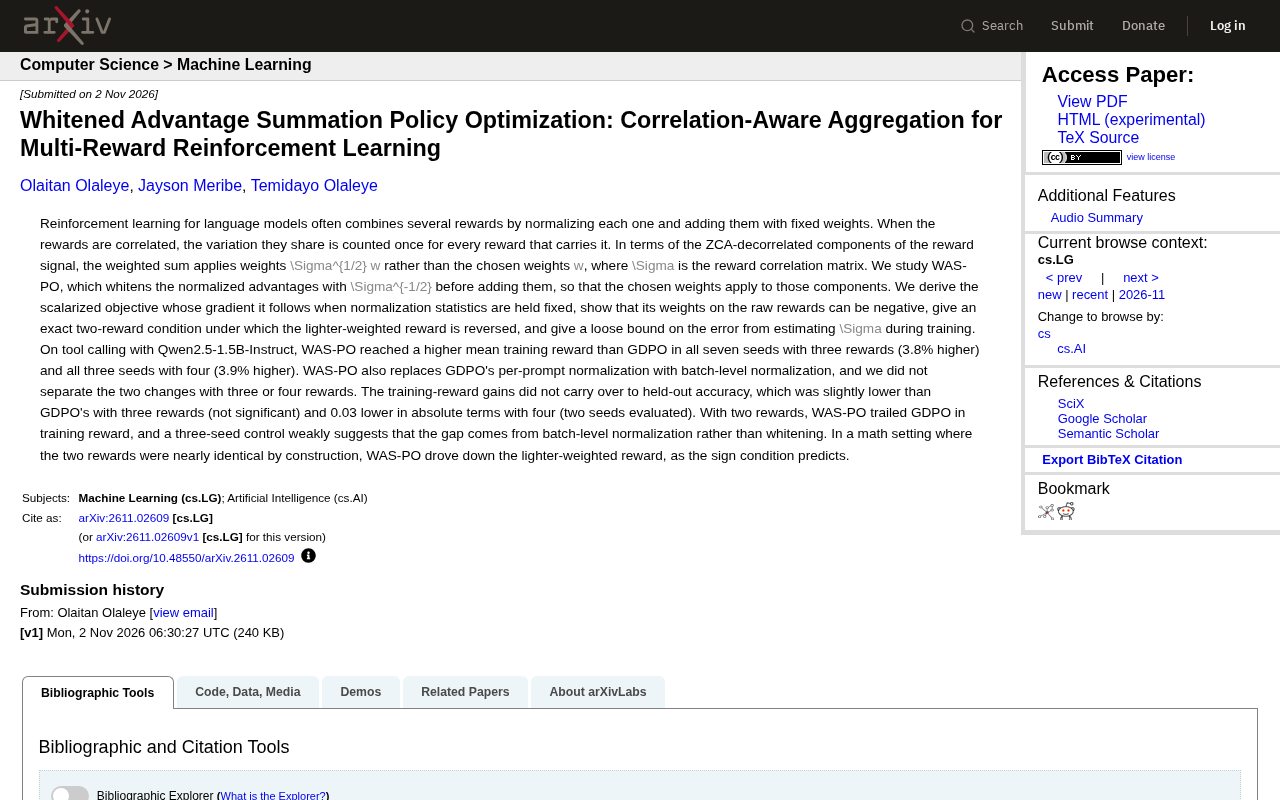
WAS-PO: Using Whitened Advantages to Solve the Correlation Trap in Multi-Reward Reinforcement Learning
WAS-PO paper proposes whitening advantages to correct correlation bias in multi-reward RL: when rewards are correlated, naive weighted summation effectively applies Σ^{1/2}w instead of w. Experiments show training reward improves steadily, but held-out accuracy does not improve in sync, and under two rewards it actually falls behind.