Databricks Lights Up Nasdaq Tower Screen: What Signals Does the First AI 100 List Send?
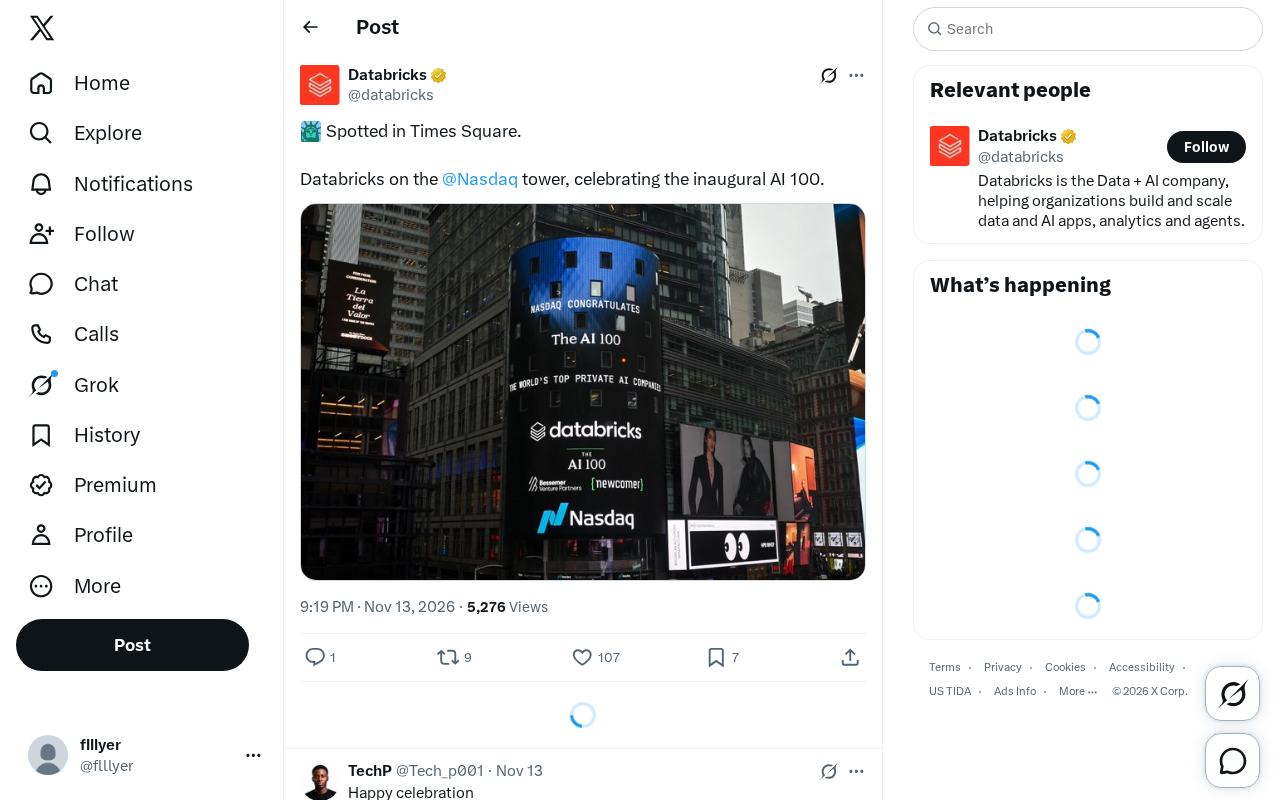
Databricks on the Nasdaq big screen reflects a new dynamic of mutual leverage between exchanges and AI companies.
The article uses Databricks appearing on the Nasdaq Tower screen to celebrate the first "AI 100" list as an entry point to analyze the industry implications. Nasdaq's AI 100 list aims to seize the narrative power of "defining leading companies" in the AI wave and gain an early edge in future listing resource competition; for data and AI platform companies like Databricks, the Times Square screen is a low-cost, high-exposure brand move with social传播 leverage. The article notes that AI infrastructure competition has extended from product features to ecosystem positioning and standard definition. Third-party lists lower the cognitive cost of vendor selection and investment screening, but their credibility depends on transparent criteria. The original information does not disclose selection dimensions or the full list, so it is better viewed as a signal than a conclusion.
Is the Times Square billboard becoming AI companies' "IPO preview"?
The news of Databricks appearing on the Nasdaq Tower screen has been circulating on social platforms, celebrating the first "AI 100" list launched by Nasdaq. No product launch, no funding figures—yet a single billboard has sparked discussion in tech circles. When a data and AI platform company chooses to appear on Nasdaq's landmark screen, the message it conveys may go far beyond brand marketing.
The information from social platforms is itself very brief, but it offers a window for observation: AI companies are using traditional financial landmarks to endorse themselves, while exchanges are actively courting the AI sector.
Why Nasdaq, and why "AI 100"
Nasdaq has long been the preferred destination for tech company IPOs, from early semiconductor companies to later internet giants—its brand image is deeply tied to "tech growth." Launching the "AI 100" list is essentially a way for the exchange to seize narrative power in the AI wave—whoever can define the "AI leaders" can gain the upper hand in the competition for future listing resources.
For Databricks, appearing on the Nasdaq screen is a low-cost, high-exposure brand move. Times Square screens are photographed daily by throngs of tourists and media, and the leverage of social传播 is obvious. The spread path of this tweet confirms this: a photo plus a sentence is enough to spark conversation in tech communities.
It should be noted that this information only shows the celebration itself and does not disclose the AI 100 selection criteria, the complete list, or the specific reasons for Databricks' inclusion. Therefore, it is more appropriate to understand it as a "signal" rather than a "conclusion."
Who is Databricks
Databricks was founded in 2013 by the original creators of Apache Spark. Its core product is the cloud-based "Lakehouse" architecture, which combines the flexibility of data lakes with the structured management capabilities of data warehouses. In recent years, it has integrated machine learning and generative AI capabilities into data processing and model training workflows, serving primarily enterprise customers that need to process massive amounts of data. It has long been regarded as one of the most closely watched private tech companies, with substantial funding—so its every public move is easily interpreted by the market as a signal related to IPO timing. Understanding this background helps explain why "appearing on the Nasdaq screen" triggers additional associations.
Competition among data and AI platforms has entered the "standard-setting" stage
Databricks' core business revolves around the data lakehouse and machine learning platform, and in recent years it has continuously embedded AI capabilities into data processing workflows. The significance of such companies participating in industry rankings is that competition at the AI infrastructure layer is no longer limited to product feature comparisons but extends to the battle for ecosystem positioning and industry narrative power.
When a company is included in a list like "AI 100," it gains not only exposure but also an implicit industry positioning—being placed in the sequence of "AI players worth watching." For enterprise customers, such third-party labels reduce the cognitive cost of vendor selection; for investment institutions, the list provides a quick reference framework for screening.
However, the credibility of a ranking depends on whether the criteria are transparent. The original information provides no details on any selection dimensions, which is a common information gap in such lists: the celebration is loud, but the methodology is often vague. When readers see similar news, it is worth asking one more question: "Selected according to what criteria?"
What is a data lakehouse (Lakehouse)
A data lakehouse is a technical approach that merges two architectures: the "data lake" and the "data warehouse." A data lake can store raw data in any format at low cost but lacks schema management and query performance; a traditional data warehouse offers fast queries and strong governance but is costly and format-restricted. The lakehouse architecture introduces transactions, schema constraints, and index optimization on top of open file storage, enabling the same data to be used both for BI analysis and directly for machine learning training. The significance of this architecture lies in reducing the movement and duplication of data between warehouses and models, which is why it is regarded as a key component of AI data infrastructure and the core battleground for related platform companies.
Why third-party rankings influence enterprise selection
Enterprise software procurement typically involves multiple departments and long decision cycles. Under information asymmetry, buyers tend to rely on external signals to narrow the candidate pool—analyst reports, industry rankings, and peer case studies are all such "cognitive shortcuts." Being included in a list backed by an exchange or a well-known institution is equivalent to obtaining a low-cost trust label, reducing the explanation cost at first contact. However, the effectiveness of such labels depends heavily on the transparency of the selection methodology: if the criteria are unverifiable, the list easily degrades into marketing material, and its screening value diminishes over time.
Exchanges and AI companies leveraging each other
Through programs like AI 100, Nasdaq is positioning itself as the "official stage" of the AI economy. This is consistent with its past positioning in tech IPOs but more proactive: rather than simply waiting for companies to list, it intervenes in the industry narrative in advance.
For AI companies, aligning with an exchange brand also has practical considerations. Tech companies need to build capital market awareness before going public, and appearing on the Nasdaq Tower is a lightweight form of pre-communication. Whether Databricks' move this time is related to listing plans is not mentioned in the original information and should not be over-interpreted; but by industry convention, such exposure typically serves brand building and capital market relationship maintenance.
Why exchanges intervene in industry narratives in advance
The core business model of a stock exchange is to attract quality companies to list and maintain trading activity, and its pipeline of listed companies depends largely on its coverage of high-growth sectors. In the tech industry, Nasdaq has long positioned itself as the "preferred choice for tech companies," but as other exchanges around the world introduce relaxed listing rules for tech enterprises, competition for listing resources has intensified. Establishing brand associations with potential listing candidates in advance through rankings, indices, and industry events is essentially a low-cost means of relationship maintenance and market education: it strengthens the exchange's industry narrative power while bringing yet-to-list companies into the capital market's view early.
An industry slice worth watching
This piece of news carries limited information, but it reflects several realities of the AI industry: leading companies are competing for the opportunity to be "defined," exchanges are competing for dominance of the AI narrative, and dissemination on social platforms further amplifies this symbolic meaning. For those following the AI industry, rather than remembering the name of the list, it is more valuable to observe whether such rankings subsequently publish verifiable criteria and whether the selected companies truly achieve differentiation in technology and business.
A Times Square screen will not change a company's fundamentals, but it can indeed change the market's allocation of attention to that company. In today's increasingly crowded AI competition, attention itself is a resource.
One-line Summary
Databricks appearing on the Nasdaq big screen reflects a new dynamic of mutual leverage between exchanges and AI companies.
Paragraph Summary
The article takes Databricks appearing on the Nasdaq Tower screen to celebrate the first "AI 100" list as an entry point to analyze the industry implications behind this scene. Nasdaq's launch of the AI 100 list is intended to seize the narrative power of "defining leading companies" in the AI wave, thereby gaining an early advantage in the competition for future listing resources; for data and AI platform companies like Databricks, the Times Square screen is a low-cost, high-exposure brand move with social传播 leverage. The article points out that competition at the AI infrastructure layer has extended from product features to ecosystem positioning and standard definition. Third-party lists can reduce the cognitive cost of enterprise vendor selection and investment screening, but their credibility depends on whether the selection criteria are transparent. The original information does not disclose the selection dimensions or the complete list, so it is more appropriate to view it as a signal rather than a conclusion.
Related articles

Inside Honey Trap Training: Emotional Dissociation and Anchoring Techniques
How are spies trained for honey trap missions? A trainee reveals emotional dissociation, perfume and keyword anchoring, and target photo binding—psychological techniques that condition reflexes for intelligence work.

Frontier AI Risk Management: Full-Pipeline Practices from Training to Deployment
OpenAI outlines a frontier AI risk management framework: from training-stage model alignment to deployment-stage sandboxing and blocking safeguards, plus post-deployment monitoring—a layered risk control system across the model lifecycle.
DaisyRose-27B: 1,200-Task RL Boosts Qwen3.8 from 5.6% to 12% on Terminal-Bench 4.1
DaisyRose-27B uses RL training on 1,200 tasks to boost Qwen3.8's Terminal-Bench 4.1 score from 5.6% to 12%, showing lightweight RL can more than double terminal task performance.