Datasette 1.0a29 Released: Fixing a Gnarly Segfault Race Condition with GPT-5.5
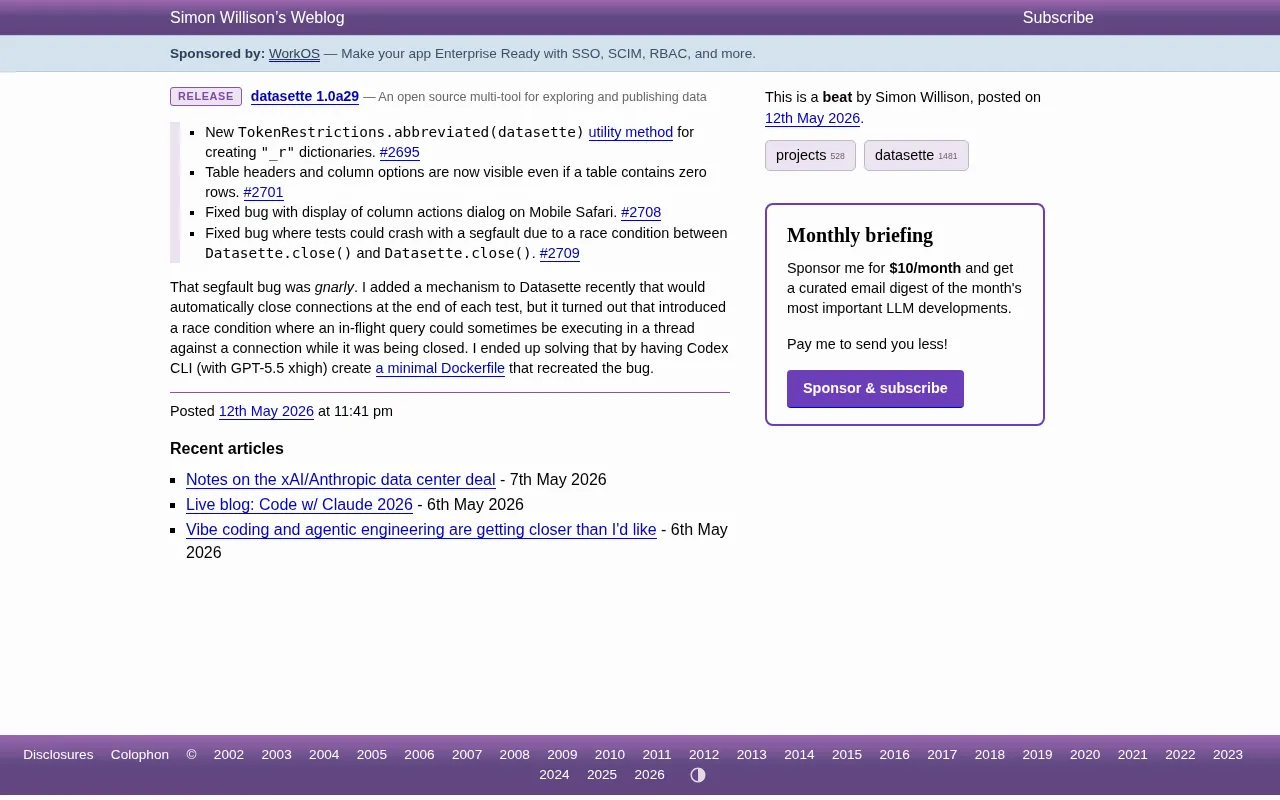
Datasette 1.0a29 released, fixing a gnarly segfault race condition with GPT-5.5-assisted debugging.
Datasette 1.0a29 preview is released, adding a TokenRestrictions utility method for simplified token permission configuration, fixing hidden empty table headers, and resolving Mobile Safari compatibility issues. The highlight is a segfault race condition introduced by test optimization—database connections being closed by one thread while queries were still executing in another, causing cross-Python/C-boundary memory access crashes. Developer Simon used GPT-5.5 xhigh to construct a Docker reproduction environment, demonstrating AI's practical value in complex concurrency debugging.
Datasette 1.0a29 Version Overview
The Datasette project recently released version 1.0a29, a preview of the open-source data exploration and publishing tool developed by Simon Willison. While this update contains relatively few changes, the process of fixing a segfault bug is technically fascinating—the developer even enlisted GPT-5.5 xhigh to help reproduce the issue.
Datasette allows users to quickly transform SQLite databases into interactive Web APIs and interfaces, widely used in data journalism, open data publishing, and similar scenarios. SQLite is the most widely deployed database engine in the world, known for its single-file, zero-configuration, embedded characteristics, and is built into everything from smartphones to browsers. However, SQLite has long lacked convenient means for data publishing and sharing—database files aren't inherently suited for serving directly on the web. Datasette fills this gap: it combines SQLite's lightweight advantages with web serving capabilities, enabling anyone to turn a .db file into a fully functional data API endpoint and visual browsing interface in seconds. This design philosophy has led to widespread adoption in data journalism (such as publishing public datasets in investigative reporting) and government open data projects. As an important milestone on the road to the official 1.0 release, each alpha version continues to polish stability and developer experience.
Key Feature Improvements in This Update
New TokenRestrictions Utility Method
This update introduces the TokenRestrictions.abbreviated(datasette) utility method for creating "_r" dictionaries. This is an API improvement aimed at plugin developers, simplifying the configuration workflow for token permission restrictions.
In Datasette's permission system, API tokens can be given fine-grained access control—for example, restricting a token to only access specific databases or tables, or only allowing queries without data modification. This permission information is encoded in the token as a _r (abbreviation for restrictions) dictionary. Previously, plugin developers who needed to programmatically create tokens with permission restrictions had to manually construct this nested dictionary structure—not only tedious but error-prone, requiring knowledge of database name-to-ID mappings and the internal representations of various permission identifiers. The new abbreviated() method encapsulates these details, allowing developers to simply pass in a Datasette instance to automatically generate the correct permission dictionary. This is a significant efficiency boost for developers building custom authentication plugins or automated token management tools.
Empty Table Header Display Fix
Previously, when a data table contained no rows, headers and column options were hidden, causing user confusion—even if a table is empty, users still need to see structural information. Version 1.0a29 fixes this issue so that headers and column operation options display normally even when a table contains zero rows. While this change seems minor, it significantly improves the daily user experience, especially during database design phases or pre-import structure verification scenarios where users frequently need to view empty table schemas to confirm field definitions are correct.
Mobile Safari Column Action Dialog Fix
A fix was applied for the column action dialog displaying incorrectly on Mobile Safari. The WebKit engine used by Mobile Safari has numerous subtle differences from Chrome/Firefox in CSS layout and JavaScript event handling—particularly regarding native support for dialog elements, scroll behavior with fixed positioning (position: fixed), and touch event handling—which has long been a compatibility pain point for frontend developers. This fix ensures iOS users get a consistent interaction experience when using Datasette.
Deep Dive: Investigating and Fixing the Segfault Race Condition
Root Cause of the Race Condition
The most noteworthy aspect of this update is a segfault bug that Simon described as "gnarly." The issue originated from a testing optimization he recently added to Datasette—automatically closing database connections at the end of each test.
This seemingly reasonable change introduced a classic race condition: while a query was still executing in one thread, another thread might already be closing the database connection used by that query. The race between two Datasette.close() calls caused intermittent segfault crashes, and such issues are extremely difficult to debug due to their unpredictable nature.
To understand the severity of this bug, it helps to understand the technical implications of both race conditions and segfaults. A race condition is a classic problem in concurrent programming: when a program's behavior depends on the execution timing of multiple threads or processes, without proper synchronization mechanisms, different execution orders may produce different results, some of which lead to errors. The tricky part about race conditions is that they typically only trigger under specific timing combinations—they might occur once in a thousand runs, rendering the traditional "run-observe-fix" debugging cycle nearly useless.
A segfault (segmentation fault) is a more low-level crash: when a program attempts to access a memory region it's not authorized to access, the operating system forcefully terminates the process. In high-level languages like Python, segfaults are relatively rare—Python's memory management and garbage collection mechanisms typically convert memory issues into catchable exceptions. But Datasette's underlying dependency, SQLite, is written in C, and Python interacts with it through the sqlite3 standard library module (which is essentially a C extension). When the Python layer closes a database connection (freeing the underlying C struct's memory) while another thread is still executing a query through an invalidated C pointer, it triggers access to freed memory, causing a segfault. This type of concurrency issue that crosses the Python/C boundary is particularly dangerous because it bypasses Python's exception handling mechanism, directly crashing the process without leaving useful Python-level error stack traces.
Using GPT-5.5 xhigh for Assisted Debugging
A notable detail in the fix process is that Simon used Codex CLI paired with the GPT-5.5 xhigh model to create a minimal Dockerfile for reliably reproducing this segfault bug.
Codex CLI is a command-line programming tool from OpenAI that allows developers to interact with AI models directly in the terminal to complete coding tasks—it can read project context, execute commands, and iteratively modify code. GPT-5.5 xhigh is a high-reasoning-capability configuration in OpenAI's model lineup—"xhigh" indicates the model invests more computational resources in deep reasoning when generating responses, which is particularly crucial for tasks requiring precise understanding of concurrency timing, memory lifecycles, and other complex system behaviors. Constructing a Dockerfile that can reliably reproduce a race condition requires precise control over thread scheduling, connection pool sizes, query execution times, and other variables—exactly where high-reasoning-capability models excel.
This demonstrates the practical value of AI programming tools in complex debugging scenarios—race condition bugs often require carefully constructed execution environments to reproduce, and AI can help rapidly generate such reproduction environments. Using Docker containers to reproduce segfaults is also a noteworthy strategic choice: containers provide repeatable, isolated execution environments, eliminating the "can't reproduce on my machine" problem, while Docker's multi-core scheduling characteristics also make it easier to trigger race conditions. Even for experienced developers, AI tools can provide genuinely effective assistance when facing low-level concurrency issues.
Engineering Practice Insights for Developers
While this update is small in scope, it contains several engineering lessons worth learning from:
-
Test infrastructure itself needs validation: A convenience mechanism added for testing (automatic connection closing) actually introduced a new segfault bug, reminding us that the testing toolchain itself can become a source of problems. In software engineering, this is the flip side of "test infection"—when test infrastructure introduces side effects, it not only fails to find bugs but actually creates them. Moreover, such bugs are often harder to locate because a developer's first instinct is typically to suspect the code under test rather than the testing framework itself.
-
Practical value of AI-assisted debugging: Using AI to generate minimal reproduction environments is an efficient debugging strategy, especially suited for environment-sensitive bugs like race conditions. Traditional race condition debugging methods include inserting
sleep()calls to artificially control timing, using tools like Thread Sanitizer for dynamic analysis, or reasoning about possible timing issues through code review. AI-assisted debugging doesn't replace these methods but provides acceleration at the specific stage of "constructing a reproduction environment"—which is often the most time-consuming part of the entire debugging workflow. -
Gradual release ensures quality: Datasette's strategy of iterating through numerous alpha versions to ensure the quality of the official 1.0 release is worth referencing for other open-source projects. From 1.0a0 to 1.0a29, there have been 30 alpha iterations—a practice that's uncommon in the open-source community, where many projects tend to rush toward an official release to gain user trust and adoption. But Datasette's strategy reflects a more deliberate versioning philosophy: a 1.0 version number implies an API stability commitment, and once released, backward compatibility must be maintained long-term. Therefore, thoroughly validating every API design decision before the official release is worthwhile. This parallels the lengthy alpha/beta cycle that the Rust language went through before its 1.0 release.
The official release of Datasette 1.0 is still in progress. Interested developers can try the latest version via pip install datasette==1.0a29.
Related articles
 Tech Frontiers
A Rare Quiet Day in AI: Recursive Self-Improvement Stirs Beneath the Surface
A rare quiet day in AI sees multiple sources go silent simultaneously. Behind the calm, Recursive Self-Improvement (RSI) research continues. What this means for the industry.
 Tech Frontiers
Reve 2 vs. Ideogram 4: A Deep Dive into Layout Control in AI Image Generation
A deep comparison of Reve 2 and Ideogram 4's layout control capabilities, covering technical approaches, real-world use cases, and industry trends for designers and creators.
 Tech Frontiers
In the Weights: Check Your Influence Score in the AI World
In the Weights is an AI influence search engine that quantifies your presence in the AI world with a score. Explore how it evaluates practitioners and what it means for digital identity.