Datasette 1.0a41 Released: Adds OpenTelemetry Support and Modal Web Component

Datasette 1.0a41 adds OpenTelemetry observability support and refactors modal dialogs into a native Web Component.
Datasette 1.0a41 delivers two key updates aimed at production readiness. First, community contributor Alec Garcia added native OpenTelemetry support, enabling operators to integrate Datasette's request traces into monitoring tools like Jaeger and Prometheus for query latency analysis and performance debugging. Second, author Simon Willison refactored all built-in modal dialogs into a single standardized Web Component with official plugin documentation, allowing third-party plugins to reuse the component directly for consistent UX at lower development cost. Together, these changes advance Datasette along two parallel tracks toward 1.0: engineering capability and plugin ecosystem extensibility.
Datasette has reached another alpha milestone on its way to a stable 1.0 release — version 1.0a41. As an open-source data exploration and publishing tool built by Simon Willison, Datasette has long been praised for its lightweight, extensible design. This release brings two notable updates for developers: native OpenTelemetry support and a refactored modal dialog system.
OpenTelemetry Support: Bringing Observability to Datasette
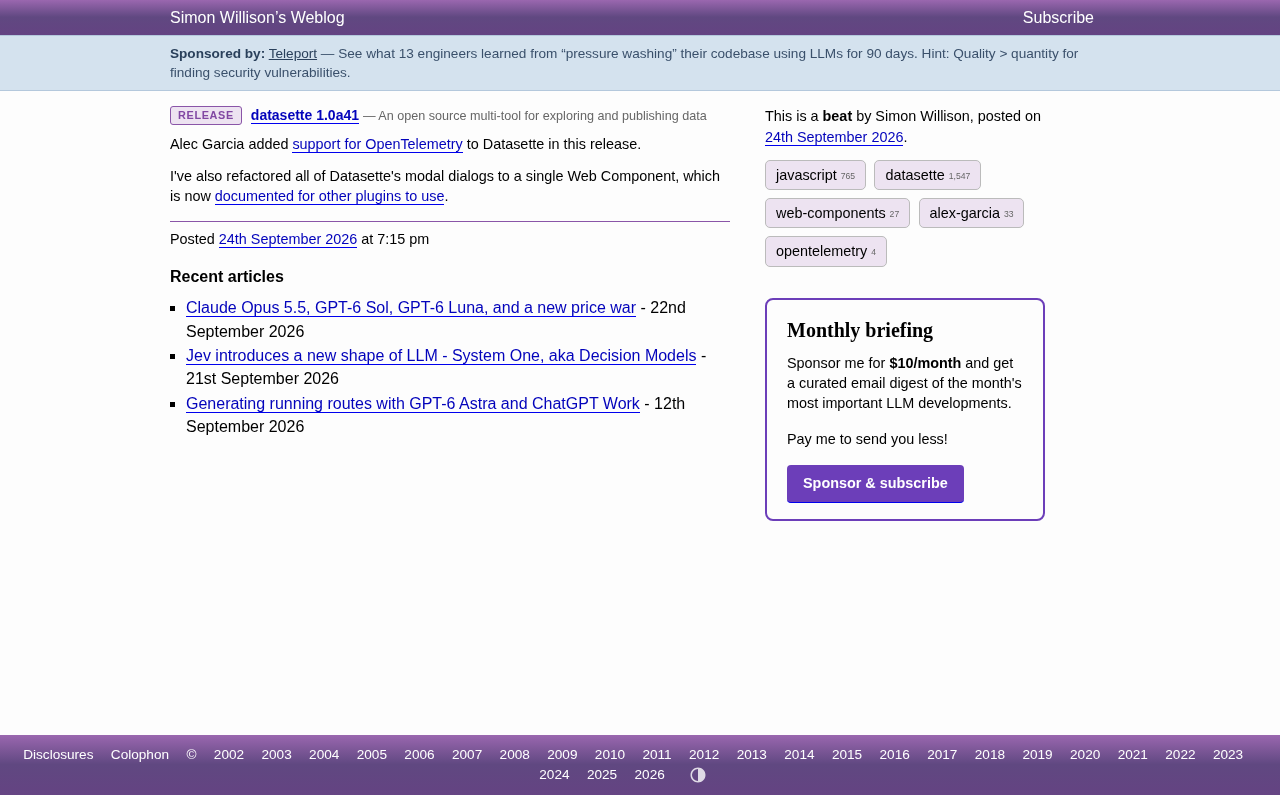
The most significant addition in this release is OpenTelemetry support, contributed by Alec Garcia.
OpenTelemetry has become the de facto observability standard in the cloud-native ecosystem, unifying the collection of metrics, logs, and traces. For any service destined for production, seamless integration with existing monitoring infrastructure is often the deciding factor in whether it gets adopted at all.
With OpenTelemetry now built into Datasette, operators and developers can incorporate its request-handling pipeline into unified trace chains — observing query latency, pinpointing performance bottlenecks, and integrating with popular tools like Jaeger and Prometheus. For teams running Datasette as a long-term data API service, this represents a meaningful step up from "hobby tool" to "production-grade component."
OpenTelemetry (OTel) is governed by the CNCF (Cloud Native Computing Foundation) and was formed in 2019 through the merger of OpenCensus and OpenTracing. Its core value proposition is vendor neutrality — developers instrument their code against a single standard API, then export telemetry data to virtually any backend (Jaeger, Zipkin, Datadog, Grafana Tempo, etc.) without modifying business logic when switching monitoring platforms. Distributed tracing is its most widely used capability: each HTTP request is represented as a "trace" composed of multiple "spans," where each span records the start time, end time, and attributes of a specific operation. For a SQL-query-centric service like Datasette, spans can precisely reveal how much time database queries consume within a single request and whether N+1 query problems exist — providing direct, actionable data for performance tuning.
Modal Refactor: Unified as a Single Web Component
The other change comes from Simon Willison himself: he has refactored all of Datasette's built-in modal dialogs into a single Web Component, which is now documented for plugin developers.
Why This Matters
Previously, frontend modals and dialogs were scattered across the codebase, making it hard to maintain consistent styling and behavior. Plugin authors who wanted to reuse the same interaction patterns had to implement their own versions from scratch. Consolidating everything into a standardized Web Component delivers several concrete benefits:
- Consistent user experience: All dialogs share a unified look and interaction model
- Lower barrier for plugin development: Third-party plugins can call the official modal component directly, without reinventing the wheel
- Easier maintenance: Centralized core code means fixes and improvements only need to be made in one place
Web Components are a browser-native componentization solution that requires no frontend framework — a natural fit for Datasette's philosophy of staying lightweight and dependency-free. This change also reflects the project's continued investment in frontend extensibility.
Web Components are a set of browser-native APIs standardized by the W3C, comprising three core technologies: Custom Elements, Shadow DOM, and HTML Templates. Unlike framework components in React or Vue, Web Components require no build tools or runtime dependencies and run directly in modern browsers. Shadow DOM's encapsulation ensures that a component's internal styles won't be accidentally overridden by external CSS (and vice versa), meaning modal dialogs from different plugins won't interfere with each other. Since Datasette is primarily Python-based with a minimal frontend, choosing Web Components over introducing a framework like React preserves its overall lightweight character while giving plugin authors a cross-framework, directly callable standard interface.
What This Means for the Datasette Ecosystem
These two updates reveal the dual track Datasette is following on its path to 1.0: solidifying production engineering capabilities (represented by OpenTelemetry) and strengthening plugin ecosystem extensibility (represented by the standardized Web Component).
For teams building data portals, internal APIs, or open data platforms on top of Datasette, observability support means more confident operations. For plugin authors, the officially documented modal component lowers the cost of building extensions. Together, they push this open-source project further along its evolution from personal tool to mature ecosystem.
Summary
Datasette 1.0a41 may be an alpha release, but neither of its changes is a minor tweak: OpenTelemetry fills a critical gap in production observability, while the modal Web Component provides a unified interaction foundation for the plugin ecosystem. Developers eager to try it out can head to the GitHub Releases page to get the latest version.
Related articles

Chain of Thought Isn't Just for AI: How Humans Can Use CoT to Improve Thinking Quality
Chain of Thought isn't just a prompt trick for large models. Starting from a Hacker News discussion, this article analyzes why CoT works for human thinking too, breaks down actionable ways to transfer it, and highlights the key differences between human CoT and machine CoT.
Cloudflare Teams Up with OpenAI: Closi…
Cloudflare Teams Up with OpenAI: Closing the Loop from Vulnerability Discovery to Defense with AI
Cloudflare uses OpenAI Daybreak to investigate security vulnerabilities and generate reviewable remediation plans, while developers use Codex to boost coding efficiency and quality.

Orca Multi-Agent Orchestration in Practice: A Guide to Parallel Collaboration with Claude and Codex
Orca is Stable AI's free open-source agent workbench supporting 34 agents like Claude Code and Codex in parallel. Learn its Git worktree isolation, multi-model orchestration, and mobile management.