Datasette Launches Official Blog: Simon Willison Built It from Scratch with OpenAI Codex
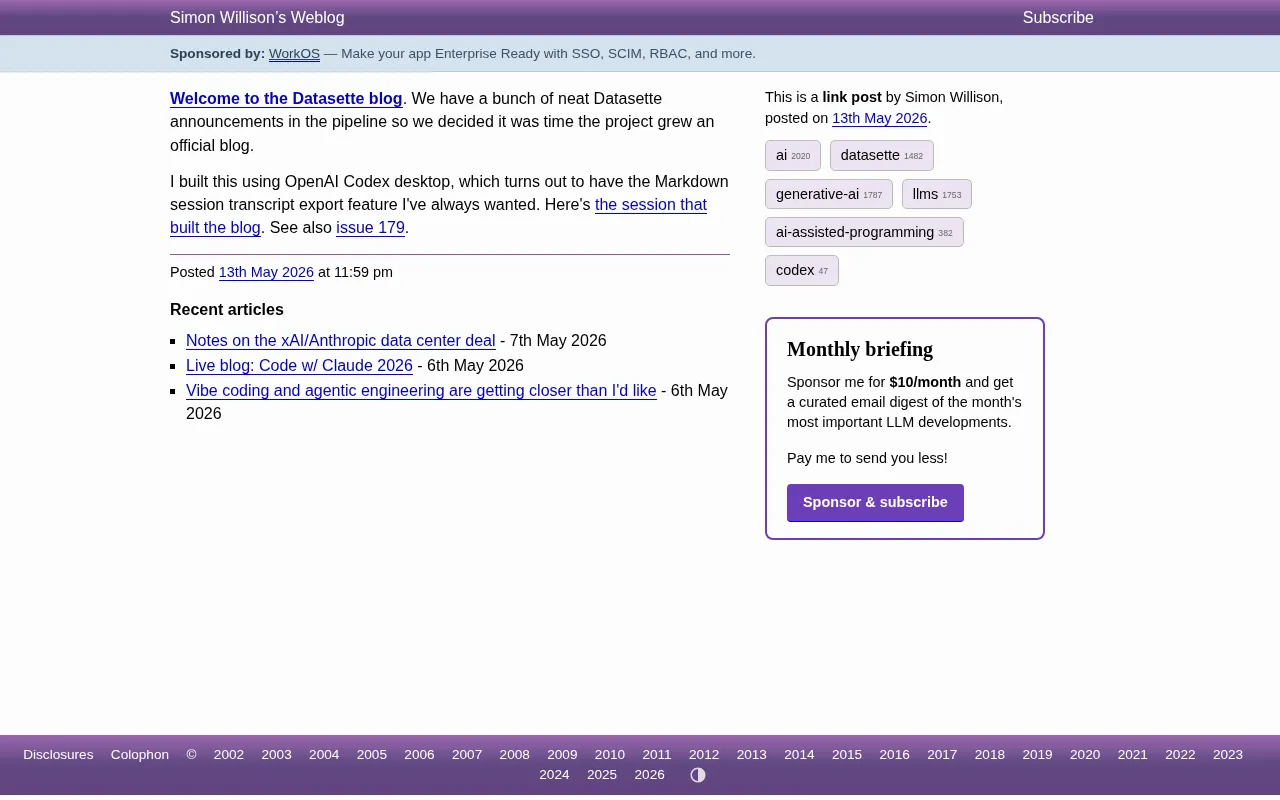
Datasette launches official blog built with OpenAI Codex Desktop, with full AI session transcript published.
Datasette has officially launched its project blog, with founder Simon Willison using OpenAI Codex Desktop for all development and publishing the complete AI interaction session transcript. He specifically highlighted Codex's Markdown session export feature, arguing that traceability and auditability are crucial for AI programming tools. This provides the AI-assisted programming community with a transparent, reproducible practice sample and signals major upcoming updates for the Datasette project.
Datasette Gets an Official Blog
Datasette project founder Simon Willison recently announced that Datasette has officially launched a project blog. Datasette is a Python-based open-source tool for data exploration and publishing, built around the core concept of instantly transforming any SQLite database file into a browsable web interface and JSON API. SQLite is an embedded relational database that stores data in a single file without requiring a separate database server process, making it particularly well-suited for data distribution and sharing scenarios. Datasette leverages this characteristic to let users publish datasets as interactive websites with a single command, supporting SQL queries, data filtering, faceted search, and more. Since its release in 2017, the project has developed a rich plugin ecosystem covering hundreds of extensions for data visualization, geospatial analysis, authentication, and beyond. The project had previously lacked a centralized official channel for publishing updates. Simon noted that the team has a series of exciting announcements coming soon, which motivated the decision to establish a formal blog platform for the project.
Building the Blog with OpenAI Codex Desktop
The blog's construction process itself is equally noteworthy. Simon Willison revealed that he used OpenAI Codex Desktop to complete all development work on the blog. OpenAI Codex Desktop launched in 2025 and differs from earlier versions that ran only in cloud sandboxes—the desktop version can operate directly in a developer's local environment, including reading and writing local files, running terminal commands, and integrating with local development toolchains. It's built on OpenAI's codex-1 model, which has been fine-tuned through reinforcement learning to specifically optimize code generation, debugging, and engineering task capabilities. Unlike GitHub Copilot, which primarily provides line-level or function-level code completion, Codex leans more toward an Agent mode—developers describe a complete task in natural language, and Codex autonomously plans steps, writes code, runs tests, and iterates on corrections, functioning more like an autonomous junior engineer.
As an active practitioner in the AI-assisted programming space, Simon has long explored how to integrate large language models into daily development workflows, and this blog build serves as a prime example.
Particularly worth noting, Simon specifically highlighted that Codex Desktop includes the Markdown session transcript export feature he had long desired. This feature allows developers to export their complete interaction with AI—including every prompt, AI response, code generation result, and intermediate revision iterations—in a structured Markdown text format. Markdown is a lightweight markup language widely used in technical documentation, GitHub READMEs, and blog writing, offering advantages like plain-text readability, ease of version control, and cross-platform compatibility. The significance of this feature lies in transforming what would otherwise be AI interactions locked inside a tool into archivable, searchable, and shareable knowledge assets. Developers can incorporate these records into project documentation as the basis for code decisions, or use them for internal team knowledge transfer and training. Simon also published the complete session transcript for building this blog, making it available for community reference and learning.
A Practice Sample for AI-Assisted Programming
A Transparent Development Process
Simon Willison's practice of publicly sharing Codex session transcripts provides the AI-assisted programming community with an extremely valuable reference sample. It's worth noting that Simon is a co-creator of the Django web framework—Django is the most popular web framework in the Python ecosystem, adopted by major platforms like Instagram and Pinterest. In recent years, he has devoted significant energy to the intersection of AI and development tools. His personal blog and TIL (Today I Learned) project contain hundreds of practical notes on LLM applications, making him one of the most influential independent voices in the AI-assisted programming space. He has also developed open-source projects like the LLM command-line tool and llm-cluster, dedicated to making it easy for ordinary developers to use large language models in their daily workflows. His practice style emphasizes transparency, reproducibility, and pragmatism—perfectly aligned with his approach of publicly sharing AI session transcripts.
By reviewing this session transcript, developers can learn:
- How to clearly describe requirements to an AI programming assistant
- The quality of AI code generation in real projects
- How the human-AI collaborative iteration process unfolds in practice
- How many interaction rounds are needed to complete a feature module from scratch
Considerations Behind AI Programming Tool Selection
Simon's choice of OpenAI Codex Desktop over other AI programming tools like GitHub Copilot or Cursor, combined with his specific emphasis on the session transcript export feature, reflects a key developer demand for AI programming tools: traceability and auditability.
In software engineering practice, traceability refers to the ability to track the origin, modification history, and decision rationale behind every piece of code; auditability emphasizes the ability to review and verify the compliance and correctness of the development process after the fact. As AI-generated code accounts for an ever-increasing proportion of production environments, these two properties become especially critical. If developers cannot trace back the context of AI-generated code—such as what prompts were given, what assumptions the AI made, and which suggestions the developer accepted or rejected—then diagnosing and fixing bugs or security vulnerabilities becomes significantly more difficult. Furthermore, in regulated industries (such as finance and healthcare), code auditing is often a compliance requirement, and the traceability of AI-generated code directly affects whether an organization can meet regulatory standards.
In practical engineering, understanding how code was generated and what prompts produced it is essential for code review and ongoing maintenance.
The Future of the Datasette Project
In the announcement, Simon hinted that the team has "a series of exciting announcements" coming soon. While no specifics were revealed, based on Datasette's recent development direction, the community can anticipate new progress in data exploration, the plugin ecosystem, and AI/LLM integration.
As a tool that transforms SQLite databases into interactive APIs and web interfaces, Datasette is widely used in data journalism, open data, and rapid prototyping. The data journalism field is particularly fond of Datasette because journalists and researchers can quickly publish public datasets (such as government budgets, election data, and environmental monitoring data) as queryable online tools without writing backend code or managing database servers. The establishment of an official blog marks the project's move toward a more mature and professionalized operational phase.
Summary
This seemingly simple blog launch announcement actually contains multiple layers of information: the Datasette project is about to receive major updates, AI-assisted programming tools are becoming standard in daily development, and the trend toward development process transparency is accelerating. Simon Willison demonstrated the development philosophy of "build with AI, and share the process openly" through his actions, setting a positive example for the entire open-source community.
Related articles
 Tech Frontiers
A Rare Quiet Day in AI: Recursive Self-Improvement Stirs Beneath the Surface
A rare quiet day in AI sees multiple sources go silent simultaneously. Behind the calm, Recursive Self-Improvement (RSI) research continues. What this means for the industry.
 Tech Frontiers
Reve 2 vs. Ideogram 4: A Deep Dive into Layout Control in AI Image Generation
A deep comparison of Reve 2 and Ideogram 4's layout control capabilities, covering technical approaches, real-world use cases, and industry trends for designers and creators.
 Tech Frontiers
In the Weights: Check Your Influence Score in the AI World
In the Weights is an AI influence search engine that quantifies your presence in the AI world with a score. Explore how it evaluates practitioners and what it means for digital identity.