Datasette LLM Accountant: An Open-Source Tool for LLM Usage Tracking and Cost Management

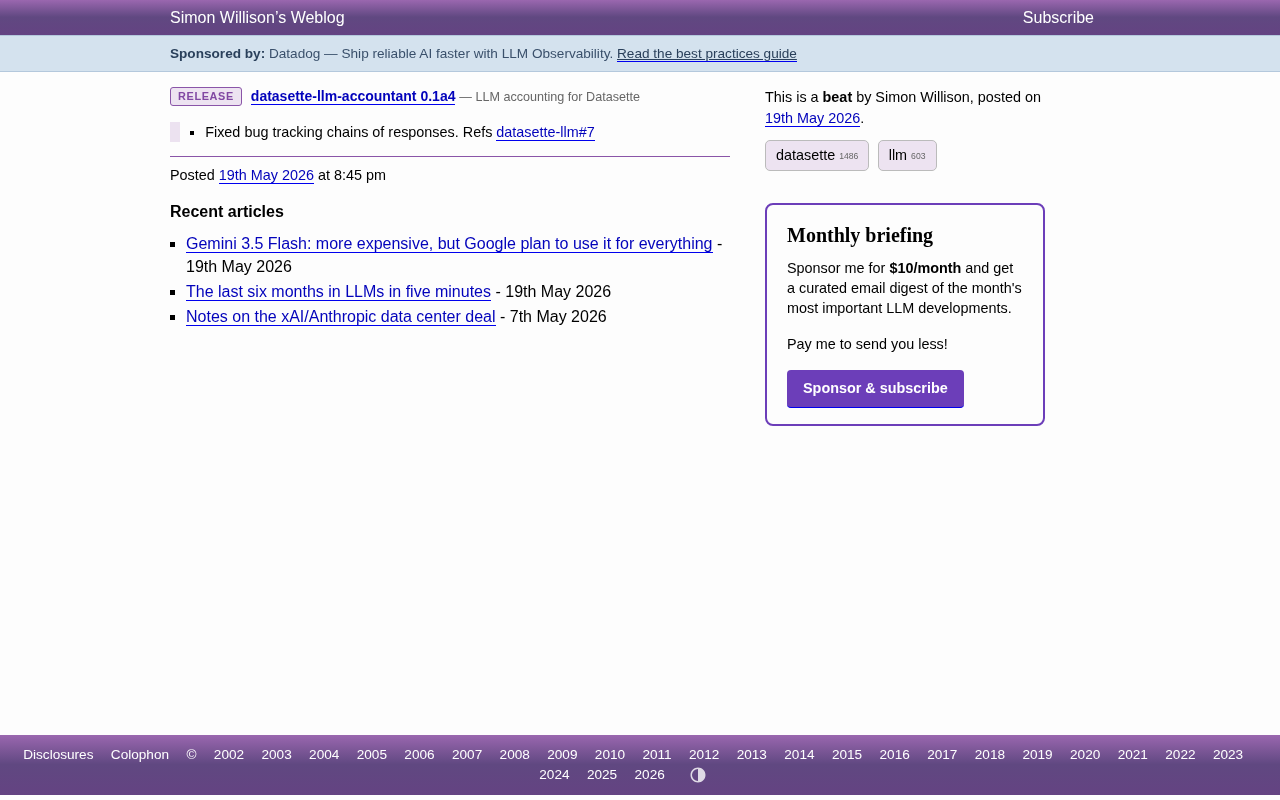
datasette-llm-accountant 0.1a4 released, fixing a response chain tracking bug
The LLM usage tracking plugin datasette-llm-accountant in the Datasette ecosystem has released version 0.1a4, fixing a defect in tracking chains of responses. The tool helps developers monitor token consumption and costs of LLM API calls. Accurately tracking chained call relationships is especially critical for cost accounting in Agent multi-turn call scenarios. The project is still in its alpha stage.
Overview
The LLM usage tracking plugin datasette-llm-accountant, part of the Datasette ecosystem, has released version 0.1a4, fixing a critical bug related to response chain tracking. Led by Simon Willison, this tool is a key component of the Datasette + LLM toolchain, helping developers monitor and log LLM API calls and their associated costs.
About Datasette: Datasette is an open-source data exploration tool created in 2017 by Simon Willison (co-creator of the Django framework). It can instantly turn any SQLite database file into a browsable, queryable Web API, dramatically lowering the barrier for data publishing and sharing. Built on a plugin architecture, the community has developed over 100 plugins covering data import, visualization, access control, and more.
datasette-llm-accountantis the newest member of this ecosystem, focused specifically on LLM cost governance.
What's New in This Update
Response Chain Tracking Bug Fix
The core change in this update is a fix for a defect in tracking chains of responses, corresponding to issue datasette-llm#7.
In real-world LLM usage, a conversation often doesn't end with a single request-response cycle — it forms a multi-turn response chain. Chain of Responses is a core concept in modern LLM application architecture, especially prevalent in ReAct (Reasoning + Acting) patterns and Function Calling scenarios. When an LLM needs to invoke external tools, a single user request evolves into a loop: initial reasoning call → tool execution → result return → further reasoning. Both OpenAI's Assistants API and Anthropic's Tool Use natively support this pattern. Tracking such chained calls requires not only recording the token consumption of each individual request but also maintaining a parent-child relationship graph between calls — placing higher demands on database schema design and concurrent writes.
For example, in an Agent scenario, a single initial request might trigger multiple LLM calls (tool invocations, chain-of-thought reasoning, etc.), with clear causal relationships between them. Accurately tracking these response chains is critical for both cost accounting and debugging.
In previous versions, chain response tracking had a defect that could lead to inaccurate usage statistics or lost call relationships. Version 0.1a4 has fixed this issue.
Introduction to the Datasette LLM Toolchain
Project Positioning and Ecosystem
datasette-llm-accountant is a plugin in the Datasette ecosystem specifically responsible for LLM usage accounting. In recent years, Simon Willison has built an entire suite of command-line tools and plugins around LLMs:
- LLM: A command-line LLM interaction tool supporting multiple model providers including OpenAI, Anthropic, and more
- datasette-llm: A plugin that integrates LLM capabilities into Datasette
- datasette-llm-accountant: An accounting plugin that tracks and records LLM usage
Among these, the llm command-line tool is the foundation of the entire system. Its design philosophy is "Unix pipe-friendly" — users can pipe text into the llm command and pipe the output to other tools, making it naturally suited for scripting and automation. Through its plugin mechanism, it supports dozens of backends including OpenAI, Anthropic Claude, Google Gemini, local Ollama models, and more. It persists all conversation history to a local SQLite database, and datasette-llm-accountant builds on this foundation by adding cost-dimension analytics.
The design philosophy behind this toolchain is to give developers transparent management of LLM usage, including core metrics like token consumption, API call counts, and costs.
Why LLM Usage Tracking Matters
As LLM applications become increasingly widespread, API call cost management has become a practical issue developers must address. The following scenarios particularly benefit from fine-grained usage tracking:
- Multi-model switching: Pricing varies dramatically across GPT-4, Claude, Gemini, and other models, requiring precise records of which model was used for each call
- Agent workflows: A single task may trigger dozens of LLM calls, requiring full call chain tracking
- Team collaboration: When multiple people share an API key, individual usage and cost allocation need to be distinguished
- Budget control: Setting usage limits to prevent steep bills caused by program errors or infinite loops
Summary and Outlook
Although 0.1a4 is just a minor version update, it reflects the ongoing engineering refinement of LLM toolchains. Notably, the a4 (alpha 4) in the version number follows the PEP 440 Python versioning specification, indicating this is the fourth alpha pre-release. For open-source tools, publicly releasing alpha versions is a "build-measure-learn" iteration strategy — using real feedback from early users (such as issue #7 fixed in this release) to quickly identify edge cases. This approach yields higher engineering quality than closed development followed by a single stable release — but it also means the API may undergo breaking changes, so it's not yet recommended for direct use in production environments.
As AI Agents and complex workflows continue to rise, the ability to accurately track response chains is becoming increasingly important. As a lightweight open-source solution, datasette-llm-accountant provides individual developers and small teams with practical LLM cost management capabilities.
The project is still in its alpha stage (0.1a4). Interested developers can follow its progress on GitHub.
Key Takeaways
- datasette-llm-accountant 0.1a4 fixes a critical bug in response chain tracking
- The tool is designed to track and record LLM API usage and costs
- Response chain tracking is essential for cost accounting in Agent scenarios and multi-turn conversations
- The project is part of Simon Willison's Datasette + LLM open-source toolchain ecosystem
- It is still in the alpha stage with ongoing iterations
Related articles
 Product Reviews
The Programmer's Desk Setup Guide: Building a Workspace That Feels Like Home
Discover how programmers build productive, comfortable workspaces. From multi-monitor setups to ergonomic design, explore the desk philosophy that drives focus and flow.
 Product Reviews
Qoder vs Cursor Real-World Comparison: Which $20/Month AI IDE Is Better?
Hands-on comparison of Qoder vs Cursor AI IDEs: Agent autonomy, human interaction count, and architecture decisions. Qoder needed only 2 interactions vs Cursor's 8.
 Product Reviews
Cursor Cloud Agent Demo: Eliminating Bottlenecks Across the Entire Software Development Lifecycle
Deep analysis of Cursor's Cloud Agent demo showing how cloud VMs, automated test artifacts, and a full-chain control plane systematically eliminate human bottlenecks across the software development lifecycle.