Davit: A Native GUI Management Tool Built Specifically for Apple Containers
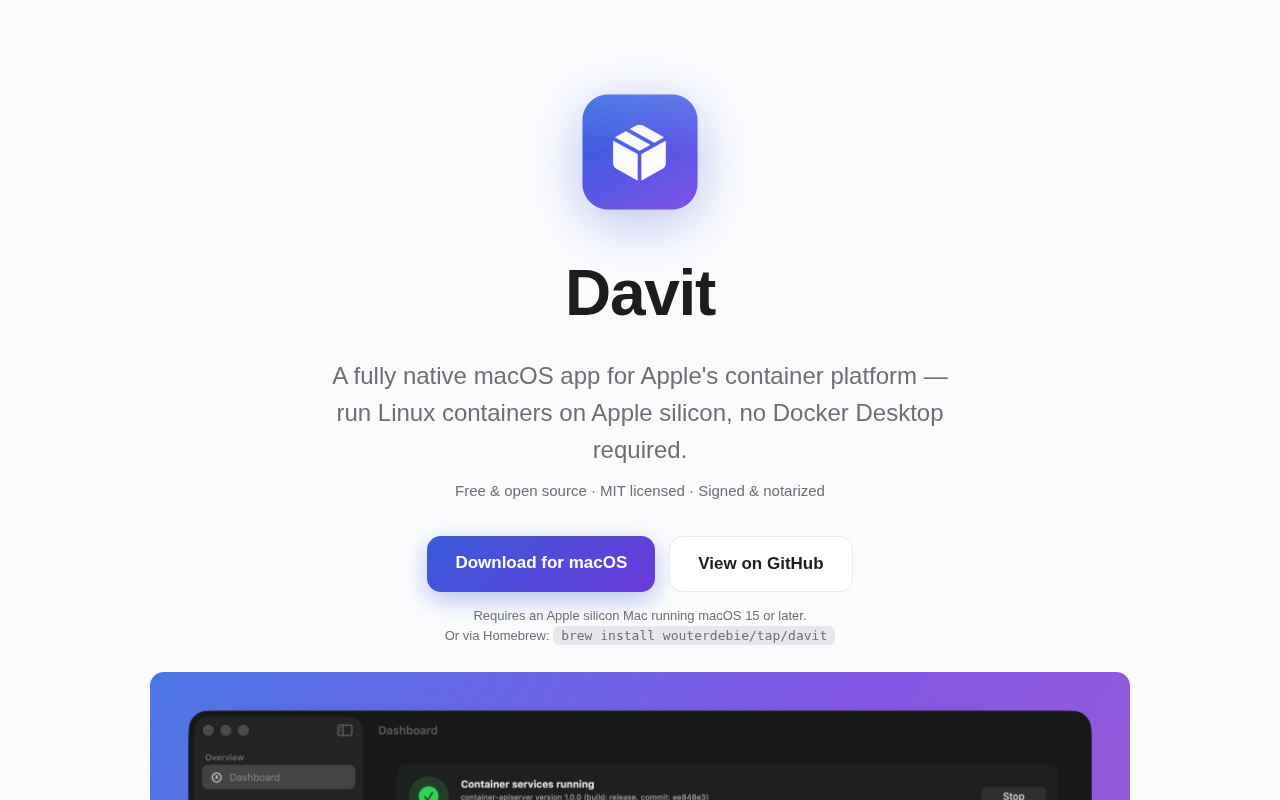
Davit is an open-source native macOS GUI tool designed specifically for managing Apple Containers.
Davit is an open-source native macOS UI tool built for Apple Containers. Featuring SwiftUI-based native integration rather than Electron, it provides graphical management for container status, images, and logs—lowering the barrier to Apple's native container technology and improving daily operational efficiency for developers.
Container Management Gets a Native Apple GUI Solution
As Apple continues to invest heavily in container technology, containerized development on the macOS platform is drawing increasing attention from developers. Recently, an open-source tool called Davit made its debut in Hacker News' Show HN section, with a clear positioning: to provide an intuitive, easy-to-use native graphical user interface (UI) for Apple Containers.
Hacker News' Show HN section is an important channel for developers to showcase self-built projects, and also an informal platform where the tech community rapidly validates new tools. The quality of feedback a project receives on Show HN is often more valuable than upvote counts—technical follow-up questions, competitor comparisons, and pain-point feedback in the comments are important signals for judging whether a project addresses real needs. For early-stage open-source projects, GitHub's star growth curve, the level of activity in the Issues section, and the maintainer's response speed together form the core metrics for assessing project health.
For developers accustomed to the command line, graphical tools may not be a strict necessity. But for users who want to lower the barrier to entry and improve daily operational efficiency, a well-designed native UI can often deliver a significant improvement in experience. Davit targets precisely this niche demand.
What Are Apple Containers
Technical Background
Apple Containers is a container runtime solution introduced by Apple, designed to help developers run Linux containers more efficiently on macOS (especially devices with Apple Silicon chips). Compared to traditional solutions like Docker Desktop, Apple's native container technology fully leverages Apple Silicon's virtualization framework, offering clear advantages in performance, resource footprint, and system integration.
The Containerization framework officially released by Apple at WWDC 2025 marks a major strategic investment in the container technology space. Built on top of Hypervisor.framework, each container instance is bound to an independent lightweight Linux virtual machine, using a customized minimal kernel (based on the open-source swift-container-plugin project), with cold-start times kept within seconds. Notably, the Containerization framework is compatible with the OCI (Open Container Initiative) specification and supports standard container image formats—this means images from mainstream image registries such as Docker Hub can run directly on Apple Containers, greatly reducing the cost of migrating from existing Docker workflows.
This advantage is rooted in the hardware architecture design of Apple Silicon (M-series chips). Apple Silicon is based on the ARM architecture, and its virtualization capabilities are built on ARM Virtualization Extensions—hardware-level virtualization support introduced by ARM in ARMv8.1, allowing the hypervisor to run at the EL2 (Exception Level 2) privilege level and the guest OS to run at EL1, thereby achieving hardware-level isolation. Similar to Intel VT-x/AMD-V on the x86 platform, ARM Virtualization Extensions capture sensitive instructions and intercept critical system calls through hardware, enabling the hypervisor to run the guest OS efficiently without binary translation. Combined with the Unified Memory Architecture (UMA), the CPU, GPU, and Neural Engine share the same physical memory pool, eliminating the overhead of copying data across memory spaces found in traditional split-memory architectures—this is especially advantageous for container scenarios that require frequent data transfer between host and guest. Apple introduced Hypervisor.framework starting with macOS 11, allowing developers to directly invoke CPU virtualization extensions and run lightweight virtual machines without kernel extensions (kext). The Containerization framework released in 2025 deepens this further, binding each container to an independent lightweight Linux VM through a customized lightweight kernel, keeping cold-start times within seconds. Compared to the traditional x86 approach where Docker Desktop must run a full Linux VM, this architecture ensures isolation while avoiding the security risks that come with traditional containers sharing a kernel.
It's worth noting that the core mechanism of container technology relies on the Linux kernel's namespace and cgroups features to achieve process isolation and resource limiting. The namespace mechanism provides six isolation dimensions: PID namespace isolates the process ID space, Network namespace provides each container an independent network stack, Mount namespace isolates filesystem mount points, UTS namespace isolates hostnames, IPC namespace isolates inter-process communication, and User namespace enables user ID mapping. cgroups (Control Groups) precisely control each container group's CPU time slices, memory limits, disk I/O bandwidth, and other resources—cgroups v2, compared to v1, introduces a unified resource control hierarchy that simplifies the configuration logic of container runtimes. As a BSD-derived system, macOS's XNU kernel is based on the Mach microkernel and the BSD layer, and does not include Linux namespace and cgroups implementations. This is why every generation of macOS container solutions has had to rely on running Linux virtual machines to obtain these capabilities—a fundamental architectural constraint that cannot be bypassed at the pure software level. Early Docker for Mac emulated the container environment by running a full Alpine Linux virtual machine, resulting in significant performance overhead.
Filesystem sharing performance was historically a pain point for macOS container solutions. Early Docker for Mac used the FUSE (Filesystem in Userspace)-based osxfs bridge layer, where every file operation required multiple context switches between the host userspace, kernel space, and guest, causing performance losses of over 10x in frequent read/write scenarios (such as npm install or compilation builds). FUSE itself is a kernel interface that allows implementing filesystems in userspace—its advantage is development flexibility, at the cost of every file operation having to go through a userspace daemon, with unavoidable context-switching overhead. Starting with macOS 12.3, Apple introduced VirtioFS support in Virtualization.framework—a host-guest filesystem sharing protocol designed under the lead of Red Hat engineer Miklos Szeredi and merged into the Linux kernel mainline in 2020. VirtioFS combines FUSE semantics with the virtio transport layer, and its core innovation lies in achieving direct mapping of host file pages into the guest virtual address space through the DAX (Direct Access) extension: when the guest reads and writes files, no data serialization or network transport is needed, completely bypassing the serialization-deserialization overhead of traditional network filesystems. In metadata-intensive operations (such as git status or node_modules directory traversal), VirtioFS delivers particularly significant performance improvements over osxfs, with some benchmarks showing gains of over 20x, fundamentally improving this long-standing bottleneck.
However, native container technology generally lacked a mature management tool ecosystem in its early days. While the command line is powerful and flexible, when faced with high-frequency tasks such as viewing container status, managing images, and monitoring logs, a graphical interface can provide a more intuitive, lower-friction operational path—and this is precisely the core value of third-party tools like Davit.
Why a Graphical UI Is Needed
Container management involves a great deal of repetitive operations: starting/stopping containers, checking running status, managing images, inspecting logs... As the number of containers grows, the cognitive burden of pure command-line operations quickly rises. An excellent container management UI can present key information in a centralized way, letting developers grasp the overall state at a glance and focus their energy on the development work that truly matters.
Building a native macOS container management UI faces several technical decisions: UI framework choice (SwiftUI vs. AppKit), the communication mechanism with the underlying container runtime (Unix Socket, gRPC, or directly invoking CLI subprocesses), and the event-driven architecture design for real-time state synchronization. SwiftUI is the declarative UI framework Apple has heavily promoted in recent years, adopting a state-driven rendering model similar to React—the UI is a function of the application state, state changes automatically trigger interface updates, and developers don't need to manually manipulate the view hierarchy. SwiftUI internally uses structs rather than classes to describe views, relying on efficient value-semantics diffing algorithms to minimize actual rendering work, and performs better than traditional imperative frameworks in scenarios with frequent list updates. Combined with the Combine reactive framework, a container's running state can be encapsulated into a unified data-flow Publisher, and SwiftUI automatically refreshes UI components such as the container list and status indicators when the state changes. Compared to AppKit's traditional imperative programming model, the code logic is clearer and easier to maintain. By contrast, tools built on Electron, while offering low cross-platform development costs (the core being bundling the Node.js runtime and the Chromium rendering engine into a standalone app), incur additional Chromium process overhead on macOS, with memory usage typically 3-5x higher than native apps. In the context of long-running developer tools, this is a cost that cannot be ignored, and it is the fundamental reason Electron apps like VS Code and Slack are frequently criticized for high resource consumption.
Davit's Core Features and Positioning
A Native Experience Deeply Aligned with the Apple Platform
Davit's most prominent feature is its native experience designed specifically for Apple Containers. Unlike general-purpose container management tools that pursue cross-platform compatibility, Davit focuses on polishing native macOS interaction details, including an interface style compliant with the Apple Human Interface Guidelines, smooth operational feedback, and deep integration with the macOS system.
The Apple Human Interface Guidelines (HIG) are interface design specifications published by Apple. Since their first release alongside the original Macintosh in 1987, they have continuously evolved and now cover visual style, interaction patterns, accessibility, motion design, and more, with specific guidance provided separately for macOS, iOS, watchOS, and visionOS. Native apps that follow the HIG typically have the following characteristics: support for automatic switching between dark/light mode, seamless integration with the system font (San Francisco) and color themes, support for keyboard shortcuts and accessibility APIs like VoiceOver, and smooth animation feedback that matches platform expectations (such as elastic scrolling and transition animations). For developer tools, complying with the HIG means users don't need to relearn interaction logic and can reuse existing macOS operating habits, reducing cognitive cost. This stands in stark contrast to tools built on Electron or cross-platform frameworks (such as Flutter or Qt)—the latter, while offering higher development efficiency, often exhibit clear gaps in performance and system integration, and generally have higher resource consumption.
This "focus on a single platform" product strategy is not uncommon in the developer tools space—abandoning the compatibility baggage of cross-platform support in exchange for a more refined user experience on a specific platform. For developers deeply invested in the Apple ecosystem, such a trade-off is often well worth it.
The Advantages of the Open-Source Model
As an open-source project released in Show HN form, Davit allows the community to deeply participate in the tool's iteration and refinement—whether by contributing code, reporting issues, or proposing feature suggestions. The open-source model is especially critical for early-stage tool projects, as it can quickly build user trust while leveraging community power to accelerate feature delivery.
However, being open source is not synonymous with being sustainable. In the developer tools space, one of the most mature commercialization paths is the Open Core model: fully open-sourcing the basic functionality that meets core usage needs, while offering features aimed at scenarios like team collaboration, enterprise compliance, and advanced performance analysis as paid subscription content. GitLab open-sources repository management and basic CI/CD functionality while offering advanced security scanning and compliance auditing as paid enterprise-edition content; HashiCorp (Terraform) follows a similar strategy, though its subsequent switch to the Business Source License (BSL) triggered the OpenTofu community fork; Elastic also, while open-sourcing the basic search engine, places features like machine learning and advanced monitoring under a commercial license. Notably, the Sponsorware model also offers individual developers another viable path: first providing advanced features to GitHub Sponsors backers, then fully open-sourcing once a sustainable revenue threshold is reached—a strategy successfully validated by Alpine.js author Caleb Porzio. For container management tools, potential paid-feature boundaries might include centralized multi-machine container status views, fine-grained resource analysis alerts, and deep integration with CI/CD pipelines. In 2022, Docker Desktop brought commercial use by enterprises with more than 250 employees into its paid scope. While this sparked community controversy, it also validated that there is a real and substantial paying market for developer tools. OrbStack's evolution from being completely free to adopting tiered pricing likewise demonstrates that if Davit can establish a clear sustainable path, it will greatly enhance its long-term vitality.
Real-World Challenges Facing Tool-Type Projects
Pressure from Ecosystem Maturity
It must be viewed objectively that Apple Containers itself is still in a relatively early stage of development. The tool ecosystem built around it (including Davit) all face a common challenge: the ongoing adaptation pressure brought by the rapid evolution of the underlying technology. Once the underlying API changes, UI tools must keep pace promptly, which is an ongoing test for open-source projects maintained by individual developers or small teams.
Currently, community feedback for this project is still insufficient, and it remains in an early exposure stage, so maintaining rational expectations about its maturity is a reasonable attitude.
Finding a Differentiated Foothold Among Competitors
The container management UI space is by no means a blue ocean. Docker Desktop is the solution with the highest market share, offering a complete interface for managing containers, images, and volumes. Its underlying implementation on macOS uses a QEMU-based virtualization approach and is gradually migrating to Apple's Virtualization.framework, but it has a heavy resource footprint, and after adjusting its commercial licensing policy in 2022 to charge large enterprises, this move objectively pushed many developers to seek alternatives. Rancher Desktop, open-sourced by SUSE, supports switching between containerd or dockerd as the runtime, positions itself for local Kubernetes development scenarios, and includes nerdctl as a docker-CLI-compatible command-line tool, making it quite popular in development workflows requiring a local Kubernetes cluster. OrbStack is known for being lightweight and fast, solving the filesystem-sharing performance bottleneck through a more lightweight VM strategy and deep VirtioFS optimization. Its self-developed lightweight Linux kernel and network stack (which directly exposes container ports to macOS localhost without port-mapping configuration) give it the fastest cold-start speed among similar products, and it has garnered significant attention in the developer community in recent years.
The core difference between Davit and the tools above is that it is designed specifically for Apple's official Containers runtime rather than being compatible with the Docker ecosystem. This means it can provide deeper integration targeting Apple's native APIs, but it also limits the scale of its potential user base. If Davit wants to stand out, the key lies in its exclusive deep support for Apple Containers: whether it can provide unique features targeting Apple's native container technology that other general-purpose tools cannot cover will directly determine whether it can gain a firm foothold in the niche market.
Reference Value for macOS Developers
For readers interested in macOS containerized development, Davit's emergence conveys several signals worth noting:
The Apple native container tool ecosystem is gradually taking shape. The emergence of third-party tools itself shows that this technical direction has gained recognition and investment from the developer community, and ecosystem building has already begun.
Graphical management tools still have real demand in the container space. Even though the command line is the mainstream choice for professional developers, a friendly UI can still lower the barrier to entry and improve daily efficiency—the two are not mutually exclusive.
A project's iteration speed and community activity are key observation metrics. For developers who want to try new things, continuously tracking the project's update frequency and Issue response status is an important reference for judging its long-term value. The long-term value gap between a project that gets exposure on Show HN but subsequently goes quiet in the community, and one that continuously iterates and responds to Issues promptly, is often an order of magnitude.
Summary
Davit represents a positive exploration in the Apple Containers tool ecosystem—although it is still in an early stage with a limited community, it fills the niche gap of native macOS graphical container management. From technical choices (native SwiftUI rather than Electron) to product positioning (focusing on Apple Containers rather than general-purpose Docker compatibility), every trade-off Davit makes points to the same goal: providing the deepest native integration experience on a specific platform. Supporting this goal are Apple Silicon's ARM Virtualization Extensions, the system-level capabilities of Hypervisor.framework, VirtioFS's shared-memory zero-copy filesystem sharing (with performance improvements of up to 20x over early solutions in metadata-intensive operations), and the modern native app development stack composed of SwiftUI + Combine—these technical foundations together determine that the ceiling for native solutions in performance and integration is far higher than that of cross-platform alternatives. At the same time, the Containerization framework's compatibility design with the OCI specification also offers users of existing Docker workflows the possibility of smooth migration. For developers on the Apple platform, the continuous emergence of such tools means richer choices and a more complete development experience. Whether it can continue to refine its feature depth, long-term maintenance, and sustainable operation will determine whether it can ultimately become a regular member of developers' toolboxes.
Key Takeaways
Related articles

Disaster and Glory of the Apollo Program: The History We Must Revisit Before Returning to the Moon
From the fatal Apollo 1 fire to Apollo 8's daring lunar orbit to Apollo 11's successful landing—revisiting the disasters, fears, and compromises of the Apollo program and their lessons for today's return to the Moon.

Netflix Trust Exercise Turns Into Firing Trap: Where Are the Boundaries of Corporate Trust?
A Netflix employee was fired after sharing private info in a trust exercise. We analyze the risks of corporate trust exercises and how employees can protect themselves.

AMD CDNA5 Architecture Deep Dive: Technical Evolution and the AI Computing Competition Landscape
Deep analysis of AMD's CDNA5 architecture covering Chiplet packaging upgrades, HBM memory evolution, and low-precision compute optimization, examining how AMD challenges NVIDIA's AI chip dominance.