Decap: The Drummer Behind the Hits You Know but the Name You Don't

Decap is the behind-the-scenes drum architect quietly shaping the sound of modern pop and hip-hop.
Using musician Decap as a lens, this piece examines a long-overlooked phenomenon in the pop music industry: the creators who most powerfully shape hit music are often not the ones standing in the spotlight. Decap's collaborator list spans Kendrick Lamar, Olivia Rodrigo, Charli XCX, Bad Bunny, BTS, and film composer Ludwig Göransson — cutting across hip-hop, Latin pop, K-pop, and film scoring. The article argues that drum patterns and rhythm are the foundational layer of modern pop's identity, yet the behind-the-scenes producers who build them remain buried in the fine print. As streaming-era audiences grow more curious about production craft, the industry is beginning to reassess what these contributors are truly worth.
A Name You've Never Heard — That's Everywhere
Mention Kendrick Lamar, Olivia Rodrigo, or Charli XCX, and virtually any pop music fan will recognize them instantly. But far fewer people know the name Decap — even though his creative fingerprints are scattered across the work of these very artists.
His name may not carry the same household recognition as the stars he supports, but from drum patterns to rhythmic frameworks, his contributions are often the difference between a song that hooks you and one that doesn't. As one account puts it bluntly: Decap clearly doesn't have Kendrick Lamar-level public visibility — yet his "fingerprints" are all over these artists' catalogs.
This is one of the more fascinating phenomena in the pop music industry: the most influential creators aren't always the ones standing in the spotlight.
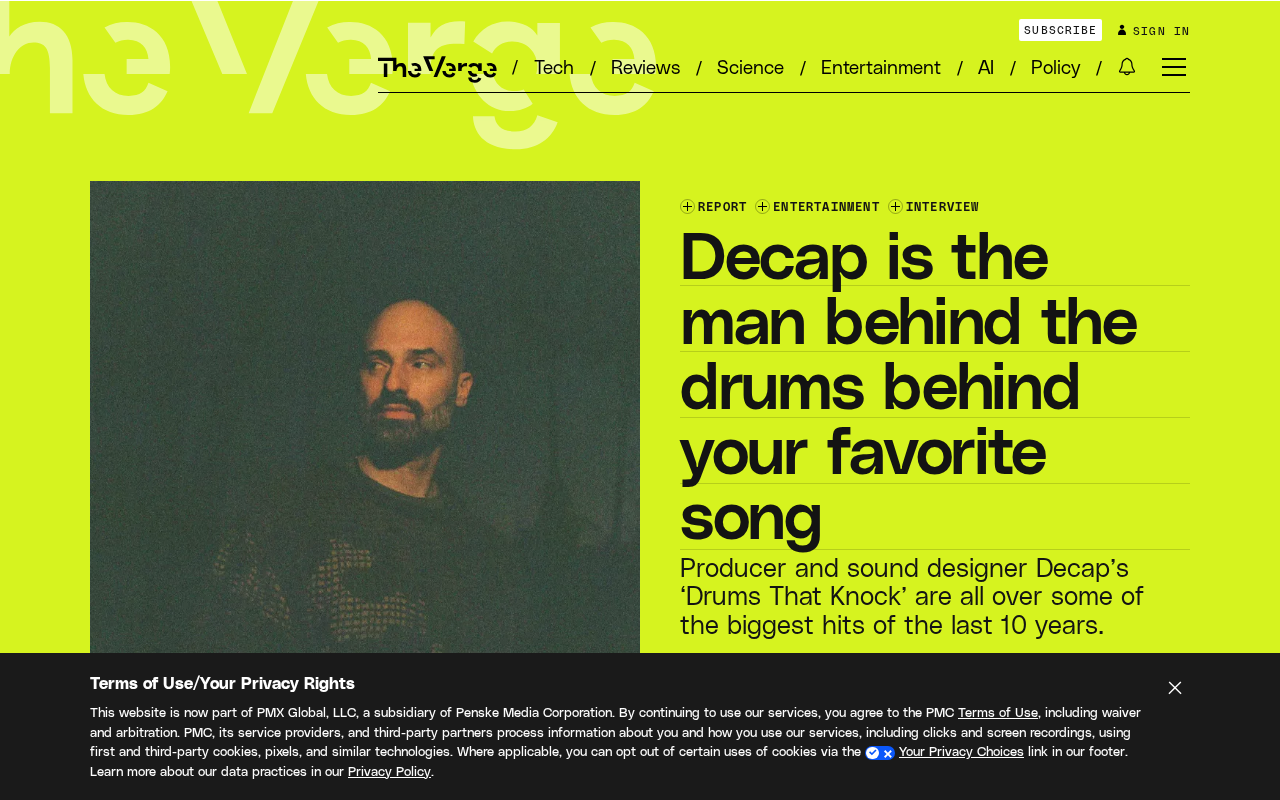
A Collaborator List That Speaks for Itself
Decap's collaborators extend well beyond those few names. His work spans Freddie Gibbs, Bad Bunny, Mac Miller, BTS, and even reaches into the film score work of composer Ludwig Göransson.
That list alone tells a story. It cuts across hip-hop (Freddie Gibbs, Mac Miller), Latin pop (Bad Bunny), K-pop (BTS), and film scores (Ludwig Göransson) — genres that couldn't be more different from one another. Moving fluidly across such a diverse range of styles and leaving a mark in each one suggests that what Decap commands isn't expertise in any single genre, but something more fundamental: a universal language of rhythm and drums.
Why Drum Patterns Matter So Much
In modern pop music production, the drum kit and rhythm tracks are the foundation of a song. Melody and lyrics matter enormously, of course — but what makes a listener involuntarily nod along, what gives a track its signature feel, is almost always those carefully crafted drum patterns and grooves. Behind-the-scenes contributors like Decap, who specialize in percussion, are in many ways shaping the most instinctive musical memories in listeners' heads.
Ludwig Göransson deserves a note of his own. The Swedish composer won the Academy Award for Best Original Score for Black Panther (2018) and took the same award again for Oppenheimer (2023), making him one of the most sought-after film composers in Hollywood today. He's also been a long-time collaborator with Childish Gambino, demonstrating an exceptional ability to cross between worlds. Decap's involvement in Göransson's projects signals that his work has moved beyond pop and hip-hop into the film industry — a world with an extraordinarily high bar for musical quality. That's a far more demanding leap than simply switching between genres.
In production terminology, creators who focus on rhythmic architecture are sometimes called "drum programmers" or "beatmakers" — a distinct role from the all-purpose "producer." In a typical modern pop or hip-hop production workflow, the drum pattern is usually the first element established. It sets the groove for the entire track, and everything that follows — melodic lines, harmonies, vocal delivery — is built around it. This explains why drum designers can collaborate across genre boundaries so readily: rhythm is the most cross-culturally penetrating element in music, processed by the human brain before language or melody ever registers.
Rethinking the Value of Behind-the-Scenes Creators
Decap's story reflects a long-standing tension in the music industry over how value is distributed. Frontline artists capture the overwhelming share of public attention and commercial reward, while producers, arrangers, and session musicians — despite being deeply embedded in how a track takes shape — are routinely buried in the fine print of credits.
As the streaming era sharpens listener interest in production details, and as social media makes the creative process more transparent, behind-the-scenes figures like Decap are inching toward the edge of the spotlight. Audiences are starting to ask: who actually wrote that drum pattern that won't leave my head? This gradual shift in attention may be quietly changing how the industry evaluates and compensates its behind-the-scenes contributors.
On the structural side, producers and session musicians have long been at a disadvantage when it comes to royalties and rights. Streaming platform royalty distribution models typically prioritize rights holders — labels and distributors — and producers who fail to negotiate "producer royalty" clauses into their contracts often walk away with nothing more than a one-time flat fee. Recent industry debate in the U.S. around the Music Modernization Act (passed in 2018) has been an attempt to correct this structural imbalance, seeking more transparent and equitable retroactive royalty rights for behind-the-scenes creators. The community Decap represents stands to be among the most direct beneficiaries of this ongoing rebalancing of industry power.
Final Thoughts
Decap is a telling case study — a creator without a superstar aura who has nonetheless genuinely helped shape the sound of contemporary popular music. His name is a reminder that behind every song that moves you, there's usually a group of largely unknown but indispensable builders. The next time a drum pattern stops you in your tracks, consider the possibility: that might just be Decap's work.
Related articles

Workbuddy for Absolute Beginners: How a Desktop AI Agent Fits Into Real Workflows
A beginner's guide to the Workbuddy desktop AI agent: installation, claiming credits, file management, and building automated workflows—compared with CodeX for fit and cost, helping professionals shift from AI question-askers to AI managers.

OpenAI's New Agent Stack: Computer Use, Decisions API, and Ultra-Fast Workflows
OpenAI Dev Day unveiled a new agent stack: Computer Use outperforms humans, Decisions API delivers ultra-low-latency classification via Luna, Agents API opens the same Computer Use capabilities, and GPT-6.1 Sol costs only one-seventh of Astra. Core updates, benchmark data, and developer insights.

Liang Wenfeng Open-Sources DeepInfo Inference Framework, Takes On U.S. Ban
DeepSeek open-sources its DeepInfo inference framework after its models, featuring GPU/CPU cross-pipelining, small-model prediction with large-model verification, and full Huawei Ascend and NVIDIA chip support—facing the U.S. federal ban head-on. This article analyzes its significance for AI deployment and open-source strategy.