Decoding a GitHub Release Tag: What One Version Label Can Tell Us

Decoding what a sparse automated GitHub release tag reveals about an AI coding tool's LLM sub-package.
Using a GitHub release record with no changelog — just the tag `@cline/llms@0.0.92` — as a starting point, this article infers the sub-package's likely role as Cline's unified LLM provider adapter. It reads the near-triple-digit patch version as evidence of rapid model-sync iteration, analyzes the value and limits of CI/CD-driven automated releases, and offers practical advice for dependents: diff commits to assess changes, and pin 0.x versions in production to avoid unexpected breakage.
When All You Have Is a Version Tag
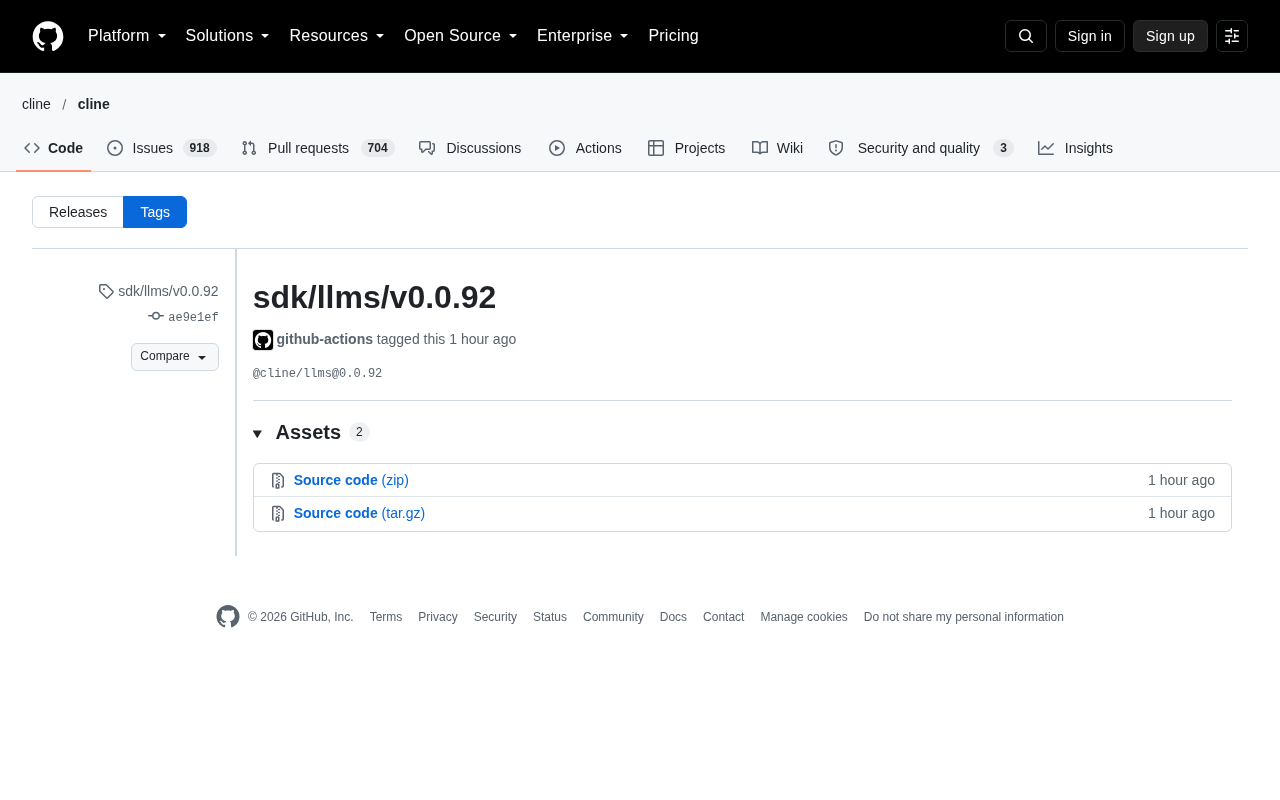
The raw material here is a single GitHub release record: sdk/llms/v0.0.92, corresponding to the package @cline/llms@0.0.92. It was automatically tagged by github-actions on October 8th at 05:09, with a commit hash of ae9e1ef. The phrases "Sorry, something went wrong" and "There was an error while loading" that appear prominently on the page are not part of the release notes — they're GitHub's placeholder messages for failed page loads.
In other words, this release contains no meaningful changelog or feature description. It looks more like an artifact produced by an automated pipeline. The version number v0.0.92 tells us this is an early-stage package still in the 0.x cycle, not yet in a stable release cadence.
What the Name Suggests
The npm scope @cline/llms offers a few clues. Cline is an AI coding assistant project that has been gaining traction in the developer community, known for autonomously executing coding tasks inside editors like VS Code. The llms sub-package, as the name implies, is likely the module responsible for unifying and adapting interfaces across various large language model (LLM) providers.
This kind of SDK sub-package typically handles:
- Abstracting API differences across model providers (OpenAI, Anthropic, Google, etc.)
- Maintaining model registries, context window sizes, pricing metadata, and similar information
- Handling common capabilities like streaming output and function calling (tool use)
In an active AI coding tool project, modules like llms tend to be the most frequently updated — model vendors push new versions and capabilities almost every week, and the SDK has to keep pace. A patch number as high as v0.0.92 is a clear indicator of that rapid iteration rhythm.
npm's scope mechanism (the
@org/packagenaming format) was introduced in 2015, allowing organizations to group related packages under a shared namespace — preventing naming conflicts while expressing semantic ownership. For AI tool projects like Cline, splitting core functionality into multiple scoped packages (e.g.,@cline/llms,@cline/core) is standard monorepo practice. Each sub-package can be versioned and published independently, letting downstream consumers pull in only what they need and reducing unnecessary dependency bloat. This pattern is especially common in AI application tooling, where the LLM adapter layer changes far more frequently than UI or core logic — independent maintenance reduces the upgrade friction caused by version coupling.
The Engineering Practice Behind Automated Releases
Notably, this tag was created by github-actions, confirming the project uses a CI/CD-driven automated release workflow. Once a developer merges code, the pipeline automatically increments the version number, creates a tag, builds the artifacts, and publishes to npm. The Assets 2 shown on the release page indicates two build artifacts were attached.
This pattern has become standard practice in modern open-source projects, and the benefits are clear:
- The release process is reproducible and traceable — every version is tied to a specific commit
- It reduces human error and eliminates problems like "forgot to tag the release"
- It supports high-frequency, small-step releases, which aligns well with the rapid iteration typical of the
0.xphase
The tradeoff, however, is that automated releases often lack hand-written release notes. For versions like this one with no Release Notes, users have no choice but to compare commits or consult a changelog to understand what actually changed.
Under the Semantic Versioning (semver) specification, a
0.x.yversion signals that the project has not yet declared a stable public API — any minor or patch increment may include breaking changes. A version likev0.0.92, sitting at the0.0.xlevel, is especially notable: in projects that strictly follow semver,0.0.xtypically indicates an extremely early experimental phase where the API may be refactored at any time. In practice, however, many projects use high-frequency0.0.xincrements as a substitute for granular change management — treating each release as a "continuous delivery snapshot" rather than a strict semantic version. Understanding this distinction helps users accurately assess upgrade risk: a patch-level increment alone is not sufficient reason to assume a change is safe.
What This Means for Users
If you're integrating or depending on @cline/llms, here's what to do when faced with a release record this sparse:
- Check the commit diff: Use GitHub's Compare feature to diff
v0.0.91againstv0.0.92, read the code changes directly, and assess whether any breaking changes are involved. - Watch for model adapter updates: Minor version updates in this kind of sub-package most likely add support for a new model or adjust interface parameters — these are generally safe to upgrade.
- Pin your version: In production environments, it's worth pinning
0.xdependencies to an exact version to prevent unexpected behavior from automatic upgrades.
A Note of Honesty
It's worth being upfront: the actual information content of this raw material is very limited. At its core, it's just an automatically generated version tag — no feature descriptions, no technical details. Most of the analysis in this article is built on reasonable inferences drawn from the @cline/llms name and version number, not from anything the release itself explicitly states.
For readers who want to understand the specific changes in this version, the most reliable path is still to visit the project's GitHub repository directly and review the actual diff for commit ae9e1ef alongside the project's maintained changelog.
Related articles

Chain of Thought Isn't Just for AI: How Humans Can Use CoT to Improve Thinking Quality
Chain of Thought isn't just a prompt trick for large models. Starting from a Hacker News discussion, this article analyzes why CoT works for human thinking too, breaks down actionable ways to transfer it, and highlights the key differences between human CoT and machine CoT.
Cloudflare Teams Up with OpenAI: Closi…
Cloudflare Teams Up with OpenAI: Closing the Loop from Vulnerability Discovery to Defense with AI
Cloudflare uses OpenAI Daybreak to investigate security vulnerabilities and generate reviewable remediation plans, while developers use Codex to boost coding efficiency and quality.

Orca Multi-Agent Orchestration in Practice: A Guide to Parallel Collaboration with Claude and Codex
Orca is Stable AI's free open-source agent workbench supporting 34 agents like Claude Code and Codex in parallel. Learn its Git worktree isolation, multi-model orchestration, and mobile management.