Decoding Anthropic's S-1: Most of the $80.7B Loss Is Just Accounting
About 90% of Anthropic's $80.7B net loss is non-cash accounting; the business already posted a quarterly profit.
After Anthropic filed its prospectus, the "$80+ billion H1 loss" drew attention, but the document shows about $72.4B of the $80.7B net loss comes from fair value remeasurement of convertible notes and another ~$8.8B relates to core note agreements—all non-cash accounting. The true operating loss is just $693M, and Q2 saw a $974M quarterly operating profit, the first ever. H1 operating cash flow was a positive $3.929B, cumulative financing ~$141.1B, cash plus short-term investments ~$131.7B, but the company faces massive rigid compute commitments to Google, Amazon, Microsoft, SpaceXAI, Broadcom, and others. In governance, it is a Delaware PBC, founders hold a fixed 50.1% voting power via Class F shares, and Class A shareholders have a weak voice.
After Anthropic filed its IPO prospectus, headlines about a "$80+ billion loss in the first half" spread quickly. The number is indeed alarming, but breaking the document down leads to a completely different conclusion: about 90% of that loss is accounting-driven book figure, not cash actually leaving the company.
Revenue Is Soaring, Losses Are on Paper
Start with the fundamentals. According to the prospectus, Anthropic's revenue reached $16.286 billion in the first half of 2026, roughly 14 times the same period last year; the second quarter alone brought in $11.555 billion. That growth rate is staggering in any industry.
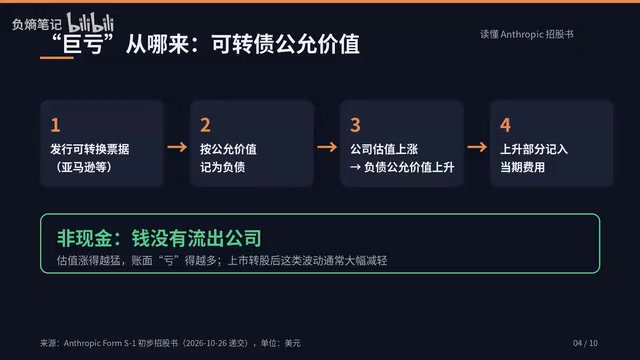
So where does the $80.7 billion net loss come from? The key lies in convertible notes. Anthropic issued convertible bonds to investors including Amazon, which can be converted into equity in the future and must be recorded as liabilities at fair value under accounting rules. The faster the company's valuation rises, the more valuable these notes become, and the liabilities swell accordingly—with the increase recognized as an expense in the current period. No cash outflow is involved in this process.
Breaking down the $80.7 billion net loss for the first half of 2026: about $72.4 billion comes from this fair value remeasurement, with another roughly $8.8 billion related to core note agreements. The operating loss truly tied to the business is only $693 million. More importantly, the second quarter saw a single-quarter operating profit of $974 million—the company's first ever quarterly operating profit. The blue line (operating loss) is narrowing, while the red line (book net loss) is amplified by valuation—the divergence between these two lines is the first key to understanding this prospectus.
Fair value remeasurement of convertible notes is the key to understanding this massive book loss. Convertible notes are essentially a hybrid financing instrument: investors put in funds in the form of debt, with an agreement to convert into equity under specific conditions in the future. In accounting treatment, such instruments are typically classified as financial liabilities measured at fair value through profit or loss. Because the conversion price is often linked to the company's valuation, when the valuation rises rapidly, the conversion value of the notes rises accordingly, and the fair value of the liability swells in tandem. Under accounting standards, the increase in liability value must be recognized as a current-period loss and recorded on the income statement. But this "loss" does not correspond to any cash outflow—the company hasn't actually paid this money; the liability line item on the books has simply grown larger. Conversely, if the company's valuation falls, this liability shrinks and actually produces a "gain" on the income statement. Therefore, such losses are highly volatile and non-cash in nature, and should be distinguished from true operating performance in analysis.
The Money Pouch: Financing, Cash, and Compute Contracts
As of the end of June, Anthropic had raised approximately $141.1 billion in cumulative financing, with cash and short-term investments of about $131.7 billion. Operating cash flow for the first half was a positive $3.929 billion, indicating that the day-to-day business is already bringing in money rather than relying solely on financing to stay afloat.
But on the other side are massive compute commitments. The major items disclosed in the prospectus include: Google at least ~$114.5 billion, Amazon at least $110 billion, Microsoft at least $44.9 billion, SpaceXAI up to ~$120.5 billion, Broadcom-related lease rent of ~$161.2 billion, plus suppliers such as Nscale, Lambda, and AMD. Most cloud and compute contracts are "pay whether you use it or not" in nature.
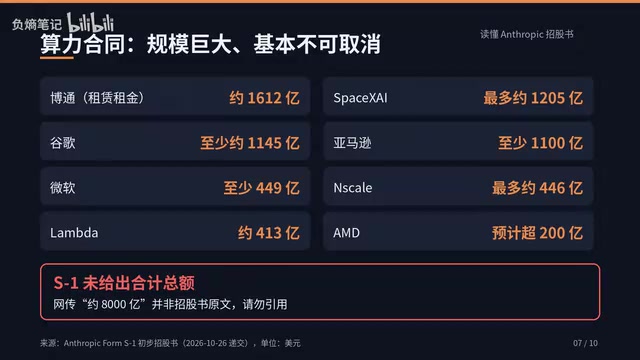
A special reminder here: the prospectus does not give a total figure for compute commitments, and the "$800 billion" figure circulating online is not in the original text—be cautious when citing it.
Governance Structure: A Controlled Public Benefit Corporation
Anthropic's corporate structure is quite unusual. It is a Delaware public benefit corporation (PBC), required to balance public interest. The Long-Term Benefit Trust (LTBT) holds Class T shares and elects a majority of the board. The seven founders hold Class F shares through an LLC, locking in 50.1% of voting power.
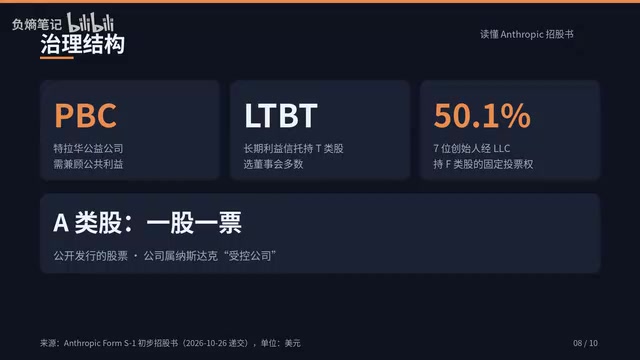
Publicly offered Class A shares carry one vote each, and the company qualifies as a "controlled company" under Nasdaq rules. This means ordinary shareholders have fairly limited influence over major decisions, with voting control locked in the hands of the trust and founders for the long term.
Delaware public benefit corporation (PBC) is a special corporate legal form in the United States, established under Delaware's Public Benefit Corporation Act effective in 2013. Unlike ordinary companies, a PBC commits in its charter to pursuing one or more specific public benefit goals and requires the board to balance shareholder interests with the public benefit mission in decision-making, rather than maximizing shareholder value as the sole objective. A PBC must also publish periodic benefit reports disclosing progress toward its public benefit goals. This structure is often adopted by mission-driven tech companies to lock in their social commitments at the legal level and reduce the risk of being swayed by short-term capital logic. However, PBC status does not grant tax-exempt status nor mandate external certification; its actual binding force depends on the specific design of charter provisions. For investors, a PBC means the company's decision-making objectives are more diverse, and the traditional "shareholder primacy" analytical framework needs to be adjusted accordingly.
The Long-Term Benefit Trust (LTBT) and dual-class share structure are central to understanding Anthropic's control arrangements. The Long-Term Benefit Trust is a special trust vehicle whose trustees are entrusted with a long-term management mission; it holds a specific class of company shares (Class T here) and elects a majority of the board based on that, thereby holding governance leadership without relying on economic ownership percentage. Meanwhile, the company uses a multi-tier share structure: founders hold a fixed 50.1% of voting power through Class F shares, while publicly listed Class A shares carry one vote each. This arrangement leaves external public shareholders, despite providing substantial capital, clearly disadvantaged at the voting level. Nasdaq rules designate such companies as "controlled companies," allowing them to exempt certain independent director and governance committee requirements. Dual-class structures are not uncommon among tech companies, but the cost is that external shareholders find it difficult to change the company's strategic direction through voting, making investment decisions more dependent on trust in management and trust trustees.
Risk Section: Four Items Worth Reading Closely
Among the risk factors in the prospectus, four deserve particular attention.
Internal loss of control risk. Claude's role in writing code and conducting security research is growing, and some processes may become difficult for anyone to fully understand and control. This is a governance challenge unique to AI companies.
Rigidity of compute commitments. If demand falls short of expectations, the company will still have to pay for a large number of idle contracts. There is a hidden risk of time mismatch between revenue growth and cost commitments.
Conflict with the government. After the company refused uses involving domestic mass surveillance and fully autonomous weapons, it was designated a supply chain risk by the Department of Defense, and related litigation is ongoing.
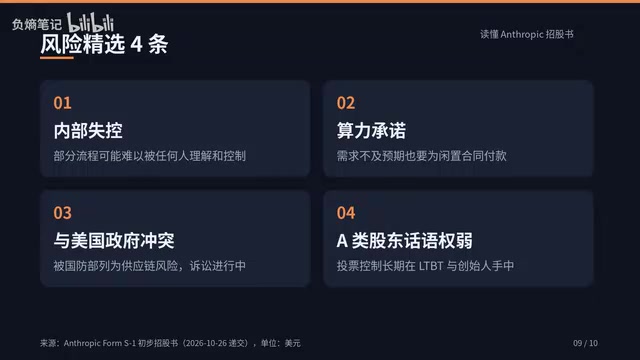
Weak voice for Class A shareholders. Voting control remains in the hands of the trust and founders for the long term, making it difficult for external shareholders to change the company's direction.
How to Read This Prospectus
Don't fixate on the net loss figure alone. The reading order should be: first look at operating profit to judge whether the business itself is improving; then look at operating cash flow and cash on hand to judge whether the company has the ability to self-generate cash; finally look at compute contracts and governance structure to judge long-term costs and where decision-making power lies.
Also note that this is a preliminary prospectus, and figures and terms may be revised later. To read the original, search for Anthropic's S-1 filing on the U.S. SEC website.
Related articles

ECC: Making AI Coding Assistants Work Like an Engineering Team
ECC, an open-source repo with nearly 300K GitHub stars, adds engineering discipline to AI coding assistants: plan first, write tests, then implement, with independent review, 71 specialized assistants, 314 skills, and built-in security scanning. Compatible with Codex, Cursor, Gemini, and more.

Don't Just Use ChatGPT! These 5 AI Tools Are More Professional
Stop throwing every task at ChatGPT. This article covers Perplexity, Notebook LM, Gama, Claude, and Cursor — five specialized AI tools for research search, document comprehension, presentation creation, writing ideation, and AI programming, helping you pick the right tool for each scenario and boost daily efficiency.

Cursor IDE: Generate Code with Natural Language and Say Goodbye to Repetitive Boilerplate
Cursor IDE lets you describe components like login forms or dashboards in natural language, instantly generating code that integrates into your existing project. We break down its workflow, integration capabilities, and limits.