Decoding the Hacker News Ranking Algorithm: Scoring, Controversy Detection, and Penalty Mechanisms

How Hacker News ranks content: time decay, controversy penalties, and opaque human interventions explained.
Hacker News front page rankings are governed by three interlocking mechanisms: a time-decay formula where vote returns diminish and posts rapidly lose value over time; a controversy penalty that downranks posts where comments far outpace votes; and a multi-layered penalty system covering domain blacklists, keyword filtering, vote manipulation detection, and manual admin intervention. Together, these form a hybrid of algorithmic automation and human editorial judgment — the underlying logic that has helped HN maintain a high signal-to-noise ratio over the long term.
Hacker News (HN) is one of the most influential content aggregation platforms in the tech world, and its front page ranking has long been a focal point for content creators and product marketers alike. Why do some posts with a large number of votes never make it to the top? Why do certain high-engagement discussions get quietly suppressed? A classic technical deep-dive, based on analysis of HN's open-sourced Arc codebase, reveals the real logic behind this ranking system.
The Core: Gravity Decay Formula
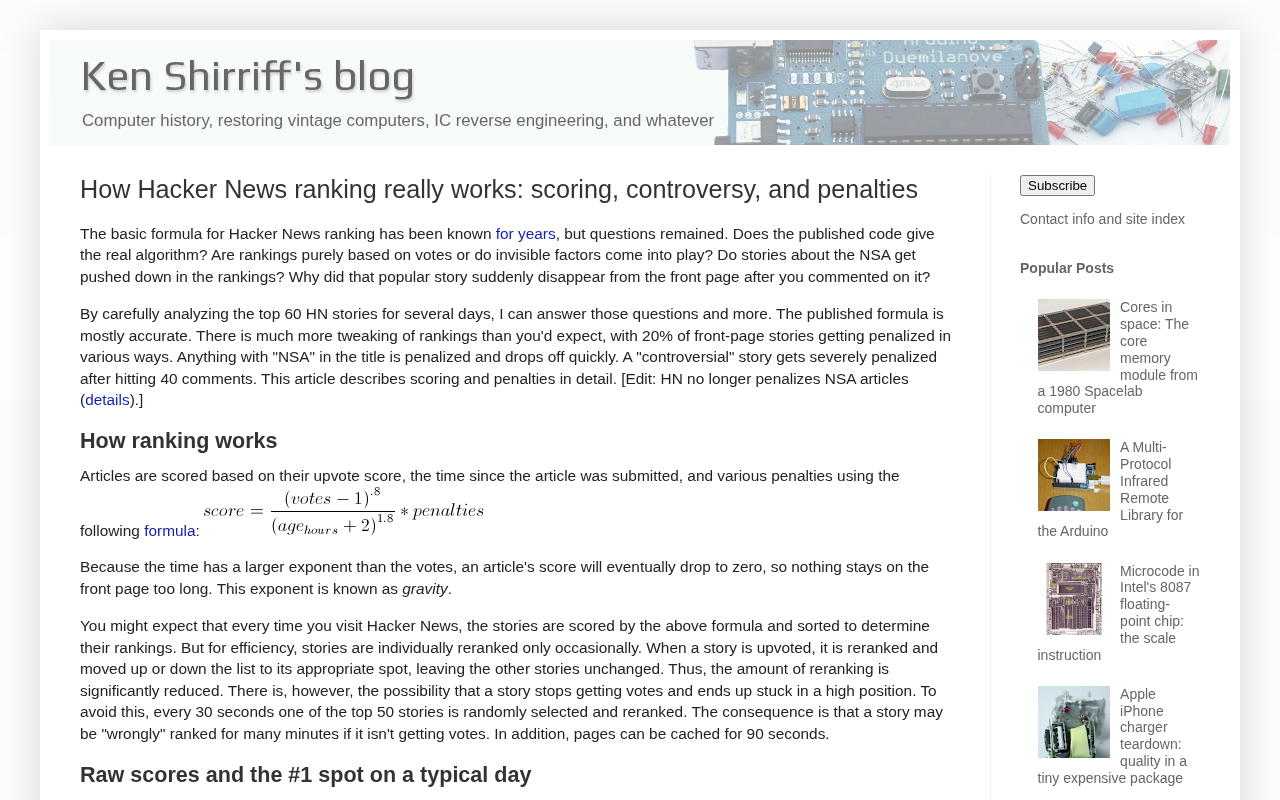
Hacker News's base ranking isn't particularly complex. At its heart is a classic time-decay formula:
score = (votes - 1) ^ 0.8 / (age_hours + 2) ^ 1.8
This formula has three key design choices. In the numerator, the vote count uses an exponent of 0.8, meaning the returns from votes are diminishing — the 100th vote is worth far less than the 10th. This discourages simply piling on votes to game the system. The denominator is the post's age, decayed with an exponent of 1.8, meaning a post's score drops rapidly over time.
The +2 in the denominator is a clever smoothing term that prevents brand-new posts (where age is close to 0) from receiving an artificially inflated score due to a near-zero denominator, making the ranking curve more natural. The overall effect of this formula is that a post needs to accumulate votes quickly after being submitted in order to capture and hold a front page position — otherwise it gets buried by fresher content.
This type of time-decay formula is known in information aggregation systems as a "Gravity Model." Reddit's early hot-ranking algorithm used a similar design philosophy. At its core, it simulates the "attention economy" — the value of information decays exponentially over time, and the system must continuously surface fresh content. Without this, early posts would permanently dominate the top, creating a Matthew Effect. HN's choice of a 1.8 decay exponent rather than the more common 2.0 results in a relatively "gentle" decay curve, giving high-quality older posts a small survival window. The 0.8 vote exponent directly compresses the payoff from large-scale vote farming, making the ranking impact of votes from the 1st to the 100th follow a power-law decline rather than a linear one. Arc is a Lisp-dialect programming language written by Paul Graham in his early years; HN was originally built with it, and the public availability of its source code has enabled systematic reverse engineering of the ranking logic.
Controversy Detection: Too Much Discussion Can Hurt Your Rank
Time decay alone doesn't explain all of HN's behavior. The analysis reveals that HN also incorporates a dedicated controversy penalty mechanism. When a post's comment count significantly exceeds its vote count, the system classifies the discussion as controversial or off-topic and penalizes its ranking accordingly.
Specifically: if the comment count exceeds the vote count and surpasses a certain threshold (roughly 40 comments), the ranking score is reduced by the square of the comment-to-vote ratio. The intent is clear — HN wants its front page to surface high-quality content with consensus value, not topics that merely fuel flame wars, political arguments, or emotional conflict.
This explains a common phenomenon: some posts have extremely heated comment sections with endless arguments, yet their position on the front page doesn't rise — it falls. In HN's value system, heated arguments are not the same as quality content.
The Hidden Penalty System: Opaque Manual and Automated Interventions
Perhaps the most thought-provoking part of the analysis is the revelation that HN has multiple layers of penalty factors. Beyond automated controversy detection, the ranking formula includes a penalty multiplier that can be adjusted by admins or the system directly to suppress a specific post's score.
By comparing posts' actual rankings against their theoretically calculated rankings, the author found that many posts had clearly been penalized. The triggers for these penalties vary widely:
- Domain penalties: Certain sites (e.g., domains perceived as overly promotional) are systematically downranked
- Keyword penalties: Posts with certain sensitive words or clickbait terms in the title are affected
- Self-promotion penalties: Content suspected of vote manipulation or excessive self-promotion is suppressed
- Manual admin intervention: Editors can directly downrank posts
The existence of this penalty system means HN's rankings are far from a purely algorithmic outcome — they are a hybrid of automated algorithms and human editorial judgment. This opacity is the source of the "controversy" referenced in the article's title: there have long been voices in the community questioning the lack of publicly stated standards for these manual interventions.
This "algorithm + human" hybrid content governance model is academically referred to as "Algorithmic Editorialization." Compared to pure crowdsourced ranking (like early Digg) or pure human editorial curation (like traditional media), it seeks a balance between efficiency and consistency — but also faces "black box" criticism: users can't know why their post was penalized, and appeal channels are extremely limited. HN's management team has long deliberately maintained this opacity; their official stance is that publishing specific penalty rules would make it easier for bad actors to game the system. This approach mirrors Google's strategy of keeping its search algorithm confidential. It's also worth noting that HN has a "hellbanning" mechanism — content posted by flagged users appears normally to those users themselves, but is completely invisible to everyone else. The affected user typically has no idea they've been shadowbanned, making it another covert tool the platform uses to combat harassment and spam.
Implications for Content Creators
Understanding this system has real practical value for anyone hoping to gain visibility on HN.
First, speed matters enormously. Due to the exponential nature of the decay formula, the first few hours after a post is submitted are the decisive window. Early votes carry the highest marginal value. Second, more comments aren't always better — if a piece of content triggers arguments rather than constructive discussion, it may activate the controversy penalty.
More importantly, attempting to manipulate rankings through vote farming, clickbait titles, or aggressive marketing is likely to run straight into HN's penalty wall. This system is designed to be resistant to manipulation and retains ultimate discretionary authority through human intervention.
A Note on Timeliness
It's worth noting that this analysis is based on HN's publicly released early Arc source code, and represents a reverse-engineering of the algorithm at a specific point in time. HN's ranking logic continues to evolve, and specific parameters, thresholds, and penalty rules may have since changed. But its core design philosophy — maintaining freshness through time decay, filtering low-quality discussions through controversy detection, and preserving community quality through penalty mechanisms — has almost certainly persisted to this day.
This is also why this article continues to be widely discussed years later (earning nearly 200 points and over a hundred comments): it reveals not just a few lines of code, but the complete thinking behind how a high-quality tech community uses a combination of algorithms and human judgment to defend its content standards.
Related articles

Chain of Thought Isn't Just for AI: How Humans Can Use CoT to Improve Thinking Quality
Chain of Thought isn't just a prompt trick for large models. Starting from a Hacker News discussion, this article analyzes why CoT works for human thinking too, breaks down actionable ways to transfer it, and highlights the key differences between human CoT and machine CoT.
Cloudflare Teams Up with OpenAI: Closi…
Cloudflare Teams Up with OpenAI: Closing the Loop from Vulnerability Discovery to Defense with AI
Cloudflare uses OpenAI Daybreak to investigate security vulnerabilities and generate reviewable remediation plans, while developers use Codex to boost coding efficiency and quality.

Orca Multi-Agent Orchestration in Practice: A Guide to Parallel Collaboration with Claude and Codex
Orca is Stable AI's free open-source agent workbench supporting 34 agents like Claude Code and Codex in parallel. Learn its Git worktree isolation, multi-model orchestration, and mobile management.