Decoding the OpenAI Astra Rumors: Can AI Conquer Frontier Mathematics?

Analyzing the OpenAI Astra rumors, compute cost trends, and AI's real capabilities and limits in frontier mathematics research.
Rumors of OpenAI's internal model Astra achieving 10 breakthroughs in mathematics have sparked debate about AI's research capabilities. This article examines why math serves as a litmus test for AI reasoning, how collapsing inference costs and model efficiency gains could accelerate progress, real-world experiences of AI as a research assistant (including its tendency to override original ideas with mainstream consensus), and why human judgment remains essential for truly original work.
The Astra Rumors: Is AI Starting to Crack Frontier Mathematics?
Recently, a rumor about OpenAI's internal model "Astra" has sparked heated discussion on Reddit and other communities: the model has allegedly achieved 10 major breakthroughs in mathematics and theoretical computer science. Although OpenAI has not officially published any related papers or made formal announcements, the news quickly ignited community debate about the boundaries of AI's research capabilities.
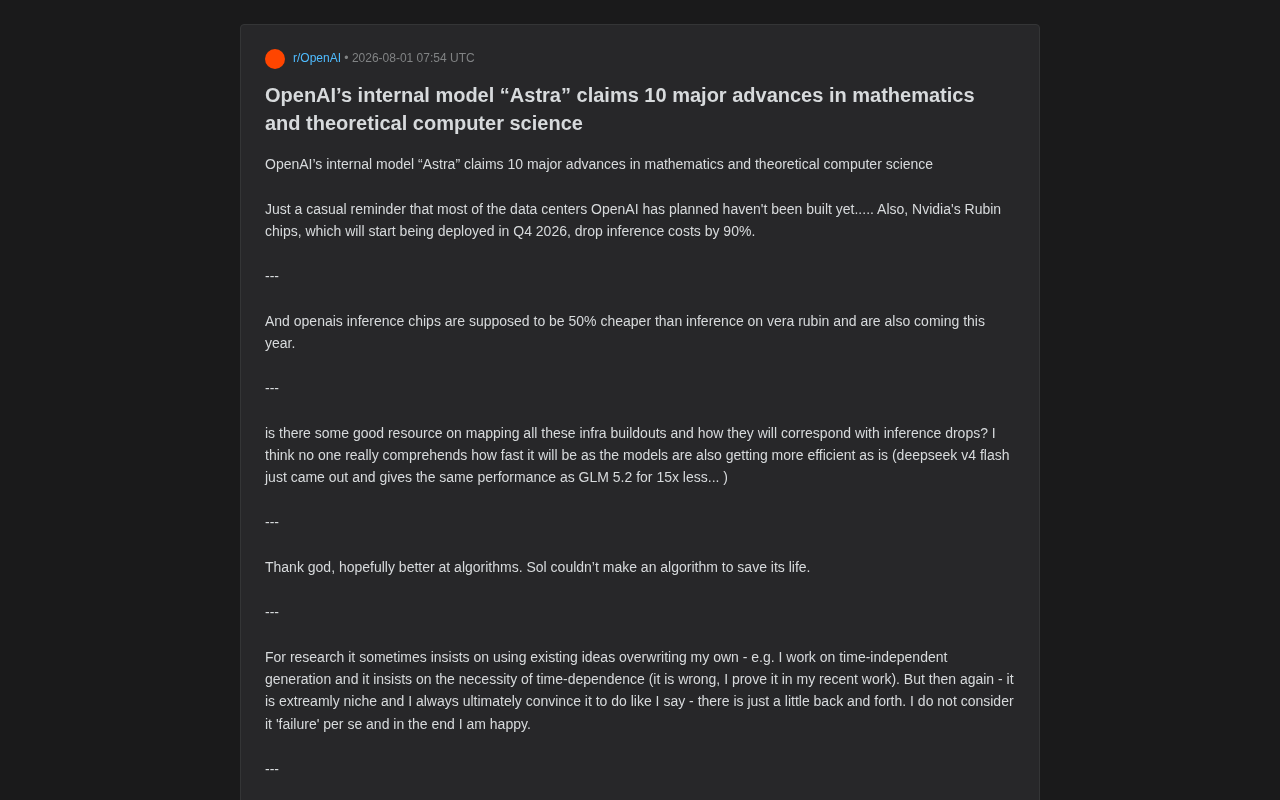
To be clear, all current information comes from community rumors and lacks authoritative verification. What exactly these "10 breakthroughs" entail—whether they are entirely original theorem proofs, improvements on existing conjectures, or merely assistance to human researchers in completing derivations—remains unknown. Therefore, this article treats the claims as a lens for observing the evolution of AI's research capabilities rather than established fact.
Why Mathematics Is the Litmus Test for AI Reasoning
Mathematics and theoretical computer science are considered "hard metrics" for measuring AI reasoning because they demand rigorous logical chains and verifiable proof structures. Unlike natural language generation, mathematical conclusions are either correct or wrong—there's virtually no gray area of "sounds plausible." If Astra can truly produce peer-verifiable new results in these fields, it would mark a substantive leap from AI as an "information synthesis tool" to an "independent research partner."
From a technical history perspective, the field of Automated Theorem Proving has decades of accumulated progress—from early formal proof assistants like Coq and Isabelle to DeepMind's more recent AlphaProof and AlphaGeometry. AI's advances in mathematical reasoning have always been incremental. The core challenge is that mathematical proofs require long chains of logical deduction where every step must hold rigorously, and often demand creative "key insights" to break through bottlenecks—such as introducing a seemingly unrelated auxiliary construction or discovering hidden connections between distant fields. This kind of creative reasoning exists in fundamental tension with the pattern matching and statistical continuation that large language models excel at. If Astra has indeed achieved breakthroughs in frontier mathematics, it would suggest the model may have developed some form of structured reasoning that goes beyond simple pattern matching—a qualitative architectural shift rather than a mere quantitative improvement.
Compute Infrastructure: The Underestimated Accelerant of AI Capabilities
One noteworthy perspective from the discussion: current model capabilities may be far from hitting the compute ceiling. Community members pointed out that most of OpenAI's planned data centers haven't been built yet, and the hardware cost reduction curve is steepening.
According to the discussion, Nvidia's Rubin chips are planned for deployment starting Q4 2026, claiming to reduce inference costs by approximately 90%. Going further, OpenAI's custom inference chips are reportedly about 50% cheaper than inference on Vera Rubin and expected to arrive within this year. These figures are all rumors that should be treated cautiously, but they point to a consensus trend: the continued collapse of inference costs.
To understand the technical logic behind these numbers, consider Nvidia's chip iteration roadmap: Hopper (2022) → Blackwell (2024) → Rubin (2026 expected). Each architecture generation typically achieves 2-3x improvement in energy efficiency, and "90% inference cost reduction" stems not only from single-chip performance leaps but also from datacenter-level system optimizations—including doubled NVLink interconnect bandwidth, increased HBM memory bandwidth, and dedicated hardware designs for inference workloads. Notably, inference and training have fundamentally different hardware requirements: inference prioritizes low latency and high throughput, while training emphasizes parallel computing power and large memory capacity. The strategy of companies like OpenAI developing custom inference chips is about trimming redundant training-oriented features to pursue optimal price-performance for inference specifically—similar to Google's rationale when it first introduced TPUs.
The Dual Drivers of Model Efficiency Improvement
Hardware cost reduction is only one side of the story; optimization of the models themselves is equally rapid. One user cited the newly released DeepSeek V4 Flash, which reportedly achieves performance comparable to GLM 5.2 at "1/15th the cost." While such claims haven't been verified through rigorous benchmarks, they reflect a real industry trend: models are simultaneously becoming more powerful and more efficient.
Model efficiency optimization involves coordinated breakthroughs across multiple technical dimensions: knowledge distillation compresses large model capabilities into smaller models; quantization compresses model weights from FP16/FP32 to INT8 or even INT4, reducing memory footprint and computation by several fold; sparse activation (such as Mixture of Experts architectures) activates only a subset of parameters per inference—for example, DeepSeek V3 has 671 billion total parameters but only activates approximately 37 billion per inference, making actual computation far less than an equivalently-sized dense model; Speculative Decoding uses a small model to pre-generate candidate tokens that are then batch-verified by the large model, partially parallelizing what was previously serial generation. When these software-level optimizations stack on top of hardware cost reductions, the rate of decline in per-unit inference cost may exceed the historical pace of Moore's Law.
When hardware cost reduction and model efficiency improvement create a compounding effect, the combined acceleration may far exceed linear expectations. As one community member put it: "Nobody really understands how fast this process will be." This exponential co-evolution of infrastructure and efficiency may be the key context for understanding whether frontier models like Astra can scale.
AI Research Assistants in Practice: Capabilities and Limitations Coexist
Setting aside rumors, the firsthand feedback in the discussion about AI's actual performance in research and algorithmic work is more informative—and reveals clear disagreements.
How Good Is AI at Algorithm Design, Really?
One user complained that AI "can't save you" in algorithm design, while another—a self-described senior engineer who spent 15 years as chief algorithm developer at an S&P 500 company—completely disagreed, arguing that the model performs "exceptionally" in algorithms and demanding specific examples, otherwise presuming it to be "a user problem."
This debate reveals a common phenomenon: assessments of AI capabilities are highly dependent on the user's expertise level and how they articulate their needs. One observer pointedly noted that when non-technical users say "write an algorithm," they often actually mean "implement some functionality for me in one shot," and the phrase "make an algorithm" is itself "extremely vague"—potentially covering everything from sorting implementations to complex system design. The mismatch between expectations and the precision of prompts is often the root cause of experience gaps.
Does AI "Stubbornly" Override Original Ideas?
Another user working on "time-independent generation" research shared an intriguing detail: the model sometimes overrides his original ideas with mainstream established views—for instance, insisting that time-dependence is necessary, even though the researcher had already proven this view incorrect in recent work.
However, he added that this is an extremely niche field, and after a few rounds of back-and-forth, he could always convince the model to follow his reasoning, so it's "not a failure"—the final results were satisfactory. This case reveals a fundamental characteristic of current AI research assistance: models tend to regress toward the "majority consensus" in their training data, and when facing truly cutting-edge, counterintuitive original research, they may become objects that need to be "corrected" rather than leaders.
From a technical standpoint, this phenomenon is inevitable. Large language models essentially learn conditional probability distributions over massive text corpora through maximum likelihood estimation, so their outputs naturally bias toward views and expression patterns that appear more frequently in training data. During the RLHF (Reinforcement Learning from Human Feedback) alignment stage, this tendency may be further reinforced, since human annotators often label preferences based on mainstream academic consensus. For frontier researchers, this means models exhibit a kind of "knowledge inertia" when confronted with original hypotheses that contradict mainstream views—they repeatedly pull discussions back toward known frameworks. This isn't the model's "deliberate" resistance but a direct manifestation of its statistical nature. Overcoming this limitation requires researchers to have clear guidance capabilities, using precise context-setting and step-by-step reasoning instructions to override the model's default prior distribution.
A Sober Assessment: The Distance Between Rumors, Trends, and Reality
Taken together, Astra's "10 breakthroughs" remains an unverified rumor that warrants caution. But the discussion surrounding it touches on several real and important trends:
First, the dual acceleration of compute infrastructure and model efficiency is a definitive direction—even if specific numbers await verification, the macro trend of cost decline cannot be ignored. Second, AI already has practical value in professional research and engineering scenarios, but its performance is highly dependent on the user's expertise and ability to express requirements. Third, AI still has limitations in truly original research—its tendency to regress toward consensus means human researchers' judgment remains irreplaceable.
If OpenAI or other institutions do eventually publish peer-verified AI mathematical results, it will be a milestone event. But until then, the rational stance is: neither blindly joining the "AGI is here" celebration nor dismissing the solid infrastructure and efficiency progress underlying technological evolution.
Key Takeaways
Related articles

Prompt Golf: A Competitive Game Where You Get AI to Say a Target Word Using the Fewest Characters
Prompt Golf gamifies prompt engineering: guide AI to say a target word using the fewest characters. Features live leaderboards, friend challenges, and replay learning.

Macrobite: Snap a Photo to Calculate Nutrition, Making Macro Tracking Effortless
Macrobite is an AI-powered nutrition tracking app that identifies food nutrients from photos, supports voice logging and Apple Watch integration, making macro tracking fast and simple.

Otiumz Deep Dive: A New Paradigm for AI-Powered Multi-Identity Social Apps
Deep dive into AI social app Otiumz: its subaccount system for multi-identity management and AI digital selves that lower social friction. How Otiumz carves a new niche at the intersection of AI companionship and multi-identity social networking.