Decomposing LLM Controllability: A Three-Factor Framework of Capacity, Responsiveness, and Alignment

A three-factor framework decomposes LLM activation steering effectiveness into capacity, responsiveness, and alignment.
This paper systematically answers a long-standing question in activation-space intervention research: why do some concept directions genuinely change model outputs while others fail or backfire? The authors model causal influence as the product of three independent factors — capacity, responsiveness, and alignment — and validate across 4 model families and 50 concepts that all three are necessary. Low capacity cuts effect by 84%, low responsiveness by 95%, and low alignment can reverse intervention direction entirely. Building on this, the paper proposes causal probes that constrain training to the causally effective subspace, achieving 17–118% steering improvements with only 3% detection accuracy loss.
Why Some Latent Structures Can Steer Model Outputs While Others Cannot
Locating latent structure in the activation space of language models has long been central to understanding and controlling model behavior. Researchers use linear probes, steering vectors, and similar tools to identify directions that represent specific concepts (such as "sentiment" or "factuality"), then intervene along those directions to guide model outputs.
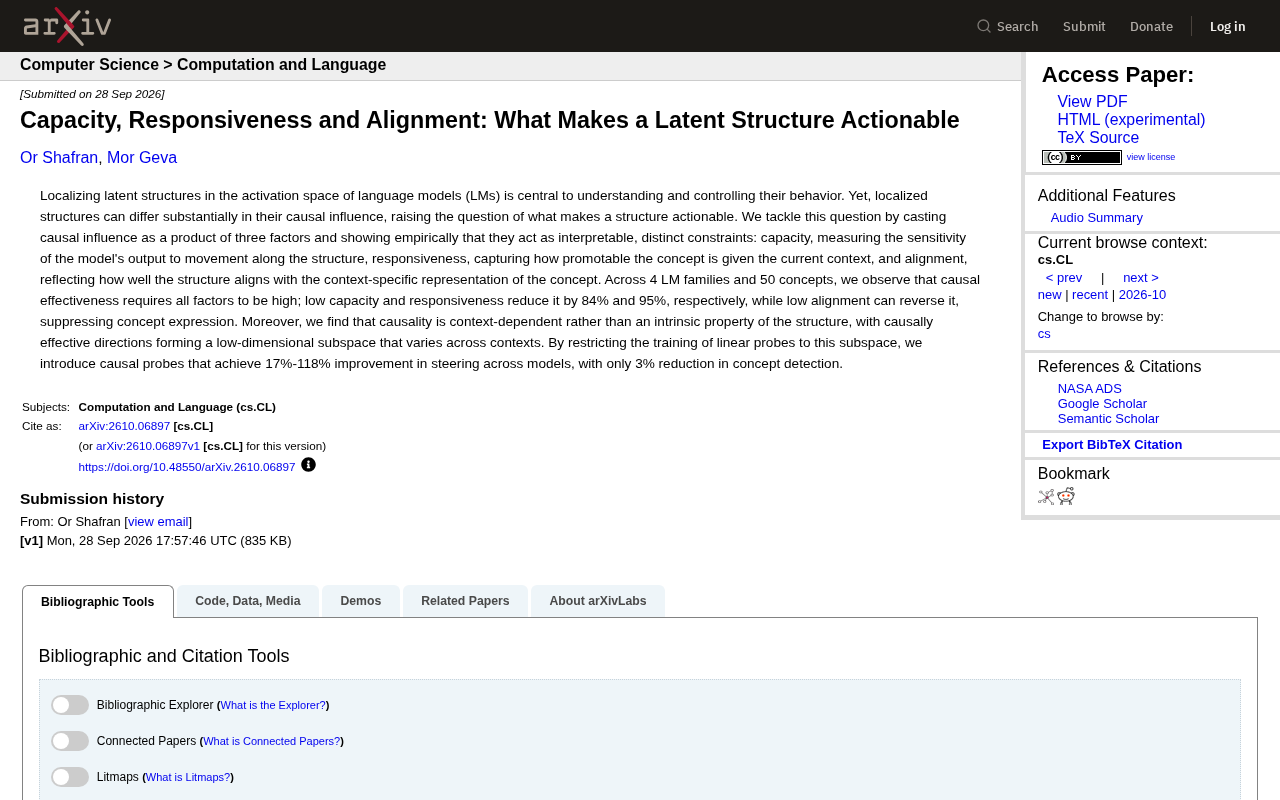
Yet a persistently overlooked question remains: not all located structures carry equal causal influence. Two "concept directions" can look identical on the surface, but one may dramatically change model outputs while the other proves nearly useless — or even counterproductive. A new arXiv paper (arXiv:2610.06897) tackles exactly this question: what actually makes a latent structure genuinely actionable?
Decomposing Causal Influence into Three Interpretable Factors
The paper's core contribution is modeling the causal influence of a latent structure as the product of three factors, and demonstrating through experiments that these are mutually independent, interpretable constraints:
Capacity
Capacity measures how sensitive model outputs are to movement along a given structure. In simple terms: when you push activations along this direction, does the output actually change? Low capacity means the direction has weak leverage over the output.
Capacity is analogous to impedance in an electrical circuit: even if the signal direction is correct, high impedance in the pathway means the output receives no effective drive. In activation space, a direction may genuinely encode a concept, yet if subsequent computation layers are insensitive to changes along that direction — suppressed, for instance, by normalization or attention mechanisms downstream — interventions along it cannot propagate to the final output. This explains why a linear probe can "find" a direction (probing only requires that the direction exists) without that direction having any meaningful effect on the model's generative behavior. A low-capacity direction is "real" at the representational level but "mute" at the functional level.
Responsiveness
Responsiveness captures how readily the concept can be "pushed" in the current context. It reflects whether the context itself provides room for that concept to be expressed. Even with the right direction, if the context simply does not support the concept, an intervention will struggle to take hold.
Alignment
Alignment reflects how well the structure matches the concept's actual representation in a specific context. A direction may be approximately correct, but if it deviates from how the concept is truly represented in the current context, the intervention's effect is diminished — or even reversed.
Experiments Confirm: All Three Factors Are Necessary
The research team conducted systematic validation across 4 language model families and 50 concepts, arriving at a clear conclusion: causal effectiveness requires all three factors to be high simultaneously.
The numbers are compelling:
- Low capacity reduces causal effect by 84%
- Low responsiveness reduces causal effect by 95%
- Low alignment is the most dangerous — it does not merely weaken the effect, but can reverse the intervention direction, actively suppressing concept expression
This means that when trying to steer a model through activation interventions, even a roughly correct direction can fail entirely or backfire if any single factor falls short. It also explains why many seemingly reasonable directions have historically shown unstable performance in steering tasks.
Causality Is Context-Dependent, Not an Intrinsic Property of Structure
Another important finding in the paper corrects a common assumption: causality is not an intrinsic, fixed property of a structure — it depends on context.
The researchers observe that directions with genuine causal efficacy form a low-dimensional subspace, and this subspace shifts with context. In other words, for the same concept under different contexts, the actionable direction may differ. This challenges work aimed at finding "universal concept vectors" — there is no one-size-fits-all direction, and control must account for context.
This finding creates tension with some assumptions in the Representation Engineering field. Earlier work (such as Zou et al., 2023's RepE framework) tended to seek stable "control vectors" across contexts, treating them as reusable intervention tools. But this paper's results show that effective subspaces drift with context, meaning directions extracted from one set of prompts may neither detect nor manipulate the target concept after a context switch. This challenges the engineering practice of building bulk "concept libraries": control vectors cannot be used outside the context in which they were extracted, and all three factors must be validated for the target deployment scenario before use.
Causal Probes: Constraining Training to the Effective Subspace
Building on these insights, the paper proposes a practical method: causal probes.
The idea is straightforward: since genuinely effective directions concentrate in a low-dimensional subspace, constrain the training of linear probes to that subspace rather than searching freely across the entire activation space.
The results are impressive:
- Steering ability improves by 17%–118% across different models
- Concept detection ability drops by only 3%
This is a highly favorable trade-off — a tiny loss in detection precision in exchange for dramatically improved controllability. It demonstrates that "detecting" and "steering" are two distinct objectives, and traditional probes typically optimize only for the former.
Traditional linear probes are trained to maximize concept classification accuracy, so they search the entire activation space for the hyperplane with the highest separability, without distinguishing whether a direction carries causal influence. This "detection-first" optimization often selects directions that are highly correlated with the concept but have no actual control over output — for example, dimensions the model uses only for internal bookkeeping without affecting generation decisions. Causal probes first identify the subspace with high capacity, high responsiveness, and high alignment, then constrain probe training to that subspace, fundamentally aligning the goals of "finding a concept" and "being able to steer that concept." The contrast between 17%–118% improvement in steering ability and just 3% loss in detection accuracy vividly illustrates the structural gap that exists between these two objectives in the full activation space.
Implications for Interpretability and Model Control Research
The value of this work lies in providing a structured analytical framework for the question of when activation interventions actually work. Previously, researchers often searched for directions and conducted interventions empirically, with success carrying an element of luck. The three dimensions of capacity, responsiveness, and alignment decompose the vague notion of "effectiveness" into measurable, diagnosable components.
For researchers working on model safety, behavioral alignment, and interpretability, this framework offers several practical takeaways:
- When an intervention fails, you can diagnose which of the three factors is the culprit;
- Don't expect to find a context-free "universal concept direction";
- When building control tools, prioritize training probes within the causally effective subspace rather than searching the full activation space.
As language models are increasingly deployed in settings that demand controllability and auditability, understanding "which internal structures actually influence outputs" becomes ever more critical. This paper advances that question from the intuitive level to one that is quantifiable and actionable — a meaningful step forward in activation-space interpretability research.
Related articles

Chain of Thought Isn't Just for AI: How Humans Can Use CoT to Improve Thinking Quality
Chain of Thought isn't just a prompt trick for large models. Starting from a Hacker News discussion, this article analyzes why CoT works for human thinking too, breaks down actionable ways to transfer it, and highlights the key differences between human CoT and machine CoT.
Cloudflare Teams Up with OpenAI: Closi…
Cloudflare Teams Up with OpenAI: Closing the Loop from Vulnerability Discovery to Defense with AI
Cloudflare uses OpenAI Daybreak to investigate security vulnerabilities and generate reviewable remediation plans, while developers use Codex to boost coding efficiency and quality.

Orca Multi-Agent Orchestration in Practice: A Guide to Parallel Collaboration with Claude and Codex
Orca is Stable AI's free open-source agent workbench supporting 34 agents like Claude Code and Codex in parallel. Learn its Git worktree isolation, multi-model orchestration, and mobile management.