Deep Agents: From Agent Loop to Managed Service
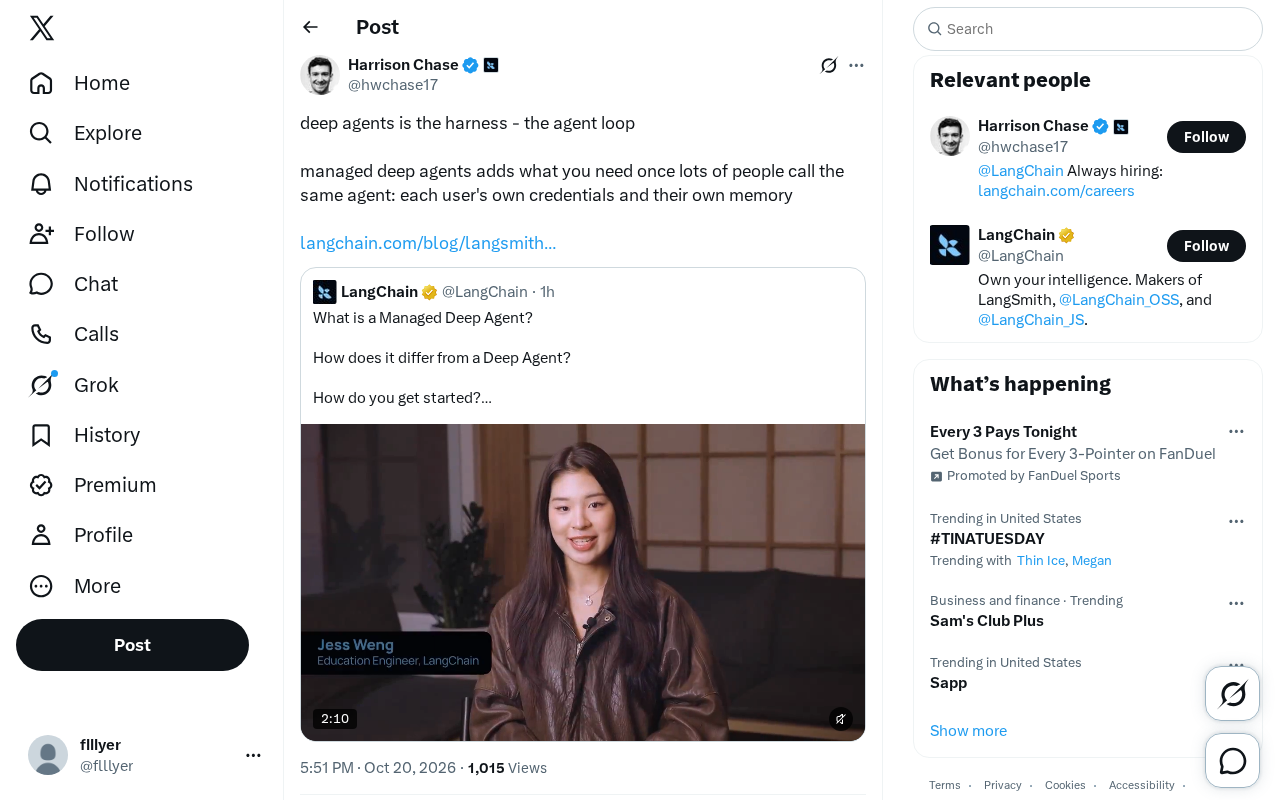
Deep Agents is the harness of the agent loop; the managed version supports multi-user scale through per-user credential and memory isolation.
The article interprets a tweet about Deep Agents: Deep Agents is essentially the harness of the agent loop, driving basic agent operation, while managed Deep Agents adds per-user credentials and memory needed when many users share the same agent. Credential isolation prevents authorization confusion, and memory isolation prevents leakage and contamination. Separating the agent loop from the managed layer is a clear architectural approach with important reference value for teams building or deploying AI agents.
Introduction
If you're building AI agents, you've probably discovered that getting an agent to run is only the first step. The real challenge comes when many users call the same agent simultaneously—how do you manage each user's credentials and memory? Recently, discussion about "Deep Agents" has drawn attention in developer communities, and its core claim is clear: Deep Agents itself is a harness—that is, the agent loop—while "managed Deep Agents" adds the capabilities required when many users share the same agent: per-user credentials and memory.
This short tweet from Twitter, only two sentences long, precisely identifies a critical layer in the agent technology stack: the gap between the basic loop and scale-ready service.
What Are Deep Agents?
According to the original tweet, Deep Agents is described as "harness - the agent loop," a foundational framework or loop mechanism that drives agent operation. In the context of AI agents, the agent loop typically refers to the iterative process in which an agent perceives its environment, makes decisions, executes actions, and observes results. As a harness, Deep Agents manages the operation of this loop and provides core runtime support for the agent.
This layer is the agent's "engine." It defines how the agent thinks and acts, but it does not address the complex requirements of multi-user environments.
The engineering meaning of a harness: In software and AI systems, a harness (literally a "restraining harness") usually refers to an outer layer that wraps core logic and provides a runtime environment and standard interfaces. It handles scheduling execution, injecting configuration, capturing errors, and exposing lifecycle hooks, so the underlying model or algorithm does not need to concern itself with surrounding infrastructure. Calling Deep Agents a harness means it is not equivalent to the model itself, but rather the orchestration layer between the model and tools/environment—deciding when to call tools, how to assemble context, and when to terminate the loop. Understanding this helps distinguish "agent capability" from "agent runtime": the former is determined by the model and prompts, while the latter is determined by engineering implementations such as the harness's scheduling strategy, timeout control, and retry mechanisms.
Typical structure of the agent loop: An agent loop generally includes four stages—perception, planning, action, and observation—and uses conditional checks to decide whether to continue iterating. Common patterns include ReAct (alternating reasoning and action) and Plan-and-Execute (plan first, then execute). Loop termination conditions, maximum step counts, and idempotency handling for tool calls are all details that the harness layer must design. These mechanisms directly determine the agent's reliability, cost, and latency, and they are also where single-user experiments differ most from production environments.
Managed Deep Agents: Solving Scale Pain Points
When agents move from single-user experiments to multi-user production environments, new challenges arise. The original tweet emphasizes that managed Deep Agents adds what is needed when many users call the same agent: each user's own credentials and memory.
This effectively points to two key dimensions:
User Credential Isolation
Each user needs independent authentication and authorization, and the agent must not confuse different users' permissions when executing actions. A managed service needs to provide secure credential management for each user, ensuring the agent accesses external resources under the correct identity.
Common patterns for multi-tenant credential management: In multi-user agent systems, credential isolation is usually implemented in one of three ways. The first is delegated authorization, where the agent acts on behalf of the end user and obtains short-lived tokens through protocols such as OAuth to call external APIs, with permission boundaries limited by token scopes. The second is service accounts plus scope mapping, where the agent uses a unified service identity but internally maintains a mapping table from users to resource scopes. The third is a credential vault, which stores each user's keys encrypted and decrypts them on demand at runtime, avoiding long-term key residency in memory. Regardless of the pattern, the core risk is the "confused deputy" problem—an agent is induced to execute a low-privilege user's request under a high-privilege identity. Therefore, credential isolation is not just a storage problem; it also requires permission checks and audit logging before every tool call.
Independent User Memory
The agent's "memory"—conversation history, context, and personalized state—must be isolated per user to avoid data leakage and context contamination. Managed Deep Agents maintains independent memory storage for each user, enabling the same agent instance to provide personalized service to different users.
Layering of agent memory: An agent's "memory" is usually divided into short-term memory (the context window of the current session) and long-term memory (user preferences and historical facts persisted across sessions). Short-term memory isolation is relatively simple: allocate a separate context per session. Long-term memory, however, requires designing namespaces or partition keys to ensure retrieval does not recall data across users. Common practices include metadata filtering by user ID in vector databases, creating a separate collection for each user, or enforcing tenant constraints at the retrieval layer. It is also necessary to consider memory write permissions, expiration and deletion policies (such as meeting data deletion compliance requirements), and memory contamination—if one user's history is mistakenly written into a shared index, it may affect other users' answer quality and even cause privacy leaks.
Multi-Source Perspectives and Industry Significance
Although this tweet comes from a single source, its viewpoint aligns closely with current trends in the AI agent field. With the rise of the Agent-as-a-Service model, how to host agents efficiently and securely has become a focus for engineering teams. Separating the agent loop from the managed layer is a clear architectural approach: the underlying harness focuses on agent logic, while the upper managed service handles multi-tenancy, identity, and state management.
This layered design helps developers reuse the core agent loop while meeting enterprise-level requirements through the managed layer.
Conclusion
As a harness for the agent loop, Deep Agents provides the foundation for agent operation; managed Deep Agents, by adding per-user credential and memory management, enables it to handle scenarios with large-scale multi-user calls. This distinction is an important reference for teams building or deploying AI agents—while focusing on agent logic, they should not overlook the infrastructure of the managed layer.
One-line Summary
Deep Agents is the harness of the agent loop; the managed version supports multi-user scale through per-user credential and memory isolation.
Paragraph Summary
The article interprets a tweet about Deep Agents: Deep Agents is essentially the harness of the agent loop, responsible for driving the basic operation of agent perception, decision-making, action, and observation; "managed Deep Agents" adds the capabilities required when multiple users share the same agent, with the core being independent credentials and memory for each user. The article points out that credential isolation solves the problem of authentication and authorization without confusion, while memory independence prevents leakage and contamination of conversation history and personalized state. The author argues that separating the agent loop from the managed layer is a clear architectural layering approach: the lower layer focuses on agent logic, while the upper layer handles multi-tenancy, identity, and state management. This is an important reference for teams building or deploying AI agents, reminding developers not to overlook infrastructure at the managed layer while focusing on agent logic.
Related articles

Chain of Thought Isn't Just for AI: How Humans Can Use CoT to Improve Thinking Quality
Chain of Thought isn't just a prompt trick for large models. Starting from a Hacker News discussion, this article analyzes why CoT works for human thinking too, breaks down actionable ways to transfer it, and highlights the key differences between human CoT and machine CoT.
Cloudflare Teams Up with OpenAI: Closi…
Cloudflare Teams Up with OpenAI: Closing the Loop from Vulnerability Discovery to Defense with AI
Cloudflare uses OpenAI Daybreak to investigate security vulnerabilities and generate reviewable remediation plans, while developers use Codex to boost coding efficiency and quality.

Orca Multi-Agent Orchestration in Practice: A Guide to Parallel Collaboration with Claude and Codex
Orca is Stable AI's free open-source agent workbench supporting 34 agents like Claude Code and Codex in parallel. Learn its Git worktree isolation, multi-model orchestration, and mobile management.