Deep Comparison of Four Open-Source AI Coding Agents: DeepSeek Harness vs. Prime Agent vs. Pi vs. OpenCode — Which One Should You Choose?

Four open-source AI coding agents compared: modularity, recursion, minimalism, and maturity.
A deep-dive comparison of four open-source AI coding agent frameworks released in 2026: DeepSeek Harness with its everything-is-a-plugin architecture, Prime Agent's self-rewriting recursive design, Pi's radical minimalism from Flask's creator, and OpenCode's battle-tested maturity with 160K+ GitHub stars. Covers design philosophy, performance benchmarks, security trade-offs, and practical guidance on choosing the right tool.
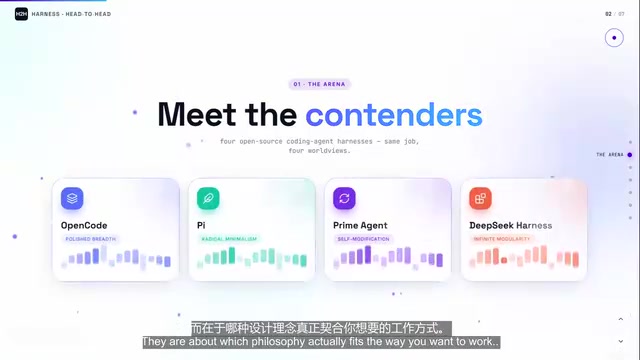
In August 2026, within just ten days, two brand-new open-source coding agent architectures burst onto the scene — DeepSeek released its own Harness framework, and Prime Intellect open-sourced an agent capable of rewriting its own instructions at runtime. They charged straight into a fierce battlefield already occupied by Pi and OpenCode. This isn't a simple product review — it's a philosophical clash between four distinct visions of what a coding agent should be.
What Is a Coding Agent "Harness"?
Before diving into the comparison, it's worth clarifying a concept. The word "Harness" gets thrown around constantly in the community, yet few people actually explain what it means. A harness is a layer of software that wraps around an AI model, transforming a pure text generator into a tool that can actually get work done in a codebase. The concept borrows from the "test harness" metaphor in software engineering — a middleware layer that controls and coordinates execution. In LLM application architecture, this corresponds to what the industry calls the "orchestration layer," responsible for managing the complete loop of model invocations, tool execution, state maintenance, and error handling.
Specifically, a coding agent harness consists of four core components:
- System prompt: Tells the model how to behave
- Tool set: Various capabilities the model can invoke (reading files, editing code, running commands)
- Context management logic: Determines how to trim context when conversations get too long
- Permission system: Decides what the agent can touch without asking
None of this is the model itself. The model handles reasoning; the harness turns reasoning into real, useful action. This distinction matters far more than most people realize — when an AI completes an incredibly difficult task, people tend to give all the credit to the model. But in reality, whether the user experience is good or bad depends largely on how the harness manages context, when it exposes tools, and how it recovers from errors.
This space exploded in 2026 for a simple reason: commercial harnesses like Claude Code, Cursor, and Codex proved that the power of "great harness + powerful model" far exceeds either one alone. Since the harness carries so much core value, why should developers be locked into a single model provider? This is the entire raison d'être of DeepSeekAd Harness, Prime Agent, Pi, and OpenCode — they all advocate that the harness and the model should be decoupled.
DeepSeek Harness: The Everything-Is-a-Plugin Modular Architecture
DeepSeek Harness (DSH) is the youngest contender in this comparison, released on August 13, 2026, alongside DeepSeek V4 Pro, and positioned directly as an open-source alternative to Claude Code. This is no hobbyist project — it's a top AI lab making clear that it wants to control not just the model layer but the underlying toolchain as well.
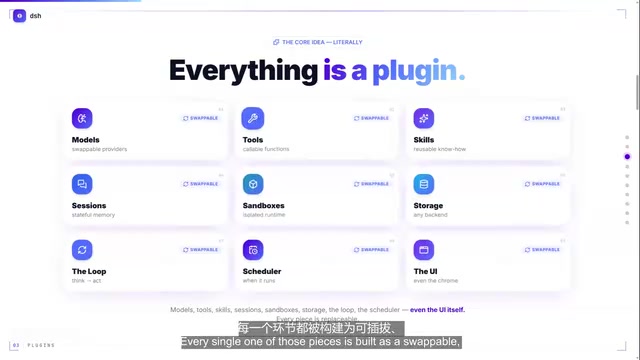
Its core philosophy is distilled in the tagline: Everything is a plugin. The model is a plugin, tools are plugins, and whether it's skills, sandboxes, storage, or the loop that controls the agent's thinking — even the user themselves — every component is designed to be pluggable and swappable. Under the hood, it's built on a framework called Cordis, structured around "spatiotemporal composability" — parts can be recombined without forking or rewriting the entire project. "Spatial composability" means components can be freely combined laterally without coupling; "temporal composability" means the system can dynamically load, unload, and replace components at runtime without downtime or restarts. This design draws from microkernel operating systems and ECS (Entity-Component-System) game engine architectures — a fairly cutting-edge engineering choice for an agent framework.
Getting Started: Grand Vision, Rough Edges
The setup process looks refreshing on paper: after installing Node.js, a single NPX command launches a web interface running on local port 3080, with no account required. But let's be honest: DeepSeek itself explicitly labels this a developer preview, with documentation warning of breaking changes.
It doesn't even have an interactive terminal interface yet — the only way to interact is through a local web app in the browser. In fact, in DeepSeek's own community discussions, a non-browser interface is the most requested feature. Fortunately, since the system is built on plugins, third-party developers have been quick to fill the gaps — the community has already built terminal frontends that recreate the Claude Code experience, team orchestration plugins, and sandbox layers.
A notable credibility signal: DeepSeek credited an internal harness (called "minimal mode") in its July changelog as the driving force behind V4 Flash's coding benchmark scores. This means the framework had already been quietly powering benchmark results internally and wasn't hastily thrown together.
Prime Agent: The Recursive Agent That Rewrites Its Own Instructions
Prime Agent from Prime Intellect is the most conceptually disruptive tool in this entire comparison. While the other three harnesses still follow the familiar pattern of "model calls tools within a managed loop," Prime Agent completely abandons it. The project was open-sourced under the MIT license in early August 2026, built around two unique ideas.
Recursive Language Model (RLM)
Instead of giving the model a fixed set of tools, Prime Agent provides a persistent iPython kernel. Here, tools, skills, and even sub-agents are no longer external plug-ins — they're Python code that the model can write, execute, and inspect directly. Context itself becomes something the model can manipulate as a variable.
This design is fundamentally different from the traditional ReAct (Reasoning+Acting) paradigm. In ReAct frameworks, tools are predefined external interfaces, and the model can only choose from a limited menu. RLM makes the execution environment itself (the iPython kernel) the only tool, letting the model "create" tools by writing code. This aligns with the concept of Turing completeness — given sufficiently basic computational primitives, you can build arbitrarily complex behavior. In theory, this means Prime Agent's capability ceiling isn't constrained by a predefined tool set, but only by the model's programming and reasoning abilities.
Continual Harness
This is the tool's most eye-catching feature. In most frameworks, system prompts and operational instructions are fixed. But Prime Agent's prompts, learned skills, and sub-agent definitions are all stored as editable state that the agent can modify itself. Running a command like Refine with an instruction like "always write tests before implementation" permanently updates the harness itself — that instruction becomes part of how it approaches every subsequent task.
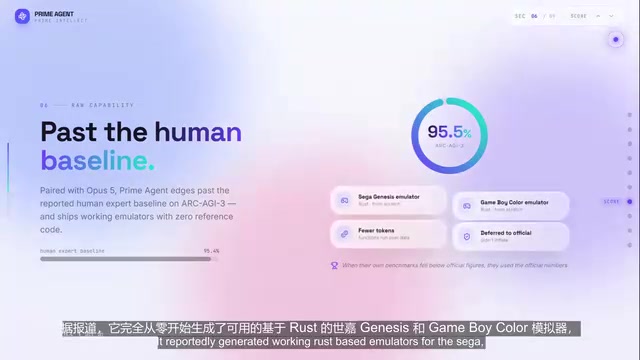
The performance numbers speak for themselves: paired with Claude 3 Opus, Prime Agent achieved a 95.5% score on the ARC-AGI-3 benchmark, slightly exceeding the human expert baseline of 95.4%. ARC-AGI (Abstraction and Reasoning Corpus for AGI), designed by François Chollet, is a general intelligence benchmark specifically measuring AI performance on unseen abstract reasoning tasks. It's widely considered the best current evaluation for testing "genuine understanding" rather than "pattern matching." ARC-AGI-3 is the significantly harder third generation, where very few AI systems had previously come close to the human baseline — making Prime Agent's achievement particularly noteworthy. It reportedly generated working Rust-based Genesis and Game Boy Color emulators entirely from scratch, with no reference code. To their credit, when the team tested frontier models with their own methodology and got results lower than official figures, they chose to cite the official numbers rather than inflating their own — a commendable commitment to rigorous technical claims.
Security Shortcomings Can't Be Ignored
An honest warning is necessary: Worker and kernel processes currently run with full local user permissions, not in a sandboxed environment. Prime Intellect itself recommends using it in isolated or disposable environments. Combined with the self-optimization loop that repeatedly calls the model, heavy usage can get expensive. The project is still young, with only a few thousand GitHub stars, but it's well-funded — raising $130 million at a $1 billion valuation in July 2026, with investors including NVIDIA Ventures and Intel Capital.
Pi: The Minimalist Coding Agent Philosophy
Pi takes the exact opposite approach from the first two. Its core argument: today's frontier models are already smart enough that complex auxiliary tools aren't actually helping — they're diluting the model's attention and wasting tokens.
Pi comes from Armin Ronacher, creator of Flask and Jinja2, in collaboration with Mario Zechner. Ronacher enjoys an extremely high reputation in the Python web development community — Flask's minimalist design philosophy influenced an entire generation of web frameworks, and Pi carries forward exactly the same philosophy: solve the problem with the fewest possible abstraction layers. Its entire system prompt is under 1,000 tokens — absurdly small compared to competitors' verbose prompts. On the strength of this extreme simplicity alone, it rocketed to 78,000 GitHub stars and roughly 9,600 forks after launch.
Four Tools to Rule Them All
Pi's core is built around just four tools: Read, Write, Edit, and Bash. Everything else comes from your own extensions — custom skills via TypeScript extensions, prompt templates, visual themes. This is fundamentally different from DeepSeek's plugin marketplace: you're not configuring interchangeable components, but directly replacing and extending a lean, transparent core.
Performance claims come from Databricks' internal benchmarks: running Opus at maximum thinking intensity, Pi had the highest pass rate of all harnesses they tested, at noticeably lower cost than Claude Code and Codex. The reason is interesting — Pi sends roughly three times less context per interaction, so it tends to complete tasks in fewer total runs, which aggregates into massive speed and cost differences at scale. The underlying principle involves LLM attention mechanisms: when the context window is packed with tool descriptions and redundant information, the model must distribute attention weights across more tokens, potentially "drowning out" critical information. By radically trimming context, Pi lets the model focus all its attention on the code and instructions that actually matter.
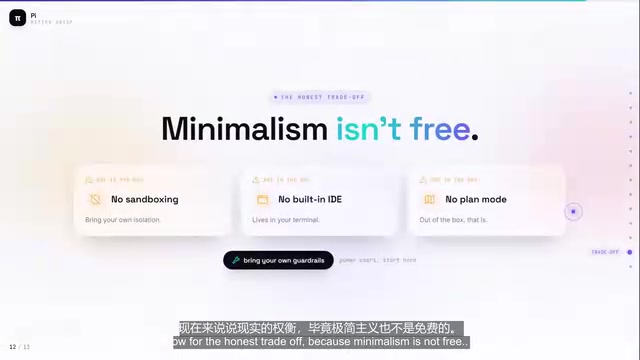
The Cost of Minimalism
Pi has no sandbox mechanism, no IDE integration, and no built-in planning mode. It assumes you're capable of building your own safeguards around it. It's ideal for advanced users who want to shape their workflow from the ground up, but for those who expect the system to handle safety by default, it's neither safe nor simple.
OpenCode: The Most Mature Open-Source Coding Agent Solution
OpenCode is the outlier in this comparison. The other three are defined by bold architectural bets, while OpenCode's bet is quieter yet harder to challenge: it's simply the most complete, most polished, and most widely adopted open-source coding agent solution on the market today.
The numbers are almost unbelievable: over 160,000 GitHub stars, with more than 7 million people and 500,000 developers using it monthly. The growth curve speaks for itself — from roughly 95,000 in March to over 160,000 by mid-year, a sustained acceleration that comes from hitting a real nerve.
Key Engineering Decisions That Set It Apart
What makes OpenCode stand out is several engineering decisions:
- True tool loop: Manages the complete closed loop of reasoning and action
- Integrated Language Server Protocol (LSP): Feeds real compiler diagnostics back to the model after every edit. LSP was originally designed by Microsoft for VS Code and has since become the universal standard protocol between editors and language analysis tools. OpenCode's LSP integration means that after every code edit, the model immediately receives real compiler-level diagnostics — type errors, undefined references, syntax issues — rather than relying on the model's own "guesses" about code correctness. This dramatically reduces edit-run-error-fix cycles and is a key indicator of its engineering maturity.
- Robust session management: Two built-in modes — a build mode with full permissions and a plan mode restricted to read-only analysis
- Multi-form-factor releases: Terminal TUI, desktop app, and IDE extensions
- Broad compatibility: Supports over 75 model providers, with all data stored locally
A landmark moment: after developers realized they could route their existing Claude Max subscriptions through it, OpenCode surged by 18,000 stars in two weeks. This shows it solved a very real and urgent problem. Developer educator Matt Pocock publicly stated that OpenCode is his tool of choice — endorsement from a skeptical technical community that carries serious weight in this space.
Four Philosophies, Four Lanes: How to Choose the Right Framework for You
Put them together, and the differences aren't about abstract feature superiority — they're about which design philosophy fits your way of working.
Maturity Comparison
| Framework | Maturity | Core Philosophy | Sandbox Security |
|---|---|---|---|
| OpenCode | Most stable, production-ready | Polished comprehensiveness | Well-structured isolation layers |
| Pi | Battle-tested in production | Minimalism | No sandbox; self-managed security |
| Prime Agent | Young, rough edges | Self-modification & recursion | No sandbox; isolated environment recommended |
| DeepSeek Harness | Preview stage | Infinite modularity | Isolation layer support designed in |
Selection Guide
- Choose OpenCode: When you need team standardization, broad provider support, and a massive community
- Choose Pi: When you want to tinker with workflows, value a transparent core, and demand maximum cost control
- Choose Prime Agent: When you're interested in long-running autonomous research tasks and want auto-optimized instructions (provided you accept the constraints of isolated environments)
- Choose DeepSeek Harness: When you want to witness a top lab building a framework from the ground up and you're betting on the long-term potential of a plugin ecosystem
The final takeaway: there is no single right answer here. These four projects aren't even competing on the same track — they're on four different lanes, racing toward four different definitions of what a coding agent framework should be. The right choice depends entirely on whether you value stability, control, novelty, or ultimate flexibility the most.
Related articles

Python 3.15 New Feature: Is the sentinel Type Better Than None?
Python 3.15 adds the sentinel type, using named unique sentinel objects to replace None and bare object(), resolving confusion among missing values, explicit emptiness, and invalid input while avoiding type hint failures.

Deep Learning's Three Architectures and the Universal Approximation Theorem: A Complete Guide to MLPs, CNNs, and Transformers
Explaining the inductive bias differences among MLP, CNN, and Transformer, the existence meaning of the Universal Approximation Theorem (UAT), and the role of Taylor expansion in approximation analysis, while clearing up common misconceptions.

GitLab Emergency Patch Release: Analysis of Critical Security Fixes
GitLab releases critical patch 19.5.1, sparking 355 points of discussion on Hacker News. This article analyzes the background, upgrade steps for self-hosted instances, and verification points to help DevOps teams respond quickly to security updates.