Deep Dive into Amazon Kiro: How Spec-Driven Development Is Changing AI Programming

Amazon launches AI programming IDE Kiro, championing a spec-driven development approach.
Amazon has launched Kiro, an AI programming IDE built on VS Code and powered by Claude Sonnet 4. It introduces a "spec-driven development" philosophy that differs from Cursor's direct code generation by emphasizing defining requirement specifications before implementation. Its two core features — Specs and Hooks — address AI intent understanding and automated code quality assurance respectively, positioning Kiro as a complement to Cursor rather than a replacement.
Introduction: A Heavyweight Enters the AI Programming Tool Arena
Just as Cursor was drawing user frustration over various issues, Amazon quietly launched its own AI programming IDE — Kiro. The tool was overwhelmed with demand at launch, with the beta application channel temporarily closed, a clear sign of the developer community's high expectations. Kiro isn't simply a "Cursor alternative" — it introduces an entirely new AI programming philosophy: Spec-Driven Development.
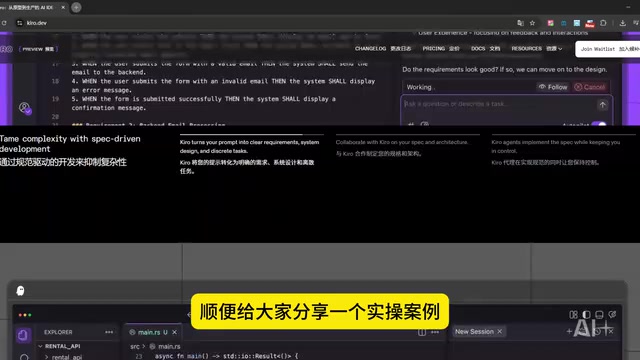
What Is Kiro: An Amazon AI IDE Built on VS Code
Architecture and Tech Stack
Kiro is an AI programming IDE backed by AWS (Amazon Web Services), built on the open-source version of VS Code (VS Code OSS). VS Code OSS is the open-source core of Microsoft's Visual Studio Code, differing from the full VS Code primarily by removing Microsoft's proprietary telemetry, licensing components, and certain closed-source extensions. Building IDEs on VS Code OSS has become the mainstream approach for AI programming tools — Cursor, Windsurf (formerly Codeium), Void, and others all follow this strategy. The key advantage is clear: developers can directly leverage VS Code's massive extension ecosystem (over 50,000 plugins), familiar keyboard shortcuts, and interface layout, while avoiding the enormous cost of building editor infrastructure from scratch. This means if you're already comfortable with VS Code, migrating to Kiro involves virtually zero learning curve.
The underlying AI model is Claude Sonnet 4. Claude Sonnet 4 is Anthropic's next-generation large language model released in 2025, positioned as the mid-tier flagship in the Claude 4 series that balances performance and cost. It excels in code generation, long-context understanding, and multi-step reasoning, with outstanding scores on benchmarks like SWE-bench (Software Engineering Benchmark). Notably, Amazon and Anthropic share a deep strategic investment relationship — AWS has invested over $4 billion in Anthropic cumulatively, and Claude models are offered to enterprise customers through the Amazon Bedrock service. Kiro's choice of Claude Sonnet 4 reflects both technical capability and Amazon's strategic move to integrate its cloud service ecosystem. During the current beta phase, it's available for free for a limited time — an undeniably attractive option for developers struggling with Cursor's subscription costs.
Core Philosophy: What Is Spec-Driven Development?
Unlike Cursor's focus on generating code from natural language, Kiro's core philosophy is "define first, implement second." It encourages developers to guide AI programming through documentation and specifications, rather than relying purely on prompts and hoping for the best.
Spec-driven development isn't a completely new invention by Kiro — it's an AI-era reinterpretation of the long-standing "Design First" approach in software engineering. Its intellectual roots trace back to several mature engineering practices: the OpenAPI Specification (Swagger) in the API domain advocates defining interface contracts before writing implementations; Behavior-Driven Development (BDD) emphasizes describing system behavior in natural language before coding; and Architecture Decision Records (ADR) require documenting key design decisions before implementation. In the context of AI programming, the core problem this approach solves is "context loss" — in traditional prompt-based interactions, the AI lacks a holistic project perspective in each conversation, causing generated code to become disconnected from the overall architecture.
In simple terms:
- Cursor's approach: Tell the AI what you want → AI generates code directly
- Kiro's approach: Clearly define requirement specifications (Specs) first → AI understands the context → Implement step by step
This approach may seem like an extra step, but through structured Specs documents, developers are essentially building a persistent "project memory" for the AI, enabling it to maintain a consistent understanding framework throughout the entire development cycle. In complex projects, this significantly reduces the probability of the AI going off track.
Kiro's Two Core Features Explained
Specs: Helping AI Truly Understand Your Intent
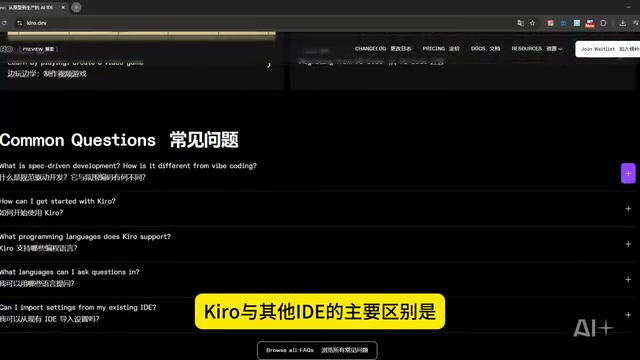
Kiro Specs is a cognitive aid for planning before you build your application, delivering value on multiple levels:
- Planning application structure: Helps you understand and plan the overall architecture more clearly
- Organizing feature logic: Provides structured support when thinking through feature design and refactoring
- Clarifying system behavior: Eliminates requirement ambiguity, enabling the AI agent to make smarter implementation decisions
- Guiding AI understanding: Compared to scattered prompts, Specs provide the AI with complete context
At its core, Specs solves the most common pain point in AI programming — the AI not understanding your true intent. Through structured specification documents, developers and AI establish a more reliable communication mechanism, which aligns with the long-advocated software engineering principle of "documentation as contract."
Hooks: Your Automated Collaborative Developer

Hooks is another standout feature of Kiro. Think of it as a silent collaborative developer that automatically handles various tedious but important tasks during development:
- Auto-updating test files: Automatically syncs test cases after code changes
- Keeping documentation in sync: Ensures documentation stays consistent with code
- Scanning for potential issues: Detects hidden problems in code in real time
- Enforcing coding standards: Maintains consistent code style across the team
Once configured, Hooks automatically trigger on events like file saves and code commits. The elegance of this mechanism lies in the fact that it adds no extra burden on developers while continuously maintaining code quality and consistency. For team collaboration scenarios, this feature is particularly valuable — it transforms engineering standards that previously relied on human discipline into systematic guarantees automatically enforced by AI.
Kiro vs Cursor: Not a Replacement, but a Complement
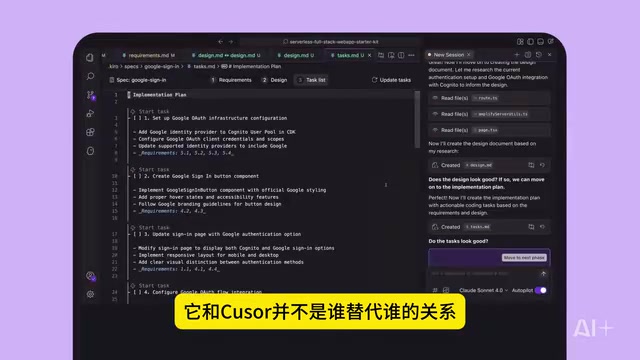
To understand the differences between the two, you first need to understand the current competitive landscape of AI programming IDEs. From 2024 to 2025, this space has shifted from a blue ocean to fierce competition. Cursor built a large paying user base through its first-mover advantage, but its subscription pricing (starting at $20/month) and occasional service stability issues have drawn complaints from some users. Amazon's timing in entering the market is strategically significant: the market has already been educated by Cursor, developer acceptance of AI programming tools has increased dramatically, yet existing tools still have obvious shortcomings in engineering depth.
Many people position Kiro as a "Cursor alternative"
Related articles
 Product Reviews
The Programmer's Desk Setup Guide: Building a Workspace That Feels Like Home
Discover how programmers build productive, comfortable workspaces. From multi-monitor setups to ergonomic design, explore the desk philosophy that drives focus and flow.
 Product Reviews
Qoder vs Cursor Real-World Comparison: Which $20/Month AI IDE Is Better?
Hands-on comparison of Qoder vs Cursor AI IDEs: Agent autonomy, human interaction count, and architecture decisions. Qoder needed only 2 interactions vs Cursor's 8.
 Product Reviews
Cursor Cloud Agent Demo: Eliminating Bottlenecks Across the Entire Software Development Lifecycle
Deep analysis of Cursor's Cloud Agent demo showing how cloud VMs, automated test artifacts, and a full-chain control plane systematically eliminate human bottlenecks across the software development lifecycle.