Deep Dive into CowAgent: How This Open-Source AI Agent Earned 44,000 Stars

CowAgent is a 44K+ Star open-source AI Agent supporting multi-platform and multi-model integration.
CowAgent is a phenomenal open-source AI Agent project on GitHub with 44,000+ Stars, featuring core capabilities including proactive thinking, task planning, Skills self-creation, long-term memory, and external resource access. It supports multi-platform integration with WeChat, Feishu, DingTalk, and more, is compatible with DeepSeek, OpenAI, Claude, and other large models, and offers multimodal interaction with text, voice, and images—ideal for personal AI assistants and enterprise digital employee scenarios.
Project Overview: A National-Level AI Agent with 44,000+ Stars
CowAgent (formerly chatgpt-on-wechat) is a phenomenal open-source project on GitHub with over 44,000 Stars, developed and maintained by zhayujie in Python, with more than 10,000 forks. Positioned as a super AI assistant powered by large language models, it's one of the most popular open-source AI Agent solutions in China.
Here's a key concept worth clarifying: AI Agents are fundamentally different from traditional chatbots. Traditional chatbots operate on a "stimulus-response" pattern—you ask a question, they give an answer—with no autonomous decision-making capability. An AI Agent, however, is an intelligent system that can perceive its environment, make autonomous decisions, take actions, and learn from feedback. It has clear goal-oriented capabilities, can independently invoke tools, plan execution paths, and maintain contextual coherence across multi-turn interactions. Since 2024, AI Agents have become one of the most critical directions for large model application deployment, representing the key leap from "AI that can chat" to "AI that can work."
Compared to similar projects like OpenClawAd, CowAgent takes a lightweight and convenient approach without sacrificing core agent capabilities—it can think proactively, plan tasks, access external resources, and continuously evolve through ongoing learning.
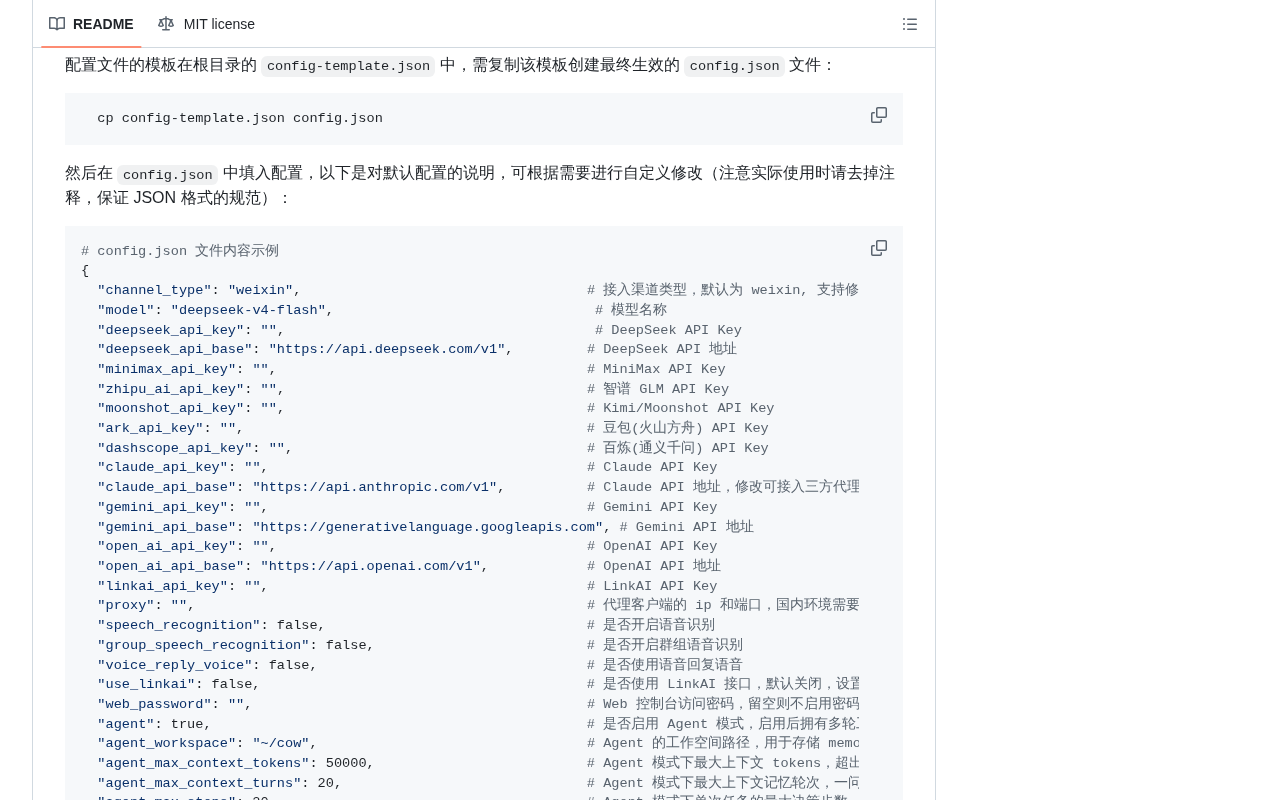
CowAgent Core Capabilities Breakdown
Proactive Thinking and Task Planning
CowAgent is not a simple Q&A chatbot. When users present complex requests, it can autonomously decompose tasks into multiple sub-steps and execute them in logical sequence. For example, when you say "Help me research competitors and generate an analysis report," the Agent automatically plans stages like information gathering, data organization, and report writing—truly upgrading from passive response to proactive execution.
This task planning capability relies on core reasoning paradigms in the current Agent field. The most representative is the ReAct (Reasoning + Acting) framework—it enables the large model to perform explicit reasoning before each action ("What do I need to do now? Why?"), then execute a specific action, and decide the next step based on the results. This closely mirrors how humans solve complex problems: think it through first, then act, and adjust when encountering issues. Additionally, Chain-of-Thought techniques allow models to decompose complex reasoning processes into step-by-step intermediate steps, significantly improving accuracy for multi-step tasks. It's the combination of these technologies that enables CowAgent to handle complex tasks like "research-analyze-output" that require multi-stage coordination.
Skills Creation and Self-Evolution
The Skills system is one of CowAgent's killer features. The Agent can not only invoke predefined skills but also create entirely new Skills based on actual needs. This self-evolution mechanism means the system's capability boundaries continuously expand with use—the more you use it, the more powerful the Agent becomes.
From a technical perspective, automatic Skills creation falls under the cutting-edge direction of Tool Learning. Traditional Agent systems rely on developers pre-defining all available tools and API interfaces, with the Agent limited to selecting from a fixed set. CowAgent's Skills system goes further: when the Agent discovers that existing skills cannot satisfy user requirements, it can autonomously write new functional modules through code generation and register them as reusable Skills. This is like an employee who not only knows how to use existing tools but can also build new ones. This capability is academically known as "Self-Augmented Agent" and was one of the hottest research directions in 2024, representing a paradigm shift from "limited toolbox" to "infinite capability expansion."
Long-Term Memory and Knowledge Base System
CowAgent features built-in long-term memory mechanisms and a knowledge base system, capable of remembering historical interactions and accumulating domain expertise. For enterprise scenarios, this means your digital employee becomes increasingly familiar with business processes and user preferences over time, continuously improving service quality.
To understand the technical sophistication of this capability, you need to know an inherent limitation of large models: limited context windows. Even the most advanced large models have an upper limit on text length they can process in a single conversation (typically between a few thousand to hundreds of thousands of tokens), and the model doesn't "remember" anything after the conversation ends. CowAgent's long-term memory system solves this through Vector Databases—it converts historical conversations and knowledge documents into high-dimensional vectors for storage. When users initiate new conversations, the system retrieves the most relevant historical memories through semantic similarity search and injects them into the current conversation context. This is precisely the RAG (Retrieval-Augmented Generation) architecture widely adopted in the industry. RAG's advantages lie in both breaking through context window limitations and enabling the Agent to provide precise answers based on private data without expensive fine-tuning of the underlying large model.
Operating System and External Resource Access
CowAgent can access the operating system and external resources—it doesn't just "talk," it can actually "do." File reading/writing, network requests, and third-party API calls are all within its capabilities, giving it the real conditions to execute actual tasks.
This capability is known as Function Calling or Tool Use in Agent architecture. The core principle is: when generating responses, the large model can output not only natural language text but also structured function call instructions (such as JSON format), which are parsed and executed by an external execution engine. For example, when a user requests "save this report to the desktop," the model generates a file write instruction, and the system's execution layer handles the actual file operation. This separation of "brain (model reasoning) + hands and feet (tool execution)" is the universal design pattern of current mainstream Agent frameworks (like LangChain, AutoGPT), and the key technical foundation for AI's evolution from "conversational assistant" to "execution assistant."
What Platforms Does It Support?
CowAgent's platform coverage ranks in the top tier among similar projects:
| Category | Supported Platforms |
|---|---|
| Instant Messaging | WeChat, WeCom, Feishu (Lark), DingTalk, QQ |
| Public Platforms | WeChat Official Accounts |
| Web | Web Access |
Whether you're an individual user wanting to use AI in WeChat, or an enterprise looking to deploy intelligent customer service in Feishu or DingTalk, you can connect directly without changing your team's existing communication habits.
The technical implementation of this multi-platform adaptability relies on a Channel abstraction layer architectural design. CowAgent abstracts different platforms' message protocols into standardized interfaces, decoupling core Agent logic from specific platforms. This means adding support for a new platform only requires implementing the corresponding Channel adapter without modifying the Agent's core reasoning and skill systems. This design is known as the "Adapter Pattern" in software engineering, which greatly reduces the complexity of multi-platform maintenance and is the architectural foundation enabling CowAgent to quickly cover so many platforms.
What Large Models Are Compatible?
For underlying model selection, CowAgent offers ample flexibility:
- International Mainstream Models: OpenAI GPT series, Claude, Gemini
- Chinese Large Models: DeepSeekAd, Qwen, GLM (Zhipu AI), MiniMax
- Aggregation Platforms: LinkAI
The benefits of this multi-model compatible architecture are clear: you can flexibly switch models based on cost budget, response speed, data compliance, and other practical needs, while avoiding the risk of being locked into a single vendor.
From an architectural perspective, the key to achieving multi-model compatibility lies in a unified LLM interface abstraction layer. Although OpenAI's API format has become the de facto standard in the large model industry, vendors still differ in details like parameter naming, streaming output, and function calling. CowAgent shields these differences through a middleware layer, exposing a unified interface to the upper-level Agent logic. The practical value of this design is significant: Vendor Lock-in is one of the core concerns for enterprises adopting AI services—once deeply bound to a specific model provider, future migration costs are extremely high. The multi-model compatible architecture allows users to choose flexibly by scenario: use the more cost-effective DeepSeek for daily conversations, switch to Claude or GPT-4o for complex reasoning, and use privately deployed Chinese models for sensitive data scenarios, achieving optimal balance of cost, performance, and compliance.
Multimodal Interaction: Beyond Text
CowAgent supports multiple input types including text, voice, images, and files. In practical use, you can send voice messages for the Agent to process, or drop a PDF document for it to summarize and analyze—the interaction is very natural.
Multimodal processing involves a complete technical pipeline behind the scenes. Voice input first needs to go through an ASR (Automatic Speech Recognition) engine to be converted to text, with common solutions including OpenAI's Whisper and Alibaba's Paraformer; Image processing relies on multimodal large models (like GPT-4o, Qwen-VL) for visual understanding capabilities, where models can directly "see" and analyze image content; File processing (such as PDF, Word, Excel) requires document parsing engines to extract text and structured information first, then feeds it to the large model for understanding and summarization. These different modal inputs are ultimately converted into a unified representation that the large model can process, forming a complete loop of "multimodal input → unified understanding → intelligent output." This multimodal capability dramatically expands the Agent's use cases from pure text conversations to various information processing needs in real work scenarios.
Typical Use Cases
Personal Scenario: An All-Purpose AI Assistant in WeChat
By connecting CowAgent through WeChat, you can have an always-online intelligent assistant to handle information queries, schedule reminders, copywriting, translation, and other daily tasks. The deployment barrier is low and it's ready to use immediately.
Enterprise Scenario: Rapidly Building Digital Employees
Enterprises can quickly build digital employees based on CowAgent, covering intelligent customer service, internal knowledge Q&A, process automation, and other scenarios. Combined with knowledge base and long-term memory capabilities, it delivers professional yet personable service experiences.
It's worth noting that the value of "digital employees" in enterprise scenarios has surpassed simple cost replacement. Traditional customer service bots are typically based on keyword matching and fixed conversation trees—the user experience is rigid and maintenance costs are high, requiring manual creation of numerous rules for each new business scenario. Digital employees built on CowAgent, leveraging large models' natural language understanding capabilities and RAG knowledge bases, can truly understand user intent and provide accurate answers based on enterprise private knowledge. More critically, the long-term memory mechanism enables the system to accumulate service experience: identifying high-frequency questions, remembering important customers' preferences, and even proactively discovering bottlenecks in business processes. This "gets smarter with use" characteristic is completely impossible to achieve with traditional rule engines.
Conclusion: Why CowAgent Deserves Your Attention
With its comprehensive Agent capability system, platform support covering mainstream IM tools, and flexible multi-model compatibility, CowAgent has become the most representative open-source project in China's AI Agent space. The 44,000+ Stars represent extensive real-world validation by developers and enterprises alike.
If you're looking for an AI assistant solution that can be quickly deployed—whether you're an individual enthusiast or an enterprise developer—CowAgent deserves a spot on your technology evaluation shortlist.
Related articles
 Product Reviews
The Programmer's Desk Setup Guide: Building a Workspace That Feels Like Home
Discover how programmers build productive, comfortable workspaces. From multi-monitor setups to ergonomic design, explore the desk philosophy that drives focus and flow.
 Product Reviews
Qoder vs Cursor Real-World Comparison: Which $20/Month AI IDE Is Better?
Hands-on comparison of Qoder vs Cursor AI IDEs: Agent autonomy, human interaction count, and architecture decisions. Qoder needed only 2 interactions vs Cursor's 8.
 Product Reviews
Cursor Cloud Agent Demo: Eliminating Bottlenecks Across the Entire Software Development Lifecycle
Deep analysis of Cursor's Cloud Agent demo showing how cloud VMs, automated test artifacts, and a full-chain control plane systematically eliminate human bottlenecks across the software development lifecycle.