Deep Dive into CowAgent: The Open-Source AI Assistant with 44,000 Stars
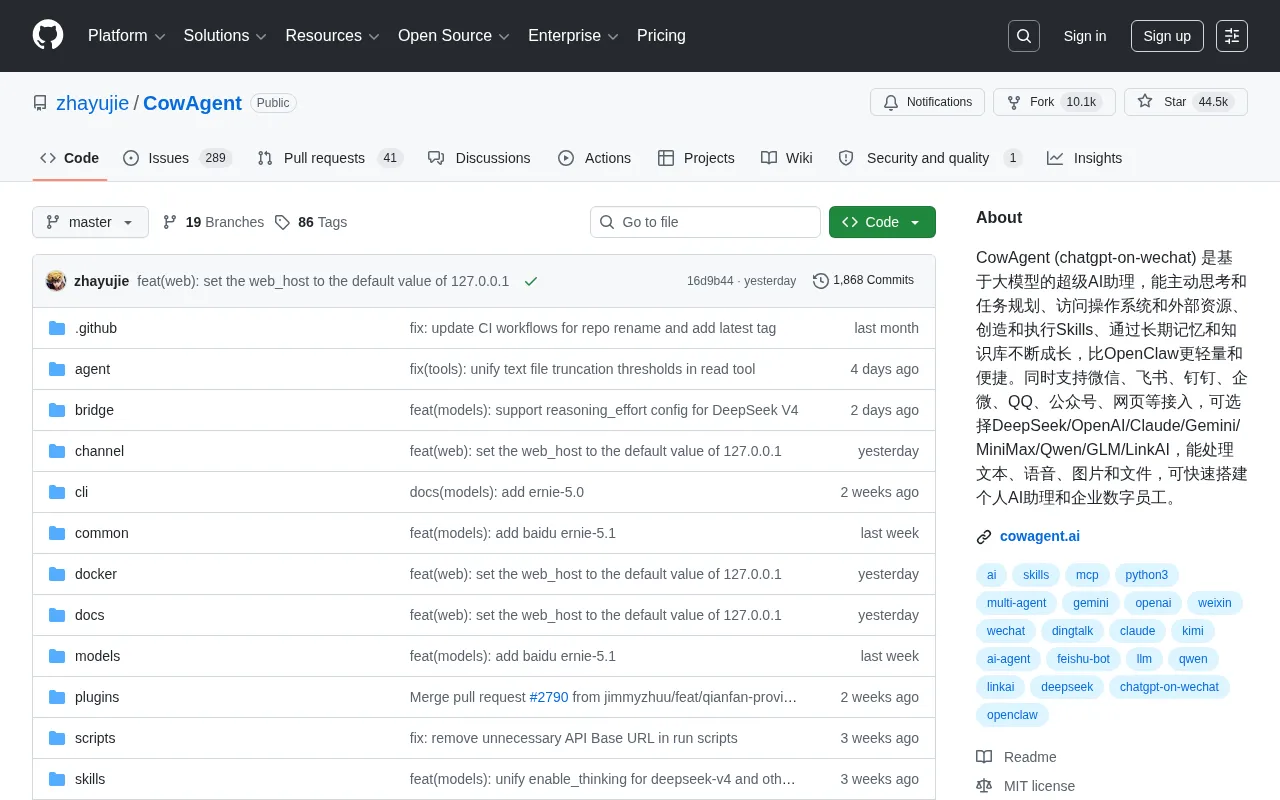
CowAgent is a 44K-star open-source AI Agent project supporting multi-platform and multi-model intelligent assistants.
CowAgent is an open-source AI Agent project with nearly 44,000 GitHub Stars, building a super AI assistant powered by large language models. It features proactive task planning, OS access, dynamic skill creation, and long-term memory as core Agent capabilities. Supporting 7+ platform integrations including WeChat, Feishu, and DingTalk, compatible with mainstream LLMs like DeepSeek, OpenAI, and Claude, and offering multimodal interactions with voice, images, and files, it's ideal for both personal AI assistants and enterprise digital employee scenarios.
Project Overview: An AI Agent Project with Nearly 44,000 GitHub Stars
CowAgent (formerly chatgpt-on-wechat) is a highly acclaimed open-source project on GitHub, amassing nearly 44,000 Stars. Positioned as a super AI assistant powered by large language models, the project is developed and maintained by developer zhayujie in Python, with over 10,000 forks—making it one of the most popular AI Agent projects in the Chinese open-source community.
AI Agent is one of the most significant development directions in artificial intelligence today. Unlike traditional large language model (LLM) single-turn Q&A, Agents possess a complete closed-loop capability encompassing environmental perception, autonomous decision-making, action execution, and feedback learning. Since 2023, Agent projects like AutoGPT and BabyAGI have ignited the open-source community, driving a paradigm shift from "AI conversation" to "AI execution." The core architecture of an Agent typically includes four major modules: Planning, Memory, Tool Use, and Action—which also serves as the key framework for understanding CowAgent's capability system.
Compared to similar projects, CowAgent's advantages lie in its lighter weight and more convenient deployment experience, while still offering powerful agent capabilities. Whether individual users want to quickly build an AI assistant or enterprises need to construct digital employees, CowAgent is up to the task.
CowAgent Core Capabilities Explained
Proactive Thinking and Task Planning
CowAgent is far more than a simple chatbot. When users present complex requirements, the system automatically decomposes tasks into multiple steps and executes them sequentially in logical order—without requiring users to guide it step by step. This Agent-oriented design evolves it from a traditional "Q&A-style" AI into a true "assistant-style" AI.
The technical foundation of this capability stems from Chain-of-Thought reasoning and the ReAct (Reasoning + Acting) framework. Proposed by Google Research in 2022, ReAct enables large models to alternate between "thinking" and "acting" during the reasoning process, thereby achieving step-by-step decomposition and execution of complex tasks. For example, when you ask CowAgent to "research the latest trends in a certain industry and generate a report," the system automatically plans sub-tasks including information retrieval, content filtering, structured organization, and report generation, executing them in dependency order. This approach significantly outperforms single-step reasoning, especially in scenarios requiring multi-step coordination.
Operating System and External Resource Access
The project supports access to the operating system and external resources, granting the AI assistant real execution capabilities—reading and writing files, invoking system commands, accessing network resources, and more. AI's capabilities extend from pure text conversation to the actual operational layer, performing exceptionally well in scenarios like office automation and data processing.
This means CowAgent can not only "talk" but also "do." For instance, it can directly execute Python scripts on a server to process Excel data, call APIs to obtain real-time information, or automatically download and organize web resources. This design that bridges large models with operating system capabilities is one of the core features distinguishing Agents from ordinary chatbots and serves as the foundation for achieving truly automated workflows.
Skills Creation and Execution
CowAgent introduces a Skills mechanism—the AI can not only execute preset skills but also dynamically create new skills based on requirements. This self-evolving design continuously expands the system's capability boundaries—the more you use it, the more powerful it becomes.
The Skills mechanism's design philosophy is closely related to Code Generation and Function Calling. OpenAI's Function Calling capability, introduced in 2023, allows large models to dynamically invoke predefined external functions based on user intent. CowAgent's Skills mechanism goes further—it can not only call existing skills but also dynamically create new skills through code generation and persist them in storage. For example, the first time you ask CowAgent to "translate this text into Japanese and generate an audio file," the system might dynamically write a skill combining a translation API and a speech synthesis API, then save it. The next time a similar request comes in, the system can directly invoke this previously created skill, responding faster with more stable results. This aligns with the concept of "Self-Programming" and represents a key capability for Agent self-evolution.
Long-term Memory and Knowledge Base
Through long-term memory and knowledge base mechanisms, CowAgent can remember historical interaction content, accumulate domain knowledge, and achieve continuous growth. This solves the pain point of traditional large models being "stateless," making the AI assistant a personalized helper that truly understands your habits and preferences.
Traditional large models are limited by context window length—even GPT-4 Turbo's 128K context window cannot retain interaction history spanning days or even months. Long-term memory implementation typically relies on vector databases (such as FAISS, Chroma, Milvus, etc.), converting historical conversations and knowledge into high-dimensional vectors via Embedding models for storage, and retrieving relevant content through Semantic Search to inject into the current conversation context when needed. This RAG (Retrieval-Augmented Generation) architecture has become the mainstream solution for addressing the large model "forgetting" problem. Through this mechanism, CowAgent can remember your work habits, commonly used terminology, project backgrounds, and other personalized information—as usage time grows, the interaction experience becomes increasingly tailored to your needs.
Multi-Platform Integration: WeChat, Feishu, DingTalk Full Coverage
CowAgent supports over 7 integration methods, covering mainstream communication platforms:
- Instant Messaging: WeChat, Feishu (Lark), DingTalk, WeCom (Enterprise WeChat), QQ
- Public Platforms: WeChat Official Accounts
- Web: Direct web access
This omni-channel design means you can use the AI assistant directly on your most frequently used platform without switching tools.
It's worth noting that integration methods differ significantly across platforms. WeChat, as China's largest instant messaging platform, has a relatively closed ecosystem—it doesn't provide an official API for personal accounts. The community typically implements message sending and receiving through reverse-engineering libraries like itchat and WeChatFerry, though this carries certain account risks. WeCom and WeChat Official Accounts provide official API interfaces with higher stability and compliance. Feishu and DingTalk, as enterprise-level collaboration platforms, both offer comprehensive open platforms and bot APIs, making the integration process more standardized. CowAgent supports multiple integration methods, allowing users to choose the most suitable solution based on their risk tolerance, use cases, and compliance requirements.
Multi-Model Support: Freely Switch Between DeepSeek, OpenAI, and More
In terms of underlying large models, CowAgent supports mainstream AI models on the market:
- International Models: OpenAI (GPT series), Claude, Gemini
- Chinese Models: DeepSeekAd, Qwen, GLM (Zhipu AI), MiniMax
- Aggregation Platforms: LinkAI
Users can flexibly choose based on needs and budget, and can configure different models for different scenarios to achieve optimal cost-effectiveness balance.
Since 2024, the large model market has shown a "hundred flowers blooming" landscape, and the strategic value of multi-model support has become increasingly prominent. DeepSeek has rapidly risen with its exceptional cost-effectiveness and open-source strategy—its DeepSeek-V3 and R1 models approach GPT-4 performance levels on multiple benchmarks, but at a fraction of the inference cost, making them particularly suitable for high-frequency calling scenarios. Qwen, developed by Alibaba Cloud, excels in Chinese comprehension and code generation, offering a rich selection of model sizes. The GLM series, developed by Tsinghua's Zhipu AI team, specializes in bilingual Chinese-English tasks, with its GLM-4 series widely adopted in China's enterprise market. Claude, developed by Anthropic, is renowned for its safety features and long-text processing capabilities, with a context window of up to 200K tokens. The practical value of multi-model support lies in users' ability to flexibly choose based on dimensions like task complexity, response speed, data privacy, and cost budget—for example, using DeepSeek for simple daily Q&A to control costs, while switching to GPT-4o or Claude for complex reasoning tasks to obtain higher-quality output.
Multimodal Processing: Full Support for Voice, Images, and Files
CowAgent is not limited to text conversations—it also supports voice recognition and response, image analysis and recognition, document content extraction and summarization, and other multimodal interactions. This significantly expands the AI assistant's practical scenarios, making daily communication more natural and efficient.
Multimodal is an important trend in large model development. Models like GPT-4V and Gemini already natively support mixed image-text understanding, while voice processing typically combines specialized models like Whisper (OpenAI's open-source speech recognition model). In practical use, multimodal capabilities greatly lower the interaction barrier—you can directly send a product screenshot for AI competitive analysis, send a voice message for AI to organize into written meeting minutes, or upload a PDF document for AI to extract key information and generate a summary. This "what you see is what you get" interaction approach truly integrates AI assistants into daily work and life scenarios.
Typical Application Scenarios
Personal AI Assistant
By integrating through familiar platforms like WeChat, CowAgent can help you handle daily tasks such as information queries, document organization, and content creation, with an extremely low barrier to entry—you can get started in just minutes. Thanks to the long-term memory mechanism, CowAgent grows to understand your preferences over time, gradually evolving from a general-purpose assistant into a dedicated personalized helper.
Enterprise Digital Employee
Combined with WeCom or Feishu, CowAgent can quickly build customer service bots, internal knowledge Q&A systems, and office automation assistants that seamlessly integrate into existing workflows to reduce labor costs. In enterprise scenarios, the knowledge base feature is particularly critical—by importing internal company documents, product manuals, FAQs, and other materials, CowAgent can build a proprietary enterprise knowledge Q&A system, improving response efficiency several-fold for scenarios like new employee training and customer inquiries. Additionally, multi-model support allows enterprises to choose privately deployed Chinese models based on data security requirements, ensuring sensitive information doesn't leak.
Conclusion: Why Choose CowAgent
With comprehensive Agent capabilities, extensive platform support, and flexible model selection, CowAgent has secured an important position in the open-source AI assistant landscape. Nearly 44,000 Stars are the community's best testament to its strength. From a technical architecture perspective, CowAgent fully implements the four core Agent modules—Planning, Memory, Tool Use, and Action—while the Skills mechanism endows the system with self-evolution capabilities, which is uncommon among similar open-source projects. If you're looking for a fully-featured, easy-to-deploy AI assistant solution—whether for personal use or enterprise deployment—CowAgent deserves priority consideration.
Related articles
 Product Reviews
The Programmer's Desk Setup Guide: Building a Workspace That Feels Like Home
Discover how programmers build productive, comfortable workspaces. From multi-monitor setups to ergonomic design, explore the desk philosophy that drives focus and flow.
 Product Reviews
Qoder vs Cursor Real-World Comparison: Which $20/Month AI IDE Is Better?
Hands-on comparison of Qoder vs Cursor AI IDEs: Agent autonomy, human interaction count, and architecture decisions. Qoder needed only 2 interactions vs Cursor's 8.
 Product Reviews
Cursor Cloud Agent Demo: Eliminating Bottlenecks Across the Entire Software Development Lifecycle
Deep analysis of Cursor's Cloud Agent demo showing how cloud VMs, automated test artifacts, and a full-chain control plane systematically eliminate human bottlenecks across the software development lifecycle.