Deep Dive into Cube Studio: Tencent's Open-Source All-in-One AI Platform

Cube Studio is Tencent Music's open-source cloud-native all-in-one AI platform covering the full MLOps workflow.
Cube Studio is an all-in-one ML/DL/LLM AI platform open-sourced by Tencent Music, built on cloud-native architecture with nearly 5,000 GitHub stars. It covers the full MLOps workflow including data labeling, Notebook development, Pipeline orchestration, multi-framework distributed training, large model fine-tuning and inference (supporting vLLM/Ollama), and RAG knowledge bases. It also features VGPU virtualization for compute management and domestic hardware compatibility (Huawei Ascend), making it ideal for enterprise AI platforms, private LLM deployment, and Xinchuang scenarios.
Project Overview: What Is Cube Studio?
Cube Studio is an all-in-one machine learning/deep learning/large model AI platform open-sourced by Tencent Music, built on a cloud-native architecture, and has earned nearly 5,000 stars on GitHub. The project covers the entire MLOps workflow from data labeling and model training to inference deployment, making it one of the few open-source AI platforms in China with such comprehensive functionality.
MLOps (Machine Learning Operations) is an engineering practice that brings DevOps principles into the machine learning domain. A complete MLOps workflow typically includes data collection and labeling, feature engineering, model training and validation, model registry and version management, inference deployment and monitoring. In real enterprise scenarios, model development accounts for only a small fraction of the total work in an AI project — the bulk of effort goes into building data pipelines, configuring training environments, deploying models to production, and continuous iteration. Common MLOps tools in the industry include MLflow, Kubeflow, and Airflow, but they often cover only parts of the pipeline, requiring enterprises to integrate multiple tools to form a complete workflow.
Building a complete AI infrastructure often requires enterprises to integrate multiple tools and platforms. Cube Studio is positioned to solve this pain point with a unified platform, combining compute management, development environments, training orchestration, and model serving capabilities to reduce the overall cost of AI engineering.
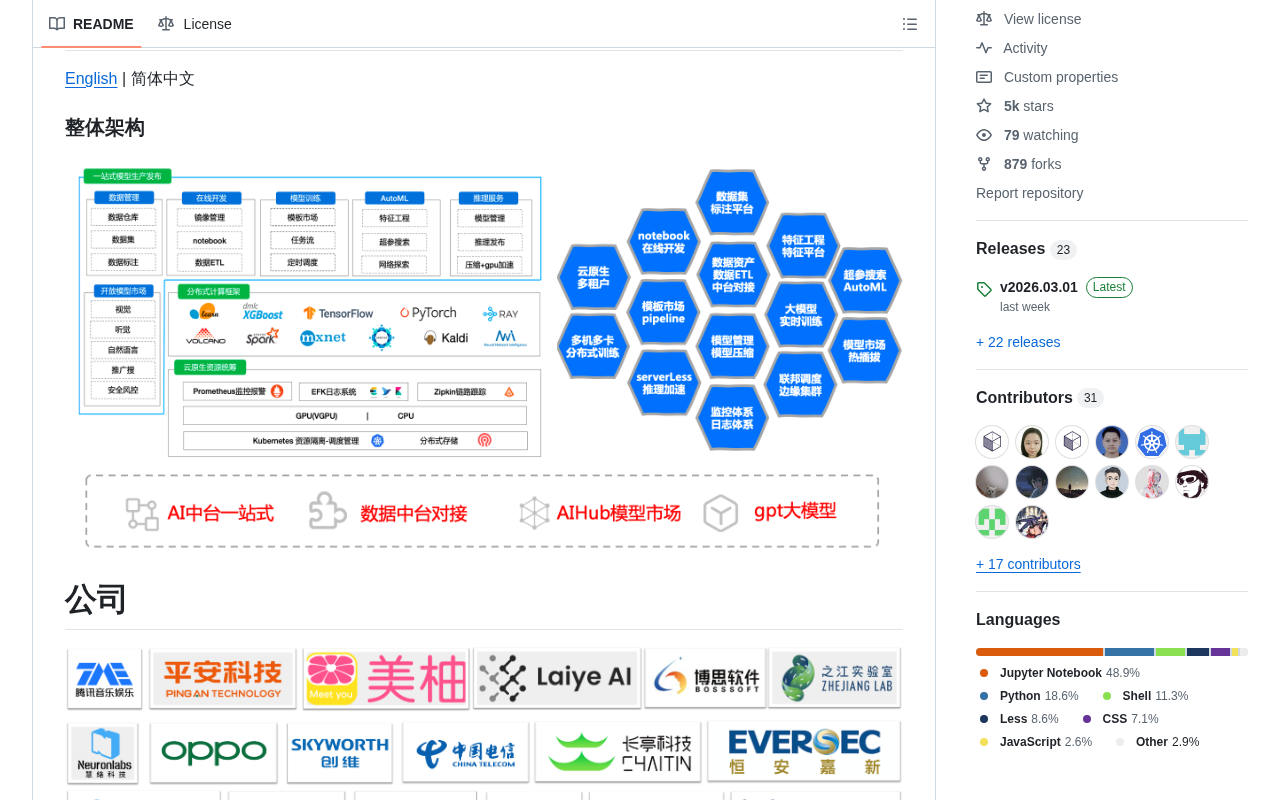
Detailed Breakdown of Cube Studio's Core Modules
Notebook Online Development Environment
Cube Studio provides a web-based Notebook online development environment where developers can perform algorithm development and debugging directly without configuring local environments. When GPU resources are scarce, a centralized development environment can significantly improve resource utilization and greatly benefits team collaboration and unified resource management.
The web-based Notebook development environment originates from the Jupyter Notebook project, which allows users to write and execute code in a browser with interactive output visualization — particularly suitable for data exploration and model prototyping. In enterprise AI platforms, Notebooks typically run as containers on Kubernetes clusters, with each user's Notebook instance corresponding to an independent Pod that can mount GPU resources on demand. JupyterHub is a common multi-user Notebook management solution, and Cube Studio builds on this foundation by further integrating resource quota management and team collaboration capabilities, enabling administrators to centrally control the CPU, memory, and GPU quotas available to each user or project team, preventing resource contention.
Pipeline Drag-and-Drop Workflow Orchestration
The platform supports drag-and-drop Pipeline workflow orchestration, allowing users to build complex data processing and model training pipelines through a visual interface. This low-code approach significantly lowers the barrier to using MLOps, enabling algorithm engineers to focus their energy on the model itself rather than engineering details.
Workflow Orchestration is the technology of organizing multiple computation steps into a Directed Acyclic Graph (DAG) based on dependency relationships and executing them automatically. In machine learning scenarios, a typical Pipeline might include data preprocessing, feature extraction, model training, model evaluation, and model registration steps, each potentially running in different containers with different compute resources. Mainstream orchestration tools include Apache Airflow (focused on data engineering), Argo Workflows (Kubernetes-native), and Kubeflow Pipelines (focused on ML scenarios). Drag-and-drop visual orchestration further lowers the barrier — users can define complex task dependencies without writing YAML or Python DSL, which is particularly friendly for data scientists without an engineering background.
Multi-Framework Distributed Training Capabilities
In terms of distributed training, Cube Studio offers remarkably broad support:
- Framework Support: PyTorch, TensorFlow, MXNet, DeepSpeed, PaddlePaddle, ColossalAI, Horovod, Ray, Volcano, and other mainstream distributed training frameworks
- Training Modes: Multi-node multi-GPU distributed training, hyperparameter search
- Network Optimization: RDMA high-speed networking support, critical for communication efficiency in large-scale distributed training
Distributed training refers to distributing model training tasks across multiple computing devices (multiple GPUs or nodes) for parallel execution, to accelerate training or support extremely large models. There are two main parallelism strategies: Data Parallelism splits data across different devices with each device holding a complete model replica; Model Parallelism splits the model itself across different devices, suitable for ultra-large models that cannot fit on a single card. PyTorch's DistributedDataParallel (DDP) and DeepSpeed's ZeRO optimizer are representative data parallelism solutions, while ColossalAI provides more flexible multi-dimensional parallelism strategies. Horovod, open-sourced by Uber, achieves efficient gradient synchronization through the Ring-AllReduce algorithm. Ray is a general-purpose distributed computing framework whose Ray Train module is specifically designed for distributed training. Volcano is a CNCF batch scheduling system that specifically addresses scheduling challenges for large-scale training tasks on Kubernetes.
RDMA (Remote Direct Memory Access) is a networking technology that allows a computer to directly access a remote host's memory without kernel intervention, achieving extremely low latency and high bandwidth data transfer. In large-scale distributed training, multiple GPU nodes need to frequently synchronize gradient data, and communication overhead often becomes the bottleneck for training speed. Traditional TCP/IP network stacks require multiple data copies and kernel-mode switches, resulting in high latency. RDMA technology (common implementations include InfiniBand and RoCE v2) can reduce network latency to the microsecond level, with bandwidth reaching 100Gbps or even 400Gbps. NVIDIA's GPUDirect RDMA technology goes further, allowing direct data transfer between GPU memory and remote GPU memory, completely bypassing CPU and system memory — this is crucial for large model training clusters with thousands of GPUs.
Large Model Training, Fine-Tuning, and Inference Deployment
Keeping pace with the demands of the large model era, Cube Studio provides complete end-to-end large model support:
- Training Side: Supports full-pipeline training for large models like DeepSeekAd, including SFT fine-tuning, reward model training, and reinforcement learning (RLHF) training
- Inference Side: Integrates inference engines such as vLLM, Ollama, and MindIE, with support for multi-node inference deployment
- Application Side: Built-in private knowledge base functionality for quickly building RAG applications
Large model training is typically divided into three stages: Pre-training, Supervised Fine-Tuning (SFT), and Reinforcement Learning from Human Feedback (RLHF). The pre-training phase uses massive amounts of unlabeled text data to train fundamental language capabilities, at extremely high cost (typically requiring thousands of GPUs training for weeks). The SFT phase fine-tunes the model using human-annotated instruction-response pair data, enabling it to follow instructions. The RLHF phase first trains a Reward Model to evaluate response quality, then uses reinforcement learning algorithms like PPO (Proximal Policy Optimization) to further optimize model outputs to better align with human preferences. Models like DeepSeek have also introduced improved algorithms such as GRPO (Group Relative Policy Optimization). For most enterprises, pre-training costs are prohibitive, making SFT and RLHF fine-tuning a more practical path to deployment.
Regarding inference engines, vLLM is a high-performance inference engine open-sourced by UC Berkeley. Its core innovation is PagedAttention technology, which manages KV Cache using a method similar to operating system virtual memory paging, improving memory utilization by 2-4x and significantly increasing inference throughput. Ollama positions itself as a local large model runtime tool, known for its minimalist user experience, suitable for development testing and lightweight deployment scenarios. MindIE (Mind Inference Engine) is Huawei's inference engine designed for Ascend NPUs, deeply optimized for Ascend hardware. Multi-node inference deployment refers to distributing an ultra-large model across multiple servers for inference, typically using Tensor Parallelism strategy, suitable for scenarios where a single machine's GPU memory cannot accommodate the complete model.
RAG (Retrieval-Augmented Generation) is a technical architecture that combines external knowledge bases with large language models. Its working principle is: when a user asks a question, the system first retrieves document fragments relevant to the question from the knowledge base, then inputs these fragments as context along with the user's question into the large model, which generates answers based on these reference materials. Compared to relying purely on knowledge stored in model parameters, RAG can effectively reduce model hallucinations and allows knowledge base content to be updated at any time without retraining the model. Building RAG applications typically requires multiple steps including document parsing, text chunking, vectorization (embedding), vector database storage, and similarity retrieval. Cube Studio's built-in private knowledge base functionality encapsulates these steps into out-of-the-box capabilities, enabling enterprises to quickly transform internal documents into knowledge sources that can be referenced by large models.
Compute Management and VGPU Virtualization
The platform features compute leasing and VGPU virtualization capabilities, enabling fine-grained partitioning and scheduling of physical GPU resources. For small and medium teams, this feature is highly practical — instead of each developer exclusively occupying a complete GPU, virtualization technology enables elastic resource sharing.
VGPU (Virtual GPU) virtualization refers to partitioning a physical GPU's computing power and memory resources into multiple virtual GPU instances, allocated to different users or tasks. NVIDIA officially provides MIG (Multi-Instance GPU) technology, which enables hardware-level resource isolation on high-end GPUs like A100/H100. In the open-source community, projects like HAMi (formerly vGPU-device-plugin) implement more flexible GPU virtualization through the Kubernetes Device Plugin mechanism, supporting proportional allocation of memory and compute power. In practical AI development scenarios, model debugging and small-scale experiments often don't require the full resources of an entire GPU. VGPU technology enables a single A100 (80GB memory) to simultaneously serve multiple developers' Notebook environments or lightweight training tasks, increasing GPU utilization from a typical 30% to over 70%, significantly reducing compute costs.
Domestic Hardware Ecosystem Compatibility
Cube Studio explicitly supports domestic CPUs/GPUs/NPUs, particularly the Huawei Ascend ecosystem. Against the backdrop of ongoing domestic substitution initiatives, this feature makes it one of the few viable open-source AI platforms for Xinchuang (information technology application innovation) environments.
Xinchuang (Information Technology Application Innovation) is China's national strategy for promoting autonomous and controllable critical information infrastructure, covering the full technology stack including chips, operating systems, databases, middleware, and application software. In the AI chip domain, Huawei Ascend is currently the most mature domestic ecosystem solution, with its Atlas series training and inference cards deployed at scale across multiple industries. The Ascend ecosystem is based on the proprietary Da Vinci architecture, accompanied by the CANN (Compute Architecture for Neural Networks) operator library and the MindSpore deep learning framework. Additionally, Cambricon MLU, Hygon DCU, Moore Threads, and other domestic AI chips are developing rapidly. For AI platforms, adapting to domestic hardware means not only driver-level compatibility but also deep adaptation at the operator library, communication library (e.g., HCCL corresponding to NCCL), and distributed training framework levels. Cube Studio's explicit support for the Ascend ecosystem gives it a differentiated competitive advantage in industries with strict Xinchuang requirements such as government, finance, and telecommunications.
What Are the Key Architectural Features of Cube Studio?
Cube Studio is designed with a cloud-native architecture, naturally fitting into the Kubernetes ecosystem. Platform components are deployed in containerized form, offering good scalability and elastic scaling capabilities.
Cloud Native is a methodology for building and running applications using technologies such as containerization, microservices, declarative APIs, and automated orchestration, with Kubernetes (K8s) as its core runtime platform. Originally open-sourced by Google, Kubernetes has become the de facto standard for container orchestration, capable of automatically managing container deployment, scaling, load balancing, and fault recovery. In the AI platform space, building on Kubernetes means naturally leveraging its resource scheduling capabilities to manage heterogeneous compute resources like GPUs, while using mechanisms like Helm Charts and Operators to automate the orchestration of complex distributed training tasks. AI infrastructure projects like Kubeflow and Argo Workflows are built on Kubernetes, and Cube Studio follows the same technical approach.
From a feature coverage perspective, it integrates data labeling (with automated labeling support), model development, training orchestration, inference services, edge computing, and an AI model marketplace, forming a relatively complete AI development closed loop.
What Use Cases Is Cube Studio Best Suited For?
Enterprise AI Middle Platform: For enterprises looking to build unified AI infrastructure, Cube Studio provides an out-of-the-box solution, avoiding the high cost of building from scratch.
Private Large Model Deployment: Combined with large model fine-tuning, inference, and knowledge base capabilities, it's suitable for teams that need to deploy and customize large models in private environments.
Xinchuang Environment Compatibility: Support for the domestic hardware ecosystem gives it a unique advantage in government and enterprise Xinchuang projects.
Conclusion: Is Cube Studio Worth Choosing?
As an AI platform project open-sourced by Tencent Music, Cube Studio is genuinely impressive in terms of feature completeness. Judging from nearly 5,000 stars and 877 forks, community attention is considerable. However, comprehensive functionality also means high system complexity, and the deployment and operations threshold may not be low.
For teams with a solid infrastructure foundation, Cube Studio is a choice worth serious evaluation, especially in scenarios requiring domestic hardware adaptation or end-to-end large model support. Teams interested in the platform are advised to start with a single-machine deployment to get a feel for it, gradually understand the capability boundaries of each module, and then decide whether to adopt it fully in production environments.
Key Takeaways
- Cube Studio is a cloud-native all-in-one AI platform open-sourced by Tencent Music, covering the full MLOps workflow with nearly 5,000 GitHub stars
- Supports multiple distributed training frameworks including PyTorch, DeepSpeed, and PaddlePaddle, with RDMA high-speed networking support
- Provides complete large model support including SFT fine-tuning, RLHF training, vLLM/Ollama multi-node inference, and private knowledge bases
- Features VGPU virtualization and compute leasing capabilities, supporting fine-grained GPU resource partitioning and elastic scheduling
- Explicitly supports domestic CPUs/GPUs/NPUs and the Huawei Ascend ecosystem, meeting Xinchuang environment requirements
Related articles
 Product Reviews
The Programmer's Desk Setup Guide: Building a Workspace That Feels Like Home
Discover how programmers build productive, comfortable workspaces. From multi-monitor setups to ergonomic design, explore the desk philosophy that drives focus and flow.
 Product Reviews
Qoder vs Cursor Real-World Comparison: Which $20/Month AI IDE Is Better?
Hands-on comparison of Qoder vs Cursor AI IDEs: Agent autonomy, human interaction count, and architecture decisions. Qoder needed only 2 interactions vs Cursor's 8.
 Product Reviews
Cursor Cloud Agent Demo: Eliminating Bottlenecks Across the Entire Software Development Lifecycle
Deep analysis of Cursor's Cloud Agent demo showing how cloud VMs, automated test artifacts, and a full-chain control plane systematically eliminate human bottlenecks across the software development lifecycle.