Deep Dive into Cursor Team Kit: Why Quality Gates Must Shift Left in the AI Programming Era

Cursor Team Kit is an engineering toolkit for governing code quality issues caused by AI programming.
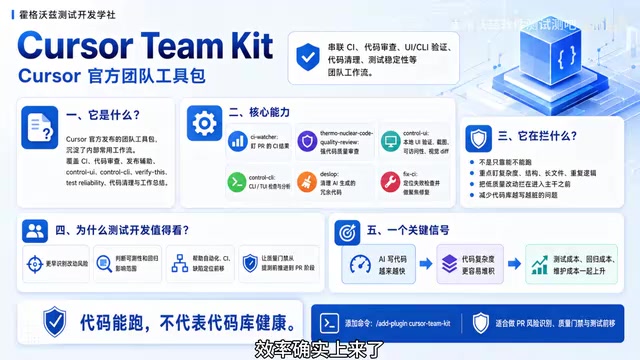
Cursor's officially released Team Kit toolkit's core value isn't about writing code faster — it's about addressing the code quality risks introduced by AI programming. It covers CI monitoring, deep code review, UI/CLI verification, and code cleanup capabilities, helping teams tackle systemic issues like technical debt accumulation, soaring code complexity, and declining test efficiency caused by AI-generated code. It represents the evolution of AI programming tools from "generating code" to "governing code quality."
More Than a Code Generation Tool: What Is Cursor Team Kit
Recently, Cursor officially released a noteworthy toolset — Cursor Team Kit. It's not an ordinary code generation plugin, nor is it a simple assistant that fills in a few code snippets. Rather, it's a standardized engineering practice toolkit that the Cursor team built by externalizing the workflows they use internally.
This toolkit covers CI monitoring, code review, UI verification, CLI inspection, code cleanup, test stability, and release readiness, among other capabilities. If you're a developer, your first reaction might be "can it help me write code faster?" But if you're in test development or quality assurance, I'd suggest looking at it from a different angle — what truly deserves attention here isn't making code faster to write, but how to keep the codebase from getting dirty after code is written fast.
The Efficiency Dividend and Hidden Costs of AI Programming
AI programming tools are now extremely common. A feature that used to take half a day to develop can now be generated quickly from a requirements description — page logic, API calls, state management, exception handling, even test code can all be produced together. Efficiency has genuinely improved.
AI programming tools represented by GitHub Copilot and Cursor are essentially code completion systems based on Large Language Models (LLMs), trained on massive open-source code repositories. Their core capability is pattern matching and context continuation, not genuine understanding of business semantics. This leads to several systemic issues: first, "hallucinated code" — generated API calls or library functions that may not actually exist; second, style inconsistency — multiple exception handling paradigms mixed within the same project; third, inflated test coverage — AI-generated test cases tend to cover only the happy path, with insufficient coverage of edge cases and exception branches.
But problems follow: the faster code is generated, the faster complexity can pile up. Much of this code isn't broken — the main flow works fine, and CI might even show green. But trouble starts as soon as requirements change:
- Files keep getting longer, functions keep growing larger
- Conditional branches multiply, similar logic scatters across different places
- Exception handling uses a different pattern each time
- Logs lack critical context
Code complexity is typically measured by Cyclomatic Complexity, proposed by Thomas McCabe in 1976. The higher the cyclomatic complexity, the more test paths exist and the higher the maintenance cost. The industry generally agrees that a single function with cyclomatic complexity above 10 needs refactoring. The special problem with AI-generated code is that it tends to produce "runnable but inelegant" code — extensive conditional branches, repetitive exception handling patterns, and long functions lacking abstraction. This Technical Debt, a concept introduced by Ward Cunningham, is analogous to borrowing: trading rapid short-term implementation for long-term maintenance costs. Tools like SonarQube have quantified technical debt as "hours needed for remediation," making it perceivable and actionable for management.
These issues may not be bugs in the short term, but they directly impact testing efficiency and quality assurance: regression scope becomes hard to determine, automation scripts become increasingly brittle, defect localization depends more and more on developer explanations, and when CI fails it's difficult to quickly determine whether it's a product issue, a script issue, or an environment issue.
Breaking Down Cursor Team Kit's Core Capabilities
CI Watcher: Enabling Earlier Detection of CI Failures
CI Watcher primarily monitors the CI results of the current PR, telling you whether checks passed or failed, along with relevant failure links.

CI (Continuous Integration) is one of the core practices in modern software engineering, originating from Extreme Programming (XP) methodology and systematically articulated by Martin Fowler in the early 2000s. Its core idea is: developers frequently merge code into the trunk, with each merge triggering automated builds and tests, thereby catching integration issues early. Quality Gates are mandatory checkpoints set within the CI pipeline — only code that passes all checks can proceed to the next stage. With the proliferation of AI programming tools, traditional CI pipelines face new challenges — code generation speed far exceeds manual review speed, and the density and intelligence of quality gates must scale accordingly.
This capability is extremely valuable for test development. CI shouldn't be something only developers check logs for — testers also need to know earlier at which stage failures occur. Incorporating CI monitoring into the testing workflow means shifting quality feedback earlier — this is precisely the key step in moving quality gates left.
Thermal Nuclear Code Quality Review: Deep Code Quality Auditing
The name sounds dramatic, but what it does is critically important — intensive code quality review. It doesn't focus on simple formatting issues, but rather on code maintainability, structural soundness, long files, complex logic, "spaghetti code," and other deep-seated problems.
In other words, it's not just asking "does the code run?" — it's asking "will this commit make the codebase harder to maintain?" This is precisely the dimension test developers should care about most — the harder code is to maintain, the higher the subsequent testing costs, and the less stable automation test cases become.
Ctrl-UI and Ctrl-CLI: Practical Interface and Command-Line Verification
Ctrl-UI leans toward local UI verification, including interface inspection, screenshot comparison, accessibility auditing, visual diff, and UI bug reproduction. Ctrl-CLI focuses on command-line tools and TUI inspection and analysis.
These two capabilities overlap significantly with test development work. A truly practical test agent can't just read requirements and write test cases — it must also be able to view interfaces, operate interfaces, check results, and analyze failures. Cursor Team Kit's practices in this area provide new ideas for test automation.
Deslog: Cleaning Up "Waste" from AI-Generated Code
Deslog can be understood as cleaning up waste from AI-generated code. The common problem with AI programming isn't necessarily that the code is completely wrong, but that it's somewhat bloated, somewhat repetitive, somewhat inconsistent with team style — runnable in the short term, exhausting to maintain long-term.

So Deslog's capability is essentially addressing the engineering side effects of AI programming. When teams heavily use AI-assisted coding tools like Cursor, this kind of "code hygiene" tool becomes indispensable. Tools like these in Cursor Team Kit represent the evolution of AI programming tools from "generating code" to "governing code quality."
Related articles
 Product Reviews
The Programmer's Desk Setup Guide: Building a Workspace That Feels Like Home
Discover how programmers build productive, comfortable workspaces. From multi-monitor setups to ergonomic design, explore the desk philosophy that drives focus and flow.
 Product Reviews
Qoder vs Cursor Real-World Comparison: Which $20/Month AI IDE Is Better?
Hands-on comparison of Qoder vs Cursor AI IDEs: Agent autonomy, human interaction count, and architecture decisions. Qoder needed only 2 interactions vs Cursor's 8.
 Product Reviews
Cursor Cloud Agent Demo: Eliminating Bottlenecks Across the Entire Software Development Lifecycle
Deep analysis of Cursor's Cloud Agent demo showing how cloud VMs, automated test artifacts, and a full-chain control plane systematically eliminate human bottlenecks across the software development lifecycle.