Deep Dive into DeepSeek Harness: A Customizable AI Engine for Test Engineers

DeepSeek Harness's plugin mechanism enables deep customization of AI engines for professional test engineering workflows.
DeepSeek Harness differentiates itself from tools like Codex and Claude Code through its open plugin mechanism, allowing deep customization for testing workflows. It addresses the core pain point of managing AI-generated test artifacts by integrating generation, management, and review in one interface. Through its Skill system and extensible architecture, Harness enables engineering governance of AI output, making it reliable, controllable, and team-shareable.
DeepSeek Harness: An Underestimated AI Engine Tool
DeepSeekAd's Harness engine, released on August 13, appears at first glance no different from existing AI tools like Codex, Claude Code, or Doubao — it offers the same conversational interface, file operations, command execution, and Skill invocation. You can use it to create folders, generate test cases, and manipulate software files on your computer. These are all standard capabilities of mainstream Engine tools.
It's worth providing some context on the current AI Agent Engine ecosystem. Tools like Codex, Claude Code, and Doubao belong to the "AI Agent Engine" category that has emerged in recent years. Their common characteristic is having a large language model at the core, complemented by peripheral capabilities such as file system access, terminal command execution, and code interpreters, forming an intelligent agent runtime environment capable of autonomously completing complex tasks. OpenAI's Codex is positioned as a cloud-based asynchronous code Agent, Claude Code by Anthropic focuses on local terminal interaction, and ByteDance's Doubao provides multimodal AI assistant capabilities for Chinese users. DeepSeek Harness enters this same arena but takes a differentiated path through its open architecture design.
However, according to in-depth demonstrations by testing-focused creators on Bilibili, Harness's true differentiator lies in its plugin mechanism. This mechanism fully opens up the engine's interface and capabilities, allowing users to deeply customize and transform the tool. This level of openness is something closed tools like Claude and Codex simply cannot provide.
From a technical perspective, Harness's plugin mechanism is essentially an extensible architecture design pattern. Similar to VS Code's Extension API, it exposes UI rendering interfaces, tool invocation interfaces, and lifecycle hooks, allowing third-party code to be injected into the engine runtime. But unlike traditional IDE plugins that merely extend editor functionality, Harness plugins can transform the AI Agent's interaction interface, constrain model output behavior, and even redefine workflow orchestration logic. This "meta-programmability" enables the same engine to be shaped into completely different domain-specific tools.
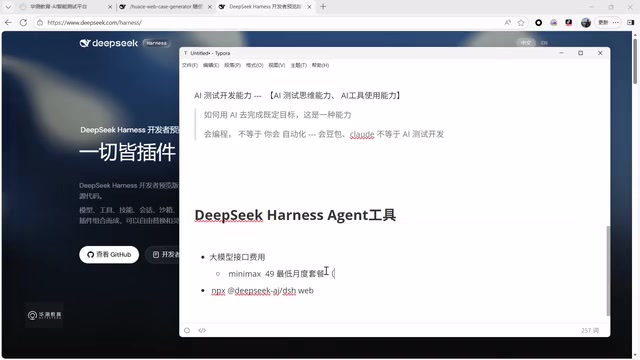
Put simply, other Engine tools are like fully furnished apartments — feature-complete but hard to modify. DeepSeek Harness is more like a "bare shell" — minimal in its initial state, perhaps even less capable than ready-made tools, but it hands over complete control of customization to the user. This is exactly why some people online complain that "this thing can't do anything" — they fundamentally haven't grasped the correct way to use it.
The Real Pain Point of AI Testing: Unmanageable Output
Why do test engineers particularly need a tool like this? The demonstration revealed a core pain point of AI testing: the management problem of AI-generated content.
Regardless of which AI tool you use to generate test cases, the output might be Excel, Markdown, or XMind files. Everything looks fine during demos, but in actual work, case files, script files, web interfaces, APP test points, and various other files end up scattered everywhere, making management extremely cumbersome. The review process is even more troublesome — you ask AI to revise once, twice, three times, but you can't intuitively view and edit everything within the same workspace, requiring constant switching between different software.
This pain point is widespread across the industry. In traditional test management, enterprises typically rely on platforms like TestRail, Zentao, or Jira+Zephyr to centrally manage test cases. But the introduction of AI-generated content breaks this closed loop: AI output formats are inconsistent (could be Markdown, JSON, or Excel), generation locations are scattered (conversation windows, local files, clipboard), and each iterative modification lacks version tracking. This leads test teams to face the paradox of "the more AI produces, the more chaotic management becomes."
The demonstrator solved this problem with a plugin: after loading it, a visual management panel appeared on the right side of the Harness interface. Generated test cases could be clearly categorized by module (such as user module, login section), displayed in tabular form showing operation steps, expected results, and assertions. When requesting AI to "keep only three assertions," modifications appeared in real-time on the interface without needing to switch to Excel or Markdown files for line-by-line verification. Through plugins, Harness integrates generation, management, and review into the same interface, essentially rebuilding the closed loop of test asset management at the AI Agent level.
The Essence of Harness: Engineering Governance of AI
Many people don't understand the deeper meaning behind the name "Harness." As a verb, harness means "to control, to master" — and what it aims to control is AI itself.
Notably, "Harness" is not a new concept in software engineering. A Test Harness refers to the framework and infrastructure used for automated test execution. DeepSeek naming their product Harness suggests its positioning goes beyond being an AI conversation tool — it's infrastructure for applying engineering constraints to AI capabilities. This aligns with the industry discussion on "AI Governance" — when AI evolves from a personal assistive tool to team collaboration infrastructure, engineering challenges like output consistency, process auditability, and result reproducibility must be addressed.
Why We Need to Harness AI
AI output is inherently unpredictable — the same person might get different results between their first and second attempts, and every person uses it differently. If you're just experimenting personally, it doesn't matter if AI generates a pile of random content. But to truly integrate AI into a software engineering system, the model's output must become reliable, controllable, and usable.
The Harness architecture is essentially an engineering solution — an architectural philosophy for constraining, streamlining, and governing AI through engineering practices. This also explains why many enterprises have poor AI adoption outcomes — fundamentally, they lack the Harness mindset.
Skill Mechanism Explained
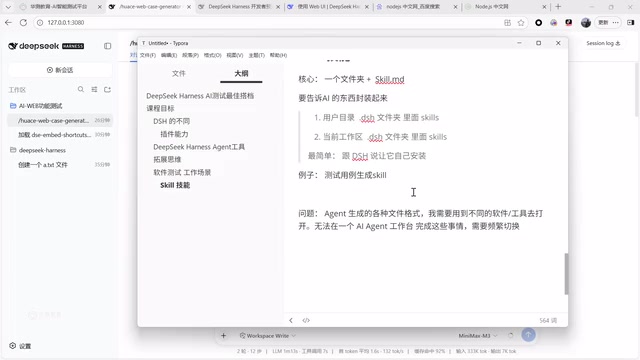
In this system, Skills are the key component. A Skill is essentially "a folder + a skill.md file," designed to encapsulate solidified rules and communicate them to the AI. For example, why does AI generate test cases in Markdown rather than XMind? Because the skill.md file constrains the output format, test point analysis methods, file naming conventions, storage locations, and a series of other rules.
From a technical standpoint, the Skill mechanism is a structured encapsulation of System Prompts and workflow rules. In LLM application development, Prompt Engineering has evolved into multiple patterns: few-shot examples, Chain-of-Thought reasoning chains, role definitions, and more. The Skill mechanism solidifies these scattered prompt engineering practices into version-manageable, reusable, and shareable file assets. The output format constraints, naming conventions, and analysis frameworks defined in skill.md files effectively "democratize" advanced Prompt Engineering capabilities — a Skill written by one expert can enable the entire team to enjoy equally high-quality AI output.
DeepSeek Harness Skills take effect in two locations:
- The
.dsh/skillsfolder in the user directory - The
.dshfolder in the current workspace
Both are active by default. A noteworthy detail: Skills are universal — the same skill can be used in both Claude Code and Codex.
From Plugin Extensions to Testing Platform: Advanced Usage
Harness's power lies in the unlimited extensibility of its plugin capabilities. The demonstrator showcased a complete path from simple to complex.
Dynamic Interface Transformation
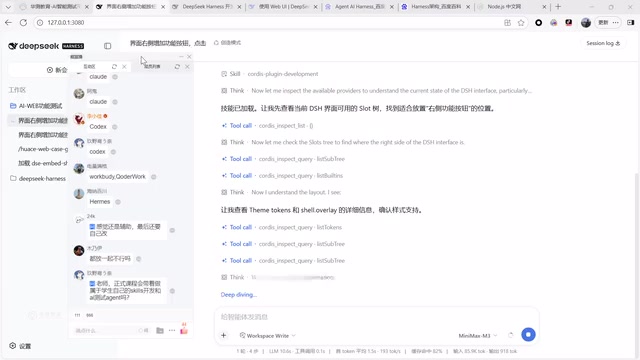
Through conversation, you can ask Harness to add functional buttons to its own interface and embed specific system interfaces. This floating panel can be dragged, maximized, made fullscreen, pinned to top, and even supports switching between multiple URLs. You can also choose to place it on the left side, right side, or in the tools panel or settings panel — anywhere you want. It's essentially letting the AI engine transform itself, gradually becoming a native tool "custom-built for software testing."
Integrating Complete Automation Testing Capabilities
Going further, after loading a pre-developed comprehensive plugin, Harness instantly gained a series of professional testing capabilities:
- Device Management: Remote control of Android, HarmonyOS, iOS, and PC devices, enabling browser operations, multi-monitor switching, and interface input
- Automated Test Orchestration: Having AI help orchestrate API automation workflows, with AI automatically identifying login credentials in environment variables and providing adjustment suggestions when execution errors occur (such as 401 or 404)
- Test Reports & Data Analysis: Automation data, manual testing data, and data dashboards all viewable within the same platform
The API automation orchestration involves core concepts in API testing. Traditional interface automation tools like Postman and JMeter require manual configuration of request parameters, environment variables, assertion rules, and execution sequences. With AI involvement, test workflows can be automatically generated by understanding API documentation, identifying data dependencies between interfaces (such as passing a Token obtained from login to subsequent requests), and intelligently diagnosing problems based on HTTP status codes (401 indicating authentication failure, 404 indicating resource not found). This capability lowers the barrier to API testing from "needing to master HTTP protocols and tool usage" to "being able to describe testing intent."
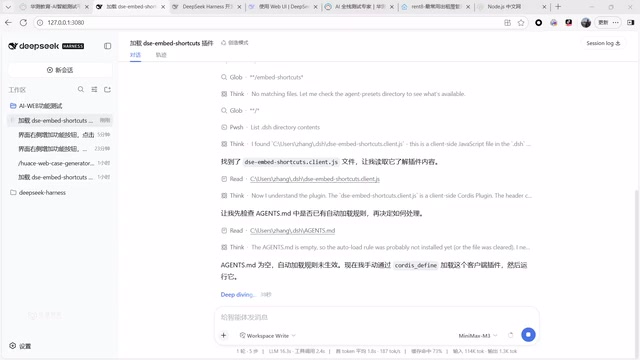
Once these features are packaged as plugins, a team of 10 only needs to load them once uniformly, or deploy them directly on an internal server, enabling organization-wide sharing and forming a complete AI quality engineering system.
Deep Integration of AI and Testing: Core Capability Analysis
The core message from this demonstration deserves deep reflection: AI and testing technology have never been separate — they exist in a state of fusion.
Many people's understanding of AI tools remains at the "can have conversations" level — using Doubao to generate test cases, chatting with DeepSeek, and picking whichever model seems smarter. But the demonstrator pointedly noted that 90% of work scenarios can be handled by models like MiniMax (approximately ¥49/month), with no need for top-tier models.
MiniMax is a large language model developed by Chinese AI startup MiniMax Technology, known for its relatively low API call costs and reasonable inference quality. This observation reveals an important economic principle in AI applications: in actual production environments, model selection should be based on task complexity rather than blindly pursuing parameter scale. Tasks like generating standardized test cases, filling templates, and format conversion can be handled by mid-range models, while reserving top-tier models (like GPT-4, Claude Opus) for scenarios truly requiring complex reasoning is a key strategy for enterprise AI cost control.
The real capability lies in two areas: AI testing thinking ability and AI tool usage ability — both are indispensable. Just as "knowing how to code doesn't equal knowing test automation," knowing how to use AI doesn't equal knowing AI test development. AI can do many things, but how to use AI to achieve defined goals, how to design and constrain — that itself is a skill.
This also explains current hiring trends — based on real interview records, whether for positions paying ¥13,000 or ¥25,000+, AI is a high-frequency topic. The core questions have shifted from "have you used AI" to "practical ability to implement AI in testing workflows" and "platform-level systematic capabilities." What enterprises truly lack are professionals who can deeply integrate AI with workflows and build controllable engineering systems.
For testing practitioners, the value of DeepSeek Harness isn't in the tool itself, but in how it most intuitively bridges the connection between AI-native capabilities and testing technology. You still need solid mastery of automation, test development, and other foundational technologies — Rome wasn't built in a day, tools will continuously evolve, but foundational capabilities remain the bedrock for adapting to any new technology.
Related articles

Chain of Thought Isn't Just for AI: How Humans Can Use CoT to Improve Thinking Quality
Chain of Thought isn't just a prompt trick for large models. Starting from a Hacker News discussion, this article analyzes why CoT works for human thinking too, breaks down actionable ways to transfer it, and highlights the key differences between human CoT and machine CoT.
Cloudflare Teams Up with OpenAI: Closi…
Cloudflare Teams Up with OpenAI: Closing the Loop from Vulnerability Discovery to Defense with AI
Cloudflare uses OpenAI Daybreak to investigate security vulnerabilities and generate reviewable remediation plans, while developers use Codex to boost coding efficiency and quality.

Orca Multi-Agent Orchestration in Practice: A Guide to Parallel Collaboration with Claude and Codex
Orca is Stable AI's free open-source agent workbench supporting 34 agents like Claude Code and Codex in parallel. Learn its Git worktree isolation, multi-model orchestration, and mobile management.