Deep Dive into DeepSeek Harness Developer Preview: A Self-Evolving Agent Framework

DeepSeek Harness introduces a self-evolving, hot-swappable agent framework aiming to be an AI operating system.
DeepSeek Harness Developer Preview presents a radical new approach to AI agent frameworks, introducing self-evolution through its mathematically-proven "primorial theory" and Codis Kernel architecture. Built in TypeScript with a fully component-based, hot-swappable design, it aims to function as an operating system for AI models rather than a fixed execution pipeline, setting it apart from existing tools like LangChain and AutoGPT.
DeepSeek Harness Makes Its Official Debut
After a period of anticipation, the Developer Preview of DeepSeekAd Harness has officially been released. As an open-source project, it's now available on GitHub, accompanied by an official technical white paper called Codex that systematically outlines the framework's core design philosophy.
A Developer Preview is a common early-release strategy in the software industry, indicating that the product has core functionality but hasn't undergone complete stability testing or user experience optimization. DeepSeek chose a dual-track release approach of "code + paper"—attracting community contributions through open source while establishing academic credibility through the white paper. This strategy is increasingly common in AI infrastructure; Meta's LLaMA series and several of Google's open-source projects have followed similar paths.
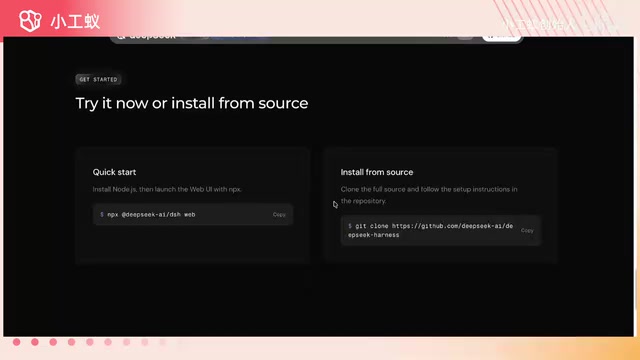
In terms of user experience, Harness has a relatively low barrier to entry. It can be launched with a single command, and with the appropriate plugins, the entire environment spins up automatically. In hands-on testing, I used a locally deployed Qwen 3 series FP8 model (approximately 27GB) to power it, verifying its excellent support for custom models—after simple configuration, the local model can take over Harness's inference tasks.
FP8 (8-bit floating point) is an emerging model quantization format that dramatically compresses model size compared to traditional FP16 or FP32, while keeping inference precision loss relatively manageable. The Qwen 3 series model deployed in FP8 format is approximately 27GB, meaning it can run on consumer-grade GPUs (such as an NVIDIA RTX 4090 with partial CPU offload). The core advantages of local model deployment include data privacy, low latency, and zero API costs. Harness's support for custom models ensures users aren't locked into any specific model provider's ecosystem—this is a key differentiator for open-source Agent frameworks compared to closed commercial products.
Additionally, it supports adding local workspaces, with an overall form factor quite similar to mainstream Agent tools like Claude Code and OpenCode. In actual use, however, both performance and user experience are quite impressive.
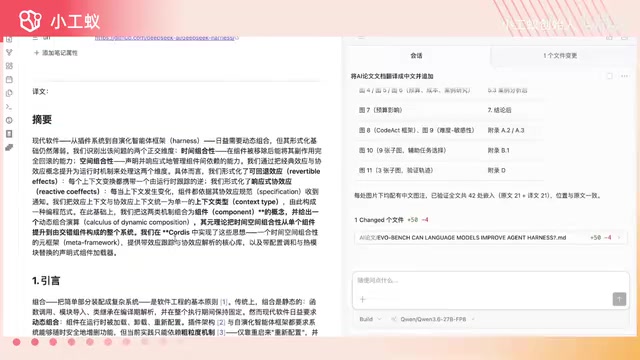
It's important to emphasize that the official team has explicitly stated the current version is still an "engineer preview" and hasn't been formally released. This means it's not yet consumer-friendly, and significant feature changes may occur in future updates.
Core Philosophy: Self-Evolution of the Agent Framework
The most fundamental difference between DeepSeek Harness and existing agent frameworks lies in its far more ambitious goal. The core proposition it aims to address is: the self-evolution of the agent framework (Harness) itself.
Traditional agent frameworks (such as LangChain, AutoGPT, etc.) typically employ fixed execution pipeline designs: prompt construction → model invocation → tool execution → result integration. This flow essentially remains unchanged after deployment. DeepSeek's "self-evolution" concept breaks this paradigm, arguing that the framework itself should possess adaptability like a living organism—dynamically adjusting its own structure based on task complexity and execution environment. This idea has deep connections to "self-organizing systems" in cybernetics and "Reflective Architecture" in computer science. Reflective architectures allow programs to inspect and modify their own structure at runtime; Java's reflection mechanism and Lisp's metaprogramming capabilities are early practices of this concept. DeepSeek has now advanced it to the system level in the AI Agent domain.
In the Codex technical white paper, DeepSeek provides theoretical proof of this concept from a mathematical perspective. When traditional Harness systems evolve to a certain stage, large language models need to optimize not just upper-level strategies—even the most fundamental Harness base components need to be capable of dynamic composition and evolution based on actual problems. The white paper proposes what it calls "primorial theory," elevating component composition across both temporal and spatial dimensions from the individual component level to the entire system level composed of interleaved components.
"Primorial theory" draws from combinatorics and category theory in mathematics. In traditional software engineering, component composition typically only considers the spatial dimension—which modules can be connected in parallel or in series. Primorial theory incorporates the temporal dimension, meaning components can not only be combined at a given moment but can also undergo interleaved composition across different execution stages. This spatiotemporal interleaving is analogous to the concept of tensor products in physics—expanding from a single-dimensional vector space to a multi-dimensional tensor space. This exponentially increases the system's expressive power and provides mathematical completeness guarantees for dynamic recombination.
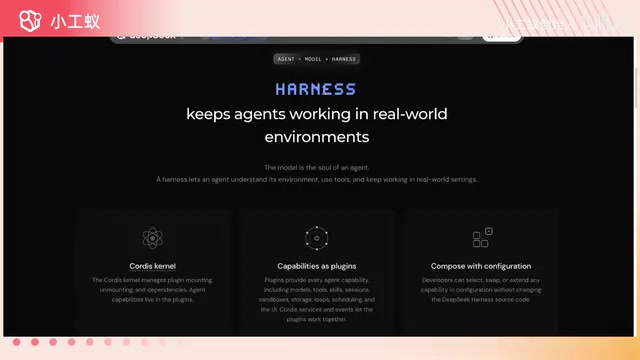
Mathematical Proof: Safety Guarantees for Hot-Swapping
The white paper's core argument is this: when a component is removed or damaged, the entire agent system can still operate reliably, and this process produces no side effects and supports rollback. Through the dual perspectives of temporal and spatial composition, DeepSeek mathematically proves that this component hot-swapping mechanism is feasible and safe, and that its fault-tolerance and rollback mechanisms are sound. This provides a solid theoretical foundation for agent robustness in real-world environments.
Hot-swapping originally comes from the hardware domain, referring to replacing hardware components without powering down the system (such as hot-replacing server hard drives). At the software level, hot-swapping means dynamically loading, unloading, or replacing modules during program execution without service interruption. This mechanism has mature applications in operating system kernels (such as Linux's Loadable Kernel Modules/LKM), microservice architectures, and game engines, but this is the first time it's been systematically introduced to the AI Agent domain. The core challenge lies in state consistency—when a component that's actively executing a task is replaced, how do you ensure intermediate states aren't lost and dependency relationships don't break? DeepSeek's mathematical proof of rollback mechanism completeness is essentially solving a problem similar to ACID transaction consistency in distributed systems, except extended to the dynamic component management scenario of intelligent agents.
Codis Kernel: An Architecture Where Everything Is a Component
Supporting the practical implementation of this philosophy is a foundational layer implemented in TypeScript, officially called the Codis Kernel. Codis engineers the "primorial theory" concepts from the white paper, and DeepSeek Harness itself is built on top of it.
The choice of TypeScript as the implementation language for the foundational layer is a noteworthy technical decision. TypeScript combines the engineering reliability of a static type system with the richness of the JavaScript ecosystem. Its asynchronous programming model (based on the Event Loop and Promises) is naturally suited for handling the I/O-intensive operations prevalent in agent frameworks (such as model API calls, file system operations, etc.). Furthermore, TypeScript's universal frontend-backend capability allows the Codis Kernel to support both server-side and browser-side execution, providing convenience for future multi-platform deployment. Compared to Python ecosystem frameworks like LangChain, TypeScript's type system can catch more component interface mismatches at compile time—this is especially important for a system that emphasizes dynamic component composition, since each composition is essentially a new interface integration.
The most distinctive feature of this architecture is that everything is a plugin, everything is a component. Whether it's models, tools, views, sessions, sandboxes, storage, loop engines, or the UI layer—all can be abstracted as configurable components. These components are all designed for hot-swapping, allowing modification, extension, and replacement without restarting the entire Harness.
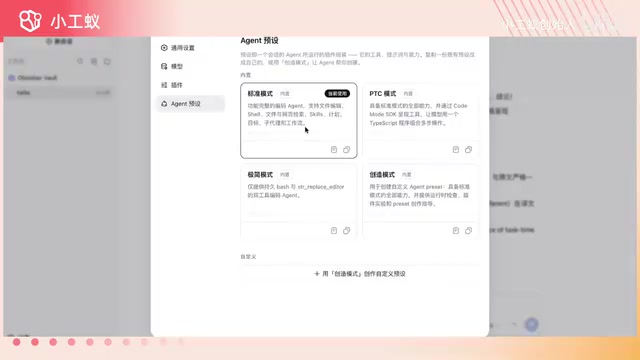
Component Ecosystem and Multiple Runtime Modes
Based on community feedback, Harness's component count is growing rapidly. Currently available components cover file systems, sandboxes, ToolServe Agents, and various other types. Users can freely choose to enable or disable them. Through different component combinations, multiple runtime modes can be formed—such as standard mode or minimal mode—and flexibly configured with various models.
Full-Process Traceable Debugging Experience
For engineers, another highly attractive feature is full-process traceability. Every step during system runtime—what it's executing, which loop iteration it's on, what it's doing—forms a complete trace record. This observability greatly facilitates debugging and understanding agent behavior logic.
Observability is a core concept in modern distributed systems engineering, typically comprising three pillars: Logs, Metrics, and Traces. In the AI Agent domain, observability is particularly critical because the inference process of large language models is inherently non-deterministic—the same input may produce different output paths. Harness's full-process tracing mechanism is similar to Distributed Tracing in distributed systems (such as the OpenTelemetry standard), but specifically adapted for Agent multi-round inference loops. Developers can clearly see the model's decision-making process, tool call parameters, and return values in each loop iteration—effectively addressing the common criticism that many current Agent frameworks are "black boxes."
Fundamental Differences from Existing Agent Tools
Overall, DeepSeek Harness positions itself as far more than just another Agent tool. Its ambition is to become infrastructure or even an "operating system" for models—a foundation deeply integrated with models, containing various dynamically modifiable components, where any changes to components and their dependencies can be perceived by Harness itself in real time.
Comparing an agent framework to an "operating system" isn't a DeepSeek original, but its implementation path is the most radical. The core responsibilities of an operating system are resource management, process scheduling, and hardware abstraction—corresponding in an Agent OS to model resource scheduling, task orchestration, and tool abstraction. Projects with similar visions in the industry include Microsoft's AutoGen (multi-agent collaboration framework), LangGraph (state-graph-driven Agent orchestration), and Anthropic's Claude Computer Use (environment interaction capabilities). However, most of these solutions remain at the application-layer orchestration level, while DeepSeek Harness attempts to achieve dynamism at the kernel layer. This more closely resembles true operating system design philosophy—particularly the microkernel architecture, where the kernel retains only a minimal feature set (inter-process communication, basic scheduling) and everything else exists as replaceable user-space services.
By contrast, most existing Harness implementations hardcode the entire process flow. Only some components (such as capabilities similar to GPT tool calling) achieve limited plugin-ization and dynamic composition, and often require restarting the entire software layer. DeepSeek Harness's thorough component-based design at the foundational level is arguably leading the industry.
Of course, conceptual leadership doesn't equal implementation maturity. It's worth noting that making everything a dynamically hot-updatable, hot-swappable component inherently consumes additional system resources—this is one reason the white paper attempts to mathematically prove its feasibility and safety. Dynamic component management requires additional registry maintenance, dependency graph updates, and state snapshot overhead that don't exist in statically compiled frameworks. The team also candidly acknowledges that the current implementation still has shortcomings and is in a "catching up" phase. In testing, approximately 80% of its features have reached the level of other mature tools, with the remainder still being developed.
Conclusion: Future Outlook for the Agent Operating System
DeepSeek Harness presents an entirely new approach to agent frameworks: rather than treating the Harness as a fixed execution pipeline, it transforms it into a living system capable of self-evolution and dynamic recombination. Although the current Developer Preview isn't yet polished—with usability and some features still being refined—its underlying "primorial theory" and Codis Kernel design undoubtedly point toward a more imaginative direction.
From a broader industry perspective, this project's emergence signals that the AI Agent domain is shifting from "application-layer innovation" to "infrastructure-layer innovation." Just as web development in the 2000s evolved from simple CGI scripts to mature application servers and container orchestration systems, agent frameworks are undergoing a leap from scripted tools to systematic platforms. As the project continues to iterate, this vision of an "agent operating system" deserves long-term attention.
Related articles

The Truth About American College Party Culture: The Risks Schools Won't Admit
Behind American college party culture, the administration's "don't ask, don't tell" attitude is amplifying freshman risks. This article analyzes how the pandemic strengthened Greek dominance, freshmen's difficulty accessing safety information, and the chain reactions caused by a culture of denial.

OpenAI Reportedly Raising $30B at $1.25T Valuation Ahead of IPO
OpenAI is planning a $30B funding round at a possible $1.25T valuation, paving the way for an IPO. If completed, it would set a private company valuation record. This article analyzes the funding size, pre-IPO logic, and industry signals.

a16z Crypto Rebrands as a16z Frontier: Pivoting to Frontier Tech as Blockchain Investment Retreats
a16z's Chris Dixon-led crypto division rebrands from a16z Crypto to a16z Frontier, expanding into broader frontier tech. We analyze the blockchain investment retreat behind the rebrand and its impact on the crypto VC industry.