Deep Dive into DeepSeek Harness: The 'Everything is a Plugin' AI Agent Framework

DeepSeek Harness: an open-source, modular AI agent framework where everything — even the thinking loop — is a plugin.
DeepSeek launched Harness, an MIT-licensed open-source AI agent framework that hit 60K GitHub Stars in under a day. Its core philosophy — "everything is a plugin" — makes models, tools, memory, sandboxes, and even thinking loops swappable. It supports local deployment with a single command, four operating modes, full observability with trajectory views, and ships alongside the new V4 Pro model. Still at v0.1, it's a promising but early-stage tool.
What Is DeepSeek Harness?
On August 13, DeepSeekAd quietly launched an open-source AI agent framework called Harness. In less than a day, it rocketed past 60,000 GitHub Stars, making it one of the fastest-growing AI projects ever. It's released under the MIT license, meaning it's completely free and open-source — anyone can download, modify, or build upon it without any authorization required.
The MIT license is one of the most permissive open-source software licenses in existence, created by the Massachusetts Institute of Technology (MIT). Unlike "copyleft" licenses such as the GPL, the MIT license allows anyone to freely use, copy, modify, merge, publish, distribute, sublicense, and even sell copies of the software — the only requirement being that the original copyright notice is preserved. This means companies can integrate MIT-licensed code into commercial products without having to open-source their own code. In the AI space, Meta's LLaMA model series uses a custom community license, while some of Stability AI's models employ more restrictive licensing. DeepSeek's choice of the MIT license sends a very clear signal: it aims to eliminate barriers to adoption as much as possible and encourage rapid growth of the community ecosystem.
To understand Harness, consider this analogy. If an AI model is a "brain," then while it can think, it can't actually do anything on its own: it can't open files, it doesn't remember what happened yesterday, and it can't invoke tools. Harness is everything that wraps around that brain — its hands, its memory, its workspace, and its set of behavioral rules.
In other words, when people talk about "AI agents," what they really mean is the combination of "model + Harness." AI agents represent one of the most important directions in artificial intelligence today. Unlike traditional "ask-one-answer-one" chatbots, agents possess capabilities for autonomous planning, tool invocation, environment awareness, and persistent memory. Their core operational logic is typically summarized as the ReAct (Reasoning + Acting) loop: first reason about what the current task requires, then execute a specific action, observe the result, and finally decide the next step. Companies like OpenAI, Anthropic, and Google are all actively advancing agent technology. In a research paper published in early 2025, Anthropic collectively referred to the surrounding infrastructure needed to build agents as an "Orchestration Framework," while DeepSeek named theirs Harness (meaning "to harness tools"), vividly conveying the framework's role in orchestrating and constraining model capabilities.
Anthropic's Claude Code is a Harness built around Claude. Claude Code is a command-line AI programming tool launched by Anthropic in 2025 that can directly read and write files, execute terminal commands, perform Git operations, search codebases, and complete complex software engineering tasks across multiple conversation turns through context memory. Claude Code's success proved a key thesis: the value of AI lies not just in the intelligence of the model itself, but in the toolchain and interaction interface built around it. However, Claude Code is deeply coupled with the Claude model, making it difficult for users to switch to other models. Now, DeepSeek — one of China's largest AI labs — has shifted from merely "building brains" to constructing the entire ecosystem surrounding them. DeepSeek Harness's "model-agnostic" design is a direct alternative to this kind of vendor lock-in. This is a strategic shift worth paying attention to.
Core Philosophy: A Modular Architecture Where Everything Is a Plugin
If DeepSeek Harness were just another tool in the category, it wouldn't be worth discussing separately. What truly sets it apart is its core philosophy — Everything is a plugin.
The "everything is a plugin" design philosophy originates from the long-standing Plugin Architecture concept in software engineering. Successful software platforms like Eclipse IDE, WordPress, and VS Code all employ similar designs: the core system provides a minimal runtime framework, with all functionality implemented through pluggable extension modules. The advantage of this architecture lies in decoupling: each module is independently developed, tested, and deployed, and a failure in one module won't crash the entire system. In the AI agent space, making the model, tools, memory, sandbox, and even the thinking loop all into plugins means developers can perform extreme optimizations for specific scenarios — such as swapping in a specialized memory system for financial analysis, or switching to a model more skilled at coding for code generation — without having to rebuild the entire agent from scratch.
And they mean it — literally everything:
- Models are plugins
- Tools are plugins
- Memory systems are plugins
- The sandbox environment where the agent runs is a plugin
- Even the agent's thinking loop — the core logic that decides "think → act → check → repeat" — is a plugin
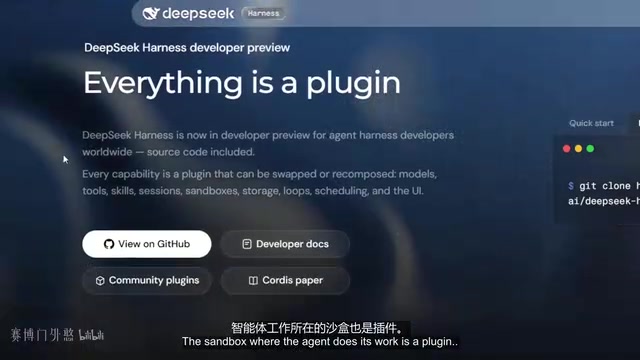
The thinking loop deserves deeper explanation. The agent's thinking loop (also called the Agentic Loop or Agent Loop) is the core mechanism that distinguishes agents from ordinary chatbots. A typical thinking loop consists of these steps: (1) receive a user instruction or environmental signal; (2) the model reasons and decides on the next action; (3) invoke tools to execute operations (such as reading files, searching the web, or running code); (4) observe the results returned by tools; (5) determine whether the task is complete — if not, loop back to step 2. Different thinking loop implementations affect agent behavior — for example, some loops support parallel tool invocation for greater efficiency, while others incorporate Self-Reflection mechanisms to reduce errors. DeepSeek Harness making the thinking loop a replaceable plugin means users can choose the most appropriate loop strategy based on task complexity — something quite rare among similar frameworks.
Every single component can be removed and swapped for another.
Think of most AI tools as a sealed car: you can change the radio station or add a phone mount, but the engine is always the same engine. DeepSeek Harness is more like a car where you can freely swap out the engine, wheels, and seats — and it still drives. If a better memory system comes along next month, you just replace that one module without scrapping the whole car. This modular architecture is precisely what distinguishes it from "sealed box" tools.
Local Deployment: Run It with a Single Command
One of Harness's most appealing features for developers is its local deployment capability. You don't need complex installation and configuration — just type a single command in the terminal, and it starts up, opening a page running on your local machine directly in your browser.
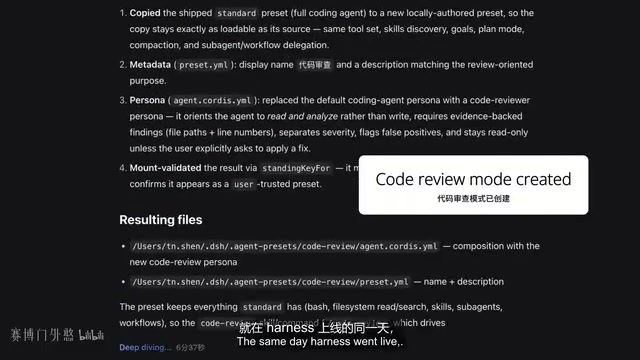
For regular users, the actual workflow is extremely simple: one command opens a chat page, and then you type your request in plain language. You don't need to interact with the underlying plugin system at all — plugins run silently in the background, fulfilling your requests while you simply review the results.
Additionally, Harness is compatible with existing instruction file specifications, such as agents.md and claude.md. These Markdown-format configuration files are placed in the project root directory and communicate project-specific rules, coding styles, tech stack preferences, and workflow constraints to AI agents. For example, an agents.md file might specify directives like "This project uses TypeScript; the use of the any type is prohibited" or "All API requests must include error handling." This practice was originally popularized by tools like the Cursor editor and Claude Code. If you've already configured these files for other AI tools, DeepSeek Harness can read them directly — no need to start from scratch. This compatibility with the existing ecosystem reflects a pragmatic strategy: rather than forcing users to learn a new configuration approach, it integrates directly into existing workflows, dramatically reducing migration costs.
Runtime Architecture and Four Operating Modes
If you're going to use Harness for real work, runtime performance matters. Harness delivers impressive observability in this regard.
Observability is a key concept borrowed from distributed systems engineering into the AI domain. In traditional software, observability typically consists of three pillars: Logs, Metrics, and Traces. When AI agents begin autonomously executing multi-step tasks, observability becomes especially critical — because agents may make unexpected decisions at intermediate steps, and debugging becomes extremely difficult without complete execution records.
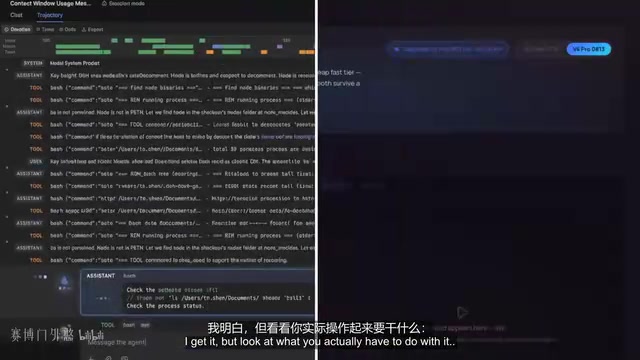
Every run is fully recorded: everything the model sees and every step it executes is saved in order, with nothing lost. These logs can be viewed in the Trajectory View. The Trajectory View provided by Harness is essentially the AI agent version of distributed tracing: it fully records every model input/output, every tool invocation, and its results. If an agent behaves unexpectedly, you can trace back to find the cause. You can even pause a run, fork it onto a new path, or re-run from any node. The ability to pause, fork, and replay approaches the concept of "Time-Travel Debugging." This level of transparency is something many early agent tools lack.
Depending on your needs, Harness offers four operating modes:
- Standard Mode: For handling everyday tasks
- Code Invocation Mode: Call tools directly through code instead of guessing
- Minimal Mode: A streamlined, lightweight option for simple work
- Creation Mode: Designed specifically for building things from scratch
Each mode loads a different set of plugins, so you don't have to maintain a bloated system just to do something simple.
Companion Release: DeepSeek V4 Pro Flagship Model
On the same day Harness launched, DeepSeek also released its upgraded flagship model V4 Pro, purpose-built for agent workloads and featuring an enormous context window — meaning it can hold a vast amount of information at once.
The context window is a core parameter of large language models, referring to the maximum text length a model can "see" and process in a single inference, typically measured in tokens (1 token corresponds to roughly 0.75 English words or 0.5 Chinese characters). Early GPT-3.5 had a context window of only 4K tokens, while frontier models in 2025 commonly reach 128K or higher. For AI agents, the size of the context window directly determines how much information they can process simultaneously: a larger window means the agent can complete more complex, longer-chain tasks without forgetting earlier conversation content. DeepSeek V4 Pro's massive context window is critical for agent workloads because the intermediate results, tool invocation records, and environment feedback generated during multi-step reasoning all need to be retained in context.
Since everything in Harness is a plugin, you can point it at any model you want — DeepSeek's own models, other open-source models, whatever fits your setup. This "model-agnostic" design gives the entire framework exceptional adaptability and flexibility.
From Standalone Tools to Agent Systems
A key insight: A single isolated tool can't run your company — only a system can. This is exactly why agent operating systems (agentOS) exist.
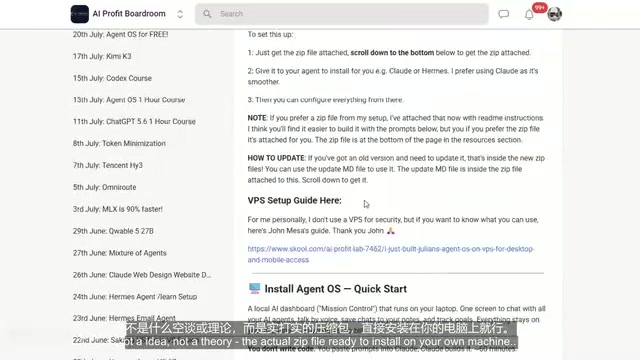
The agent operating system (agentOS) is a next-generation software architecture paradigm being explored by the AI industry. Just as traditional operating systems (like Windows and Linux) provide process management, file systems, and communication protocols for applications, the goal of agentOS is to provide a unified runtime environment, shared memory layer, and collaboration mechanisms for multiple AI agents. Under this architecture, each agent is essentially a "process" within the operating system — they can run in parallel, share data, and communicate with each other. Companies like Microsoft and Salesforce are also advancing similar concepts in their respective products.
In such a system, all agents work side by side within a single dashboard, rather than requiring you to open ten browser tabs and log into ten different accounts. They share the same memory — what one agent learns, the others can see. For example, one agent reviews all the events that occurred overnight and generates a summary, while another pulls the next set of action items and organizes them into a list. Neither agent cares which Harness is running underneath.
This is exactly where the modular architecture shines: when DeepSeek Harness improves next month, or when new tools emerge in the future, you just swap out that one piece while the rest of the system remains unchanged. DeepSeek Harness's modular design naturally aligns with the agentOS vision: since all components are replaceable plugins, multiple Harness instances can work together under the same orchestration layer, and that layer only needs to concern itself with standardized interfaces without understanding the internal implementation of each agent. You're not collecting a set of isolated tools — you're running a system that can accommodate whatever comes next.
A Reality Check: Harness Is Still at Version 0.1
Let's be honest: Harness is currently at version 0.1 — a developer preview. The official documentation explicitly warns: there will be breaking changes, plugins may break, and they'll be fixed later. Some of the 300+ community plugins may also be deprecated in the future.
If you're planning to run your entire company on it today, prepare for some bumps in the road. This disclaimer is actually quite practical — it tells you how to approach the tool right now: try it out, experiment with it, but don't bet the farm on it just yet.
That said, this doesn't diminish the overall trajectory. Core AI capabilities that were once locked behind expensive, closed tools are now open-source and free — and they come from a lab that iterates rapidly and builds powerful models. For developers and teams looking to quickly build AI agents rather than cobble solutions together from scratch, DeepSeek Harness is undeniably a compelling choice.
Key Takeaways
Related articles

Chain of Thought Isn't Just for AI: How Humans Can Use CoT to Improve Thinking Quality
Chain of Thought isn't just a prompt trick for large models. Starting from a Hacker News discussion, this article analyzes why CoT works for human thinking too, breaks down actionable ways to transfer it, and highlights the key differences between human CoT and machine CoT.
Cloudflare Teams Up with OpenAI: Closi…
Cloudflare Teams Up with OpenAI: Closing the Loop from Vulnerability Discovery to Defense with AI
Cloudflare uses OpenAI Daybreak to investigate security vulnerabilities and generate reviewable remediation plans, while developers use Codex to boost coding efficiency and quality.

Orca Multi-Agent Orchestration in Practice: A Guide to Parallel Collaboration with Claude and Codex
Orca is Stable AI's free open-source agent workbench supporting 34 agents like Claude Code and Codex in parallel. Learn its Git worktree isolation, multi-model orchestration, and mobile management.