Deep Dive into DeepSeek Super-agent Enterprise Agent Architecture

SuperAgent uses a Router-Worker two-tier architecture and fast/slow paths to turn Agents from single sessions into sustainable task systems.
Based on DeepSeek Harness's "SuperAgent Design Exploration" and Bilibili creator "Beishan"'s interpretation, the article breaks down an enterprise continuous-work Agent architecture: Router coordinates while Workers execute concurrently; fast/slow paths separate deterministic checks from model judgment, which cannot replace permission checks; subscription passthrough improves routing but is not authorization; Inline Spill and chain recall manage long-term context. It also walks through a fund quarterly report scenario and recommends starting with read-only tasks and five ledgers, noting the prototype is not a production security solution.
Title
Deep Dive into DeepSeek Super-agent Enterprise Agent Architecture
Meta Description
A deep dive into the DeepSeekAd Super-agent enterprise agent architecture: Router-Worker two-tier division of labor, fast/slow path event filtering, subscription passthrough vs. authorization boundaries, long-term context management, and a pilot path for enterprises starting with read-only tasks.
Article Content
When Agents in the enterprise move from "one-off answers" to "continuous work," the real challenge is no longer whether the model is smart enough, but how to manage long-running tasks, events, permissions, and human attention. The DeepSeek Harness team offered an architectural prototype in "SuperAgent Design Exploration": upgrading the Agent from a single session to a task system capable of sustained work. This article, based on the interpretation video by Bilibili creator "Beishan," breaks down its core designs—Router-Worker division of labor, fast/slow path event filtering, subscription passthrough vs. authorization boundaries, and long-term context management—and explores a pilot path for enterprises.
Why isn't a single ReAct loop enough?
An ordinary Agent works around a single Session: ask a question, think, call tools, return results. It is already valuable for handling individual tasks, but enterprise work often starts in group chats, receives revision feedback on code platforms, and is finally delivered to a ticket system—while other tasks are still being pushed forward simultaneously. Cramming all information into one Session leads to blocking and confusion; opening a separate Session for each matter forces people to repeatedly explain context and check results one by one.
SuperAgent is not about adding an "autonomous operation" switch to the model, but about having the system take on the coordination work originally done by humans. The original text proposes four characteristics: continuous, efficient, proactive, and persistent, corresponding to engineering problems of understanding tasks across entry points, advancing concurrently, judging when to intervene, and recovering from exceptions.
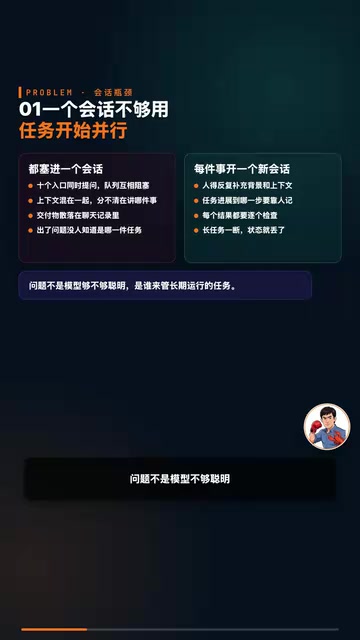
ReAct (Reasoning + Acting) is an agent paradigm in which a large language model alternates between reasoning and acting: the model first outputs its thinking (Reasoning), then decides which tool to call (Acting), observes the tool's returned result, and continues to the next round of reasoning, looping until the task is complete. Its strength lies in coupling "thinking" and "doing" in one interpretable trajectory, suitable for single, well-defined Q&A or tool-calling tasks. But the ReAct loop is inherently serial and session-bound: each step depends on the observation from the previous step, and the entire history accumulates in the same context. When a task requires parallel advancement across multiple entry points—group chats, code platforms, ticket systems—or lasts for weeks and needs exception recovery, a single loop both blocks due to context bloat and cannot truly run multiple tasks concurrently. SuperAgent's two-tier architecture is designed precisely to break through this single-loop boundary.
Two-tier architecture: division of labor between Router and Worker
The core of the architecture is a two-tier design. On the left, diverse inputs—group chats, tickets, code, platform events—enter through a unified entry point; in the middle, the Router handles global coordination and dispatch; on the right, Worker A through Worker D execute concurrently; finally, status is aggregated for human acceptance.
The Router understands tasks and intent, decomposes and dispatches, schedules concurrency, and aggregates results for acceptance. Workers complete specific tasks in relatively independent contexts, and for complex tasks a Worker can further use sub-Agents internally. This preserves a continuous experience on the user side while reducing the pressure on a single session to personally handle everything.
The original text also discusses merging and assessing events that arrive in dense batches: this can amortize invocation overhead but may increase queuing and erroneous correlation, so throughput alone is not the only metric. More critically, the original text argues that the Router design could even omit Bash, but the open-source prototype's main session actually still has related tools, and some constraints rely on prompt design—recommendations do not equal implemented tool-level permission isolation.
Fast and slow paths: event filtering and routing responsibility
When an Agent approaches a work group, what it first encounters is often not a shortage of tasks but too much noise. The original text draws on Fast Path and Slow Path to split event filtering into two layers.
The first layer is the programmatic fast path, performing deterministic checks such as source, group, and identity whitelists; group messages outside the allowed scope can be filtered out directly by the program. The second layer is the semantic slow path, where the model judges whether to act based on context—for example, "the data in this report seems off, who can verify it?" requires semantic understanding. The two paths yield four outcomes: ignore, record, take the task, or clarify.

The boundary that must be drawn is: model judgment cannot replace identity authentication, access control, and pre-execution permission checks. Deterministic rules handle clear-cut issues first; the model only handles candidate events that require semantic understanding.
Fast and slow paths have a second application: event routing. When a new task's ownership is unclear, Router assessment and dispatch are needed; but once a task is established, it can subscribe to the relevant discussion thread, after which subsequent events in the same thread are delivered directly to the associated Worker by the program, without going through the global Router every time. For example, when a new comment appears in a code review, the relevant Worker receives it directly and continues processing.
The Fast Path and Slow Path concepts originate from the idea of separating fast and slow paths in computer system design: the fast path uses deterministic, low-overhead rules to handle the vast majority of common cases, while the slow path uses heavier but more flexible logic to handle the few cases requiring deep judgment. In Agent event processing, the value of this pattern lies in layering cost and accuracy—programmatic checks such as whitelists, source validation, deduplication, and hash comparison are nearly zero-cost and yield deterministic results, filtering out a large amount of noise; semantic judgment requires model invocation, with high cost, latency, and potential errors, and should be reserved only for candidate events that truly require understanding. This controls model invocation overhead and avoids model misjudgments directly triggering unauthorized actions. Similar ideas appear in network packet filtering and risk-control rule engines.
Subscription passthrough is not authorization: the most accident-prone area
In the prototype, one discussion thread may be associated with multiple tasks, but subscription is only a routing relationship, not a permission. Receiving a message does not mean the task scope can be expanded. If a new message requests access to unauthorized client holdings, or shifts from "generate a research draft" to "modify official data," that has exceeded the original authorization and must be refused or re-authorized. It cannot be automatically allowed just because it belongs to the same discussion thread.
This is the vulnerability that most needs vigilance in the entire architecture: improvements in routing efficiency cannot come at the cost of permission boundaries.
In Agent systems, routing and authorization are two dimensions that must be separated. Routing answers "who should this message be sent to for processing"; authorization answers "does this processor have permission to do this." The subscription passthrough mechanism optimizes the former: once a task is established, subsequent thread events can be delivered directly by the program to the associated Worker, bypassing the global Router to reduce latency. But a message reaching a Worker does not change its permission boundary—a Worker's permissions should be determined by the authorization scope recorded when the task was created, not by the message source. If "same discussion thread" is mistaken for "same authorization domain," message-driven privilege escalation occurs: an attacker or careless operator only needs to append a message requesting a sensitive operation to an existing thread to potentially induce the Worker to overstep. The correct approach is to perform an independent permission check before the Worker executes; any out-of-scope operation must be refused or go through a re-authorization process.
Context management for long-term tasks: Inline Spill and chain recall
When a task lasts for weeks, cramming all historical messages and files into the prompt is definitely not feasible. The original text proposes Inline Spill and chain recall: the current context retains only necessary summaries and object identifiers, while full content is stored in a queryable location and read level by level along associated objects when needed. For example, the Router first sees "Task 42 is awaiting review," then reads the corresponding original discussion events and report as needed. This saves context while preserving traceability entry points.
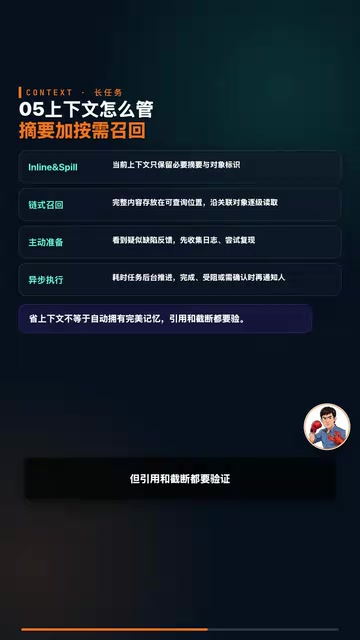
But this does not mean the system automatically has perfect memory, nor does it necessarily require vector databases or knowledge graphs. Enterprises still need to verify three things: whether references point to the correct version, whether truncation loses constraint conditions, and whether cross-department queries leak data.
Inline Spill draws on the "spill" concept from operating systems and databases: when the working set exceeds fast storage capacity, cold data is written to external storage, and only pointers or summaries are kept in main memory. In the Agent context, this means the prompt contains only the summaries, status, and object identifiers (such as task ID, material version, chapter references) necessary for the current task, while complete historical messages, original documents, and large logs are "spilled" to queryable external storage. Chain recall corresponds to on-demand, level-by-level reading: starting from an object identifier in the summary, read the next layer of content along associations, and go deeper if necessary, rather than loading everything at once. This pattern differs from retrieval-augmented generation (RAG)—it does not rely on vector similarity retrieval but on explicit object references and hierarchical relationships, making it more controllable and traceable, but it also requires the system to maintain reference consistency and version correspondence.
Proactive action and "refusing to execute"
The original text explores proactive action: upon seeing feedback about a suspected defect, first collect logs and try to reproduce, then submit results once it is confirmed that action is needed—trading extra computation for waiting time. But more proactive action is not always better; payments, external communications, and modifications to production data should not be executed on speculation alone.
Scenario walkthrough: fund quarterly report update
Using an enterprise design example (not an existing feature of the open-source project), the full workflow is walked through: an institution regularly tracks multiple funds' quarterly reports, and researchers need to update interpretation reports, focusing on whether the fund manager, investment strategy, and main risks have changed.
- The document system generates a quarterly report upload event; the programmatic fast path checks source credibility, fund and file version matching, and whether the file hash is duplicated. After passing, the semantic slow path judges whether it is formal material or merely a discussion for reference.
- The Router checks whether an unfinished task for the current period already exists for that fund; if so, it appends according to rules; if not, it creates a new one, recording the fund identifier, material version, owner, deliverables, deadline, and authorization scope.
- The Router dispatches three types of Workers—material verification, change extraction, and evidence verification—for parallel processing, each with clear inputs, outputs, and acceptance rules; outputs with missing materials or conflicting evidence are marked "to be verified" rather than fabricated and completed.
- The researcher appends a request in the discussion thread, and the subscribed Worker receives it directly.
- The context retains only the fund identifier, task status, key change summaries, and material references, reading specific chapters when needed, with each important conclusion accompanied by source and page number. The final delivery includes an internal draft with evidence, a difference list, missing materials, and pending questions, with an authorized researcher deciding whether to adopt it.
Enterprise pilot: start with read-only tasks
The original author validated the scheduling architecture's benefits using synthetic message streams and simulated-duration work, but simulated duration does not mean the quality of real code tasks has been validated, nor can it be extrapolated that all enterprise scenarios will be faster and cheaper.
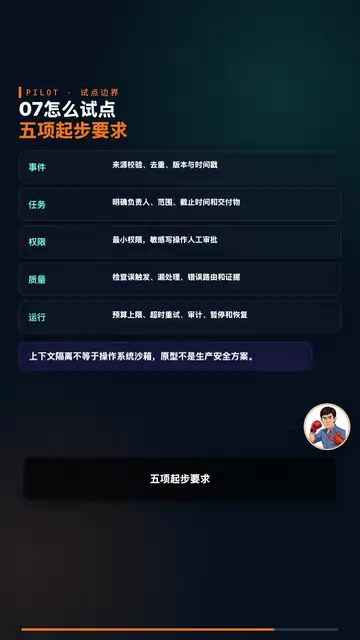
The recommendation for implementation is to start with a read-only task such as "update a difference report when new material arrives," test with historical samples, and then connect real events on a small scale. Five starting requirements:
- Event ledger: source validation, deduplication, versions and timestamps
- Task ledger: clear owner, scope, deadline, and deliverables
- Permission ledger: least privilege, manual approval for sensitive write operations
- Quality ledger: check false triggers, missed processing, erroneous routing, and evidence
- Operations ledger: budget caps, timeout retries, auditing, pause and resume
Also remember: the prototype is not a production security solution. Context or directory isolation does not equal an operating system sandbox; shared credentials, databases, and external interfaces can still conflict.
Conclusion: what enterprises need to design is mechanisms, not prompts
When Agents move from one-off answers to continuous work, what enterprises need to design is not just prompts but mechanisms for tasks, events, permissions, and delivery. Router-Worker division of labor solves the separation of coordination and execution; fast and slow paths solve who should judge noise; subscription passthrough solves routing efficiency, but the authorization gate cannot be skipped even one step; Inline Spill and chain recall solve long-term context; Watchdog and budget caps solve being able to stop after an exception. The original text is an architectural exploration; the prototype is not a formal product, nor a production security solution—it must know when to intervene and when not to; it must be able to advance concurrently and also stop in the face of exceptions and unauthorized actions.
One-line Summary
SuperAgent uses a Router-Worker two-tier architecture and fast/slow paths to upgrade the Agent from a single session to a task system capable of sustained work.
Paragraph Summary
Based on the DeepSeek Harness team's "SuperAgent Design Exploration" and Bilibili creator "Beishan"'s interpretation, the article breaks down an architectural prototype for enterprise continuous-work Agents. The core includes: the Router handles global coordination and dispatch, while Workers execute concurrently in independent contexts; fast and slow paths split event filtering into deterministic programmatic checks and model semantic judgment, with the model handling only candidate events and unable to replace permission checks; subscription passthrough improves routing efficiency, but subscription is only a routing relationship, not authorization—any scope expansion requires re-authorization; long-term context uses Inline Spill and chain recall, retaining summaries and object identifiers and reading level by level on demand. The article also provides a fund quarterly report update scenario walkthrough and recommends that enterprises start with read-only tasks and establish five mechanisms: event ledger, task ledger, permission ledger, quality ledger, and operations ledger, emphasizing that the prototype is not a production security solution.
Related articles

The New Digital Identity Revolution: How to Own and Govern Your AI Twin
Digital identity is entering the age of AI twins. Drawing on a Reddit discussion, this article analyzes who owns an AI twin, control over data and models, and governance mechanisms such as permission tiers, behavior auditing, and identity labeling—exploring how ordinary people can own and govern their own AI twins.

Claude Built a Programming Language Out of Memes: Memesis Lets AI Agents 'Meme Around' Safely
A developer used Claude Code to build Memesis, a programming language for AI agents with internet meme keywords, built-in sus/yolo safety, open source and locally runnable.

Meta Muse AI Digital Avatar Launches Video Calling, U.S. Users Can Customize Appearance
Meta announces U.S. users can interact with customizable Muse AI avatar via video call, and reveals a Tamagotchi-like wearable as AI assistants shift from tools to companions.