Deep Dive into Guava: Core Features and Practical Usage Guide

A comprehensive guide to Google Guava's core features and practical usage for Java developers.
This article provides an in-depth analysis of Google's Guava library, covering its enhanced collections framework (immutable collections, Multimap, BiMap, Table), efficient local caching with CacheBuilder, and elegant concurrency tools like ListenableFuture. It explains Guava's design principles, internal implementations, and its profound influence on Java standard library evolution, offering practical guidance for Java developers.
Deep Dive into Guava: Core Features and Practical Usage Guide
In the Java ecosystem, certain utility libraries have become essential tools for developers, and Google's open-source Guava library is undoubtedly one of the brightest stars among them. As of now, Guava has earned over 51,000 stars on GitHub, with more than 11,000 forks, and continues to grow by several stars daily. These numbers reflect Guava's unshakable position in enterprise Java development.
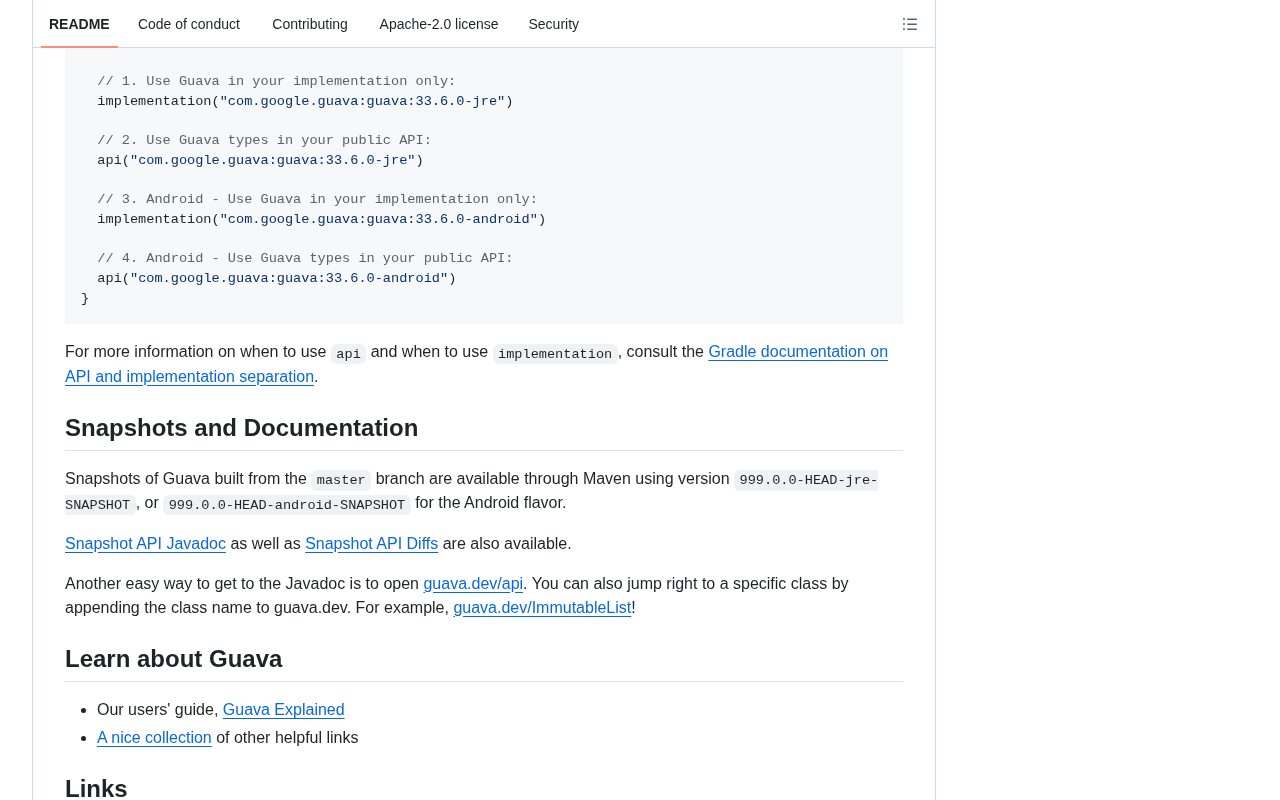
What Is Guava: Google's Core Java Library
Guava (pronounced like "gwah-vah") is a set of core libraries built by Google for Java developers. It originally emerged within Google to solve common problems that repeatedly surfaced during daily development, and was later polished and validated before being officially open-sourced. Virtually every line of code in Guava has been battle-tested in Google's massive production environment, providing an exceptionally high level of stability and reliability.
Guava covers an extensive range of functionality, including Collections, Caching, Primitives Support, Concurrency Libraries, Common Annotations, String Processing, I/O operations, and various utility classes. It's not a framework targeting any specific domain, but rather a comprehensive supplement and enhancement to the Java standard library.
Guava Core Features Explained
Enhanced Collections Framework: Immutable Collections and Extended Types
Guava significantly extends the Java collections framework. Its most celebrated contribution is the introduction of Immutable Collections, such as ImmutableList, ImmutableMap, and ImmutableSet. These immutable collections are not only thread-safe but also optimized for memory usage and performance, making them ideal for constants or method return values.
The design philosophy behind immutable collections stems from the "immutability" principle in functional programming. In concurrent environments, mutable state is the root cause of race conditions, deadlocks, and similar issues. Immutable objects are inherently thread-safe and can be safely shared across multiple threads without locking. Guava's immutable collection implementations use compact internal data structures—for example, ImmutableList uses arrays rather than linked list nodes, and ImmutableMap uses open-addressing hash tables instead of chained hash tables—thereby reducing object header overhead and pointer-chasing costs. Compared to the List.of() and Map.of() factory methods introduced in Java 9, Guava's immutable collections offer richer Builder Pattern support and collection view transformation capabilities, while remaining compatible with Java versions below 8.
Beyond that, Guava provides several collection types missing from the standard library:
- Multiset: A collection that allows duplicate elements, making counting and frequency statistics convenient
- Multimap: A mapping structure where a single key can correspond to multiple values, eliminating the need to manually maintain
Map<K, List<V>> - BiMap: A bidirectional mapping data structure that guarantees value uniqueness
- Table: A dual-key mapping structure similar to a two-dimensional table, suitable for row-column indexing scenarios
Taking Multimap as an example, without it, developers typically need to manually maintain Map<K, List<V>> or Map<K, Set<V>> structures, which introduces substantial boilerplate code: checking whether a key exists during put operations, initializing collections when they don't exist, handling empty collections during iteration, and so on. Guava's Multimap encapsulates these operations into a unified API, offering multiple implementations such as ArrayListMultimap, HashMultimap, and TreeMultimap, each corresponding to different value collection types and ordering requirements. Its asMap() method can convert a Multimap into a standard Map view, maintaining compatibility with existing APIs. This design pattern is extremely common in scenarios like event buses, index construction, and group aggregation.
These data structures often require developers to implement them manually through nested collections, but Guava wraps them into clean, easy-to-use APIs that significantly reduce code complexity.
Guava Cache: An Efficient Local Caching Solution
Guava's CacheBuilder is the direct reason many projects adopt Guava. It provides a powerful yet lightweight local cache implementation that supports multiple eviction strategies based on capacity, time, and references, along with configurable cache loading logic, expiration times, and statistics collection.
Looking at the internal implementation, Guava Cache's core draws from ConcurrentHashMap's segmented locking approach, dividing the cache space into multiple Segments, each independently managing its own hash table and eviction queues to reduce lock contention in high-concurrency scenarios. Its eviction strategy supports LRU (Least Recently Used) variants, using AccessQueue and WriteQueue—two doubly-linked lists—to track access order and write order respectively. Reference-based eviction leverages Java's WeakReference and SoftReference mechanisms, allowing the GC to automatically reclaim cache entries under memory pressure. It's worth noting that the Guava team later spun off the Cache evolution work into the Caffeine project, which uses the W-TinyLFU algorithm and significantly outperforms traditional LRU in hit rates. Caffeine has become the default recommended local cache implementation in Spring Boot 2.x.
For scenarios that don't require external cache middleware like Redis, Guava Cache is an ideal choice. It's particularly suitable for:
- Reducing the overhead of repeated computations or database queries
- Moderate cache data volumes that don't need distributed sharing
- Fine-grained control over eviction strategies
ListenableFuture: Elegant Concurrency Programming Tools
On the concurrency front, Guava's ListenableFuture extends Java's standard Future interface by allowing callback registration, enabling a more elegant way to handle async task completion events. Before Java 8 introduced CompletableFuture, this was a crucial solution for async programming pain points, and it still plays an important role in many legacy projects and specific scenarios today.
To understand the value of ListenableFuture, we need to review the evolution of Java's async programming. The Future interface introduced in Java 5 only provided a blocking get() method to retrieve results, making it impossible to implement "automatically trigger subsequent logic upon task completion." Developers could only poll or block while waiting. Guava's ListenableFuture solved this pain point through addListener() and the Futures utility class, supporting chained composition, exception handling, and result transformation. Java 8's CompletableFuture absorbed this design philosophy, providing richer composition APIs like thenApply, thenCompose, and exceptionally. However, in legacy systems still running on Java 7, or in projects deeply integrated with Google's tech stack such as gRPC, ListenableFuture remains the de facto standard. Guava also provides helper classes like MoreExecutors and Futures to help developers manage thread pools and combine results from multiple async operations.
Why Guava Is So Popular Among Java Developers
Guava's sustained high popularity is inseparable from several distinctive characteristics.
Guaranteed code quality. As a project officially maintained by Google, every Guava release undergoes rigorous testing. Its API design follows consistent conventions, and the documentation is quite comprehensive.
Effectively eliminates reinventing the wheel. Many utility methods that developers write repeatedly in practice—such as string splitting and joining (Splitter/Joiner), collection filtering and transformation, precondition checking (Preconditions), and more—are all provided by Guava in clean, efficient implementations, allowing developers to focus on business logic.
Broad compatibility and far-reaching influence. Guava's design philosophy has profoundly influenced the evolution of the Java standard library. In fact, many features introduced in Java 8, including aspects of the Stream API, bear Guava's fingerprints. Specifically, the Objects class in Java 7 (providing equals and hashCode helper methods), the Optional class in Java 8, the filter-transform-collect pattern in Stream API, and the immutable collection factory methods in Java 9 can all be traced back to corresponding features pioneered in Guava. Guava's Preconditions class inspired the design of Objects.requireNonNull(); its FluentIterable was a major inspiration for the Stream API. This pattern of "community libraries validating needs, standard library absorbing the essence" has become a typical evolution path in the Java ecosystem. JetBrains' 2023 developer survey shows that Guava remains among the top three most referenced third-party libraries in Java projects.
Usage Recommendations and Considerations
Despite Guava's power, there are a few points to keep in mind when using it:
Guava's version iterations are relatively frequent, and some APIs are marked with @Beta, meaning they may change in future versions. Therefore, features bearing this annotation should be used cautiously in production environments.
Additionally, as the Java standard library itself continues to improve (especially from Java 8 onward), some of Guava's functionality can now be replaced by native APIs. When introducing Guava, developers should evaluate whether the dependency is truly needed based on the project's actual JDK version, avoiding unnecessary dependency bloat.
Conclusion
After more than a decade of development, Guava has long become a foundational utility library in Java development. It not only solves a vast number of practical problems in daily development but also sets a benchmark for the entire Java community with its elegant design. Whether you're a beginner Java developer or an experienced engineer, deeply understanding and properly leveraging Guava can significantly improve development efficiency and code quality. For any Java project of meaningful scale, Guava deserves serious consideration.
Related articles

GitHub Daily · August 8: Self-Evolving Agents Explode on the Charts, Swarm Intelligence and Dev Tools Take Flight Together
GitHub Trending Aug 8: Self-evolving agent prime-agent surges 2293 stars, swarm intelligence and distributed Agent infrastructure dominate the charts.

Cursor Port Leak: Investigating and Resolving 600+ Uncleaned Port Forwards on Linux
Cursor editor has a port leak issue on Linux, leaving 600+ uncleaned port forwards after extended use. Learn the cause, risks, and temporary cleanup solutions.

Gemini Student Discount Renewal Hit by Bait and Switch: Advertised at $4.99, Checkout Shows Higher Price
Reddit user exposes Google Gemini Pro student discount renewal bait and switch: popup shows $4.99/month but checkout reveals a higher price. Analysis of AI subscription pricing transparency issues.