GitHub Daily · August 8: Self-Evolving Agents Explode on the Charts, Swarm Intelligence and Dev Tools Take Flight Together

Self-evolving coding agents and Agent infrastructure dominate GitHub Trending on August 8.
prime-agent surged 2,293 stars in a single day, showcasing self-evolving coding agents as the next frontier for AI programming. Today's GitHub Trending chart forms a complete Agent tech stack—from execution and coordination to memory, accountability, and infrastructure—signaling that AI Agents have entered the systems engineering era. denoland/celld gained 516 daily stars, providing self-hosted distributed durable state for stateful Agents, poised for an imminent breakout.
GitHub Daily · August 8: Self-Evolving Agents Explode on the Charts
If the open-source hotspot of the past two years was an arms race centered around foundation models themselves, then the Trending charts of summer 2026 have made one thing crystal clear: the battlefield has shifted to Agent orchestration, evolution, and infrastructure. Today's chart reads almost like a condensed industry map—the #1 spot goes to a self-improving coding agent, followed closely by graph-native AI context infrastructure, a swarm intelligence engine, multi-agent coordination tools, and the distributed runtimes and developer toolchains that underpin these systems.
One clear signal emerges: A single Agent is no longer enough. How to make multiple Agents collaborate, how to give them persistent memory, and how to make them accountable—these are the new technical focal points. Let's dive deep into today's ten trending projects one by one.
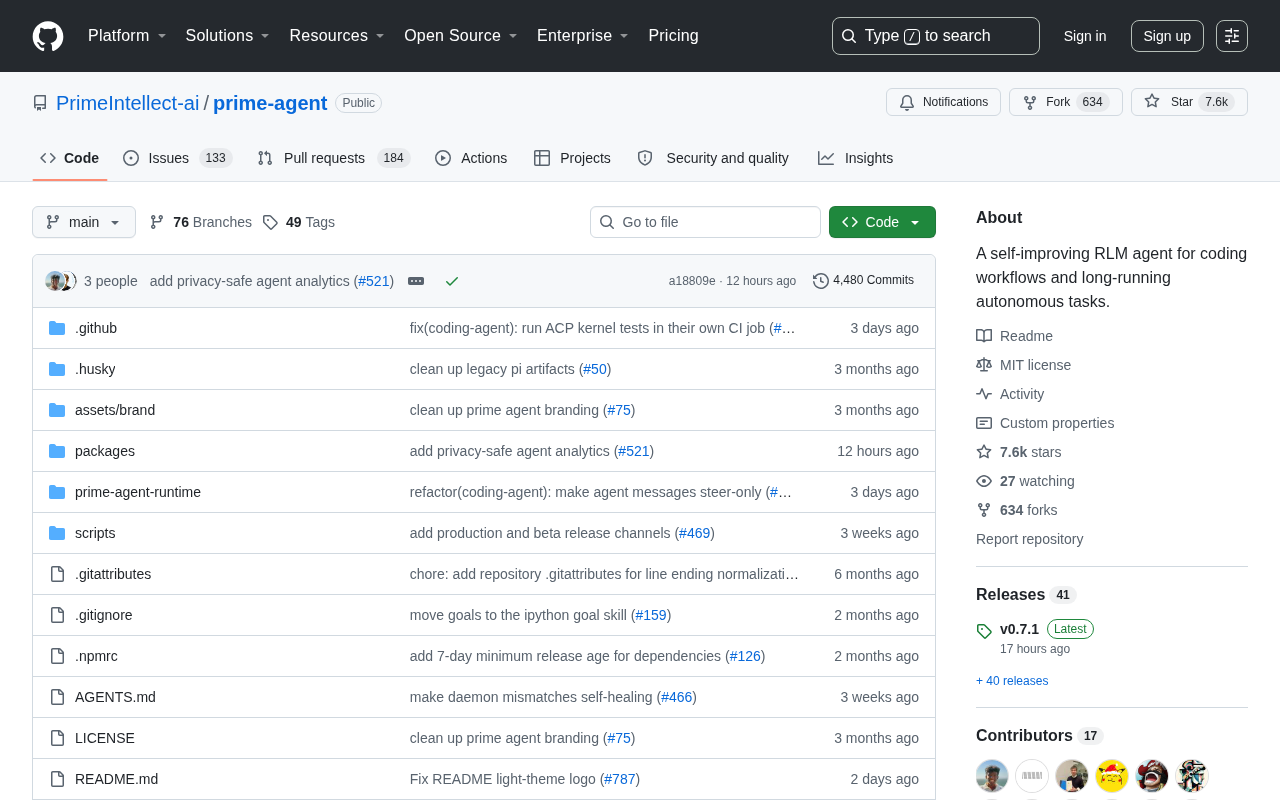
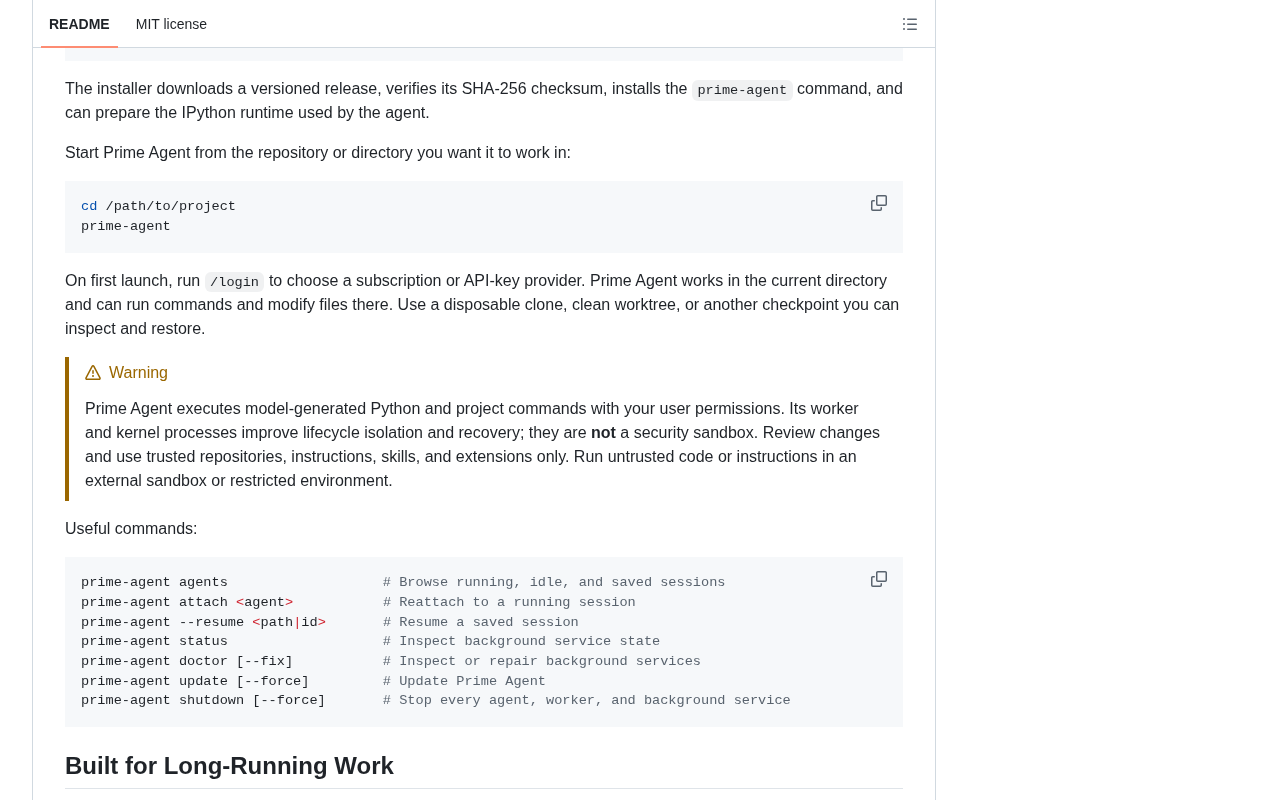
PrimeIntellect-ai/prime-agent: A Self-Evolving Coding Agent
Project positioning: A self-evolving coding agent built on RLM (Reinforcement Learning Model), designed specifically for long-running autonomous tasks.
Surging 2,293 stars in a single day to claim the top spot, this growth rate is in a league of its own on today's chart. The core pain point it addresses is a major weakness of current AI programming tools—stability and self-correction capability during long tasks. Tools like Cursor, Windsurf, and Devin perform excellently in short interactions, but once the task chain extends (e.g., having an Agent independently complete a multi-file refactoring or cross-day project iteration), they tend to drift off-course, lose context, or get stuck in infinite loops.
prime-agent's differentiator lies in being "self-improving"—it attempts to continuously correct its own strategies through reinforcement learning during execution, rather than relying on human intervention every time. This is hugely significant for scenarios like ops automation, large codebase migrations, and unattended CI fixes.
On the tech stack side, it chose TypeScript, which both lowers the barrier for frontend and full-stack developers and suggests strong toolchain integration capabilities (Node ecosystem plugins, MCP protocol integration, etc.). The high fork ratio of 7,507 stars to 624 forks shows that many developers aren't just watching—they want to get hands-on and modify it. This is a project that's truly being "used."
semantica-agi/semantica: Graph-Native Memory for AI
Project positioning: Graph-Native context infrastructure for accountable AI systems.
2,473 stars with 122 new ones today. It targets a seriously underestimated problem: AI system "memory" and "accountability". Most current RAG solutions use vector databases, which excel at semantic similarity retrieval but struggle to express structured relationships and reasoning chains between entities. When an Agent makes a decision, it's very difficult to answer "why did it do that."
semantica uses graph structures to organize context, making it naturally suited for expressing "who-did what-causing what" causal and relational networks. This is especially critical for compliance-sensitive domains like finance, healthcare, and law—industries that need AI not just to provide answers, but to enable auditing of where those answers came from. Written in Python, it integrates seamlessly with the mainstream AI ecosystem. Its appearance on the chart forms an interesting complement to prime-agent: one handles "execution," the other handles "memory and accountability."
666ghj/MiroFish: A Clean and Versatile Swarm Intelligence Engine
Project positioning: A clean, general-purpose Swarm Intelligence engine focused on "predicting everything."
With 70,696 total stars, it's the absolute heavyweight on today's chart. While the daily increment of 141 is relatively modest, staying on Trending demonstrates stable long-tail popularity. MiroFish's approach is fundamentally different from monolithic large models—it draws on nature's emergent swarm intelligence from fish schools and ant colonies, accomplishing complex prediction tasks through the collaboration of many simple individual agents.
This paradigm holds unique value in scenarios like financial forecasting, sentiment analysis, and complex system modeling: when problems lack clear causal models and data is noisy, swarm intelligence is often more robust than a single model. Implemented in Python with bilingual Chinese-English documentation, it clearly has significant influence in both domestic and international communities. Its existence reminds us that AI isn't limited to the "brute force miracle" approach.
chenyme/grok2api: Multi-Account API Gateway for the Grok Ecosystem
Project positioning: A multi-account unified API gateway for Grok Build, Grok Web, and Grok Console.
7,191 stars and 2,175 forks—the extremely high fork ratio reveals its real use case: developers forking and self-deploying en masse. As xAI's Grok series capabilities strengthen, developer demand for stable, programmable access to Grok has surged, while the official interface's account management and rate-limiting issues have spawned these middleware tools.
Written in Go, its strengths lie in performance and concurrency handling, making it perfectly suited for high-throughput gateway services. Projects like this always exist in a regulatory gray area, but from a technical perspective, it reflects that third-party model access infrastructure remains a hard requirement—behind every viral model, a batch of these "access layer" tools inevitably emerges.
jdx/mise: All-in-One Dev Tools, Env Vars, and Task Manager
Project positioning: A multi-purpose tool combining dev tool version management, environment variables, and task runner capabilities.
A veteran star project with 32,141 stars, written in Rust, serving as a modern replacement for asdf, direnv, and make. In an era where AI projects are sprouting everywhere, mise's continued popularity proves a simple truth: no matter how fancy the Agent, it still has to run in a real development environment.
It can uniformly manage multi-language versions for Node, Python, Rust, and more, automatically load project-level environment variables, and replace Makefiles for task orchestration. For developers who frequently switch between multiple AI projects, mise dramatically reduces the pain of "environment hell." The startup speed and reliability that Rust brings is its core advantage over traditional tools.
unclebob/swarm-forge: Minimalist Multi-Agent Coordination Tool
Project positioning: A simple tool for coordinating multiple AI agents.
1,930 stars with 81 new today. This project deserves special attention—the author unclebob is Robert C. Martin, author of Clean Code and a titan of software engineering. What's even more intriguing is that he chose Clojure, a functional Lisp dialect, to write a multi-agent coordination tool.
This conveys an interesting perspective: multi-Agent orchestration is fundamentally a problem of state, concurrency, and composition, and functional languages have natural advantages in these areas. swarm-forge emphasizes "simple," forming a stark contrast with those massive, complex Agent frameworks—it's more like an engineering master's textbook answer to "how to elegantly coordinate Agents." For developers wanting to understand the essence of multi-Agent orchestration, this is excellent learning material.
denoland/celld: Self-Hosted Distributed Durable Objects
Project positioning: A self-hosted, distributed Durable Objects runtime.
2,371 stars with a staggering single-day surge of 516, making it the second-fastest growing project today. Durable Objects was originally a proprietary concept from Cloudflare—a stateful edge computing primitive. denoland (the Deno team) has turned it into a self-hostable open-source solution, meaning developers can obtain stateful distributed computing capabilities without being locked into a single cloud vendor.
This is critical infrastructure for Agent systems: long-running Agents need persistent state and coordination in distributed environments. Written in Rust for guaranteed performance. Only 67 forks but 516 daily stars indicates it's in the early explosion phase—the community is highly attentive but hasn't deployed it at scale yet. This is a project worth getting in on early.
K2SOsint/Legendary_OSINT: The Gold Standard List of Open Source Intelligence Tools
Project positioning: An OSINT (Open Source Intelligence) tools and resources list for anti-fraud investigations, threat intelligence analysis, and KYC/AML.
1,622 stars, the only "resource aggregation" type project on today's chart. It serves a professional yet essential audience: fraud investigators, cyber threat intelligence analysts, and compliance/risk control professionals. As AI lowers the barriers to online scams and identity forgery, the counter-measures side's demand for high-quality OSINT tools rises accordingly. While list-type projects like this contain no code, their information aggregation value is irreplaceable in vertical domains.
pranshuparmar/witr: Tracing the Origin of Every Process
Project positioning: A CLI + TUI tool that can trace any process, port, container, or file back to "who started it."
20,018 stars with 234 daily. "Why is this running?"—this pain-point-hitting tagline says it all. Every developer and ops engineer has encountered this confusion: a port is occupied, a mysterious process is running, and you have no idea where it came from. witr is written in Go, providing both command-line and terminal UI interfaces to visualize the investigation chain.
Its popularity once again confirms the rule that "tools solving real small pain points are the easiest to achieve widespread adoption." In an era flooded with AI tools, this kind of no-nonsense system utility actually provides a sense of groundedness.
google/skills: Google's Official Agent Skills Library
Project positioning: A collection of Agent Skills for Google products and technologies.
16,449 stars with 327 daily—Google's official stamp brings built-in traffic. It provides a set of "Skills" that enable AI Agents to invoke and operate various capabilities within the Google ecosystem. This is the standard move for tech giants in the Agent era: by opening up skills libraries, they turn their own products into part of the Agent ecosystem. Written in Python, it lowers the barrier for community contributions. Its chart appearance shows that standardization of Agent "capability extension" is becoming contested territory among major companies.
Today's Trend Observation: Agents Enter the "Systems Engineering" Era
Stringing today's ten projects together, a clear throughline emerges: AI Agents are transitioning from "toys" to "systems engineering."
- Execution Layer: prime-agent (self-evolving coding), MiroFish (swarm intelligence)
- Coordination Layer: swarm-forge (multi-Agent orchestration), google/skills (skill extension)
- Memory & Accountability Layer: semantica (graph-native context)
- Infrastructure Layer: celld (distributed persistent state), mise (dev environment)
- Access & Operations Layer: grok2api (model gateway), witr (process tracing), Legendary_OSINT (intelligence tools)
This almost constitutes a complete "Agent tech stack." When people stop debating "which model is stronger" and start discussing "how to make Agents remember, collaborate, persist, and be auditable," it signals that the field is truly maturing.
Today's Must-See TOP 3
- PrimeIntellect-ai/prime-agent — 2,293 daily stars to claim the top, self-evolving Agents represent the next direction for coding agents. A must-see.
- denoland/celld — 516 daily stars with stunning growth, providing distributed infrastructure for stateful Agents. On the eve of an explosion, worth following early.
- unclebob/swarm-forge — Uncle Bob demonstrates multi-Agent coordination in Clojure. The best teaching material for understanding the essence of orchestration.
From today's chart, we can foresee that upcoming open-source focus will continue to revolve around Agent reliability, accountability, and infrastructure. Whoever can solve the problem of "making Agents truly reliable for long-running execution" will command the narrative for the next phase.
Related articles

Differential Heuristics: Optimizing A* Search Efficiency with Landmark Precomputation
Deep dive into Differential Heuristics: using landmark precomputation and triangle inequality to build tighter heuristic functions that significantly reduce A* node expansions and boost pathfinding performance.

The Scaling Dilemma of Vertical AI Engine MLOps: Engineering Practices from Prototype to Scale
Exploring MLOps scaling challenges for vertical AI engines moving from prototype to production, covering model iteration pipelines, data drift detection, and inference cost optimization.

The Boy Who Cried Wolf Effect in AI Safety Warnings: Why the Public No Longer Believes "Dangerous"
The AI industry's repeated claims that new models are "too dangerous" have severely depleted public trust. This article analyzes how AI safety warnings became marketing tactics and how to rebuild credible risk communication.