Deep Dive into LobeHub Open-Source Platform: A New Paradigm for Multi-Agent Collaboration with 76K Stars
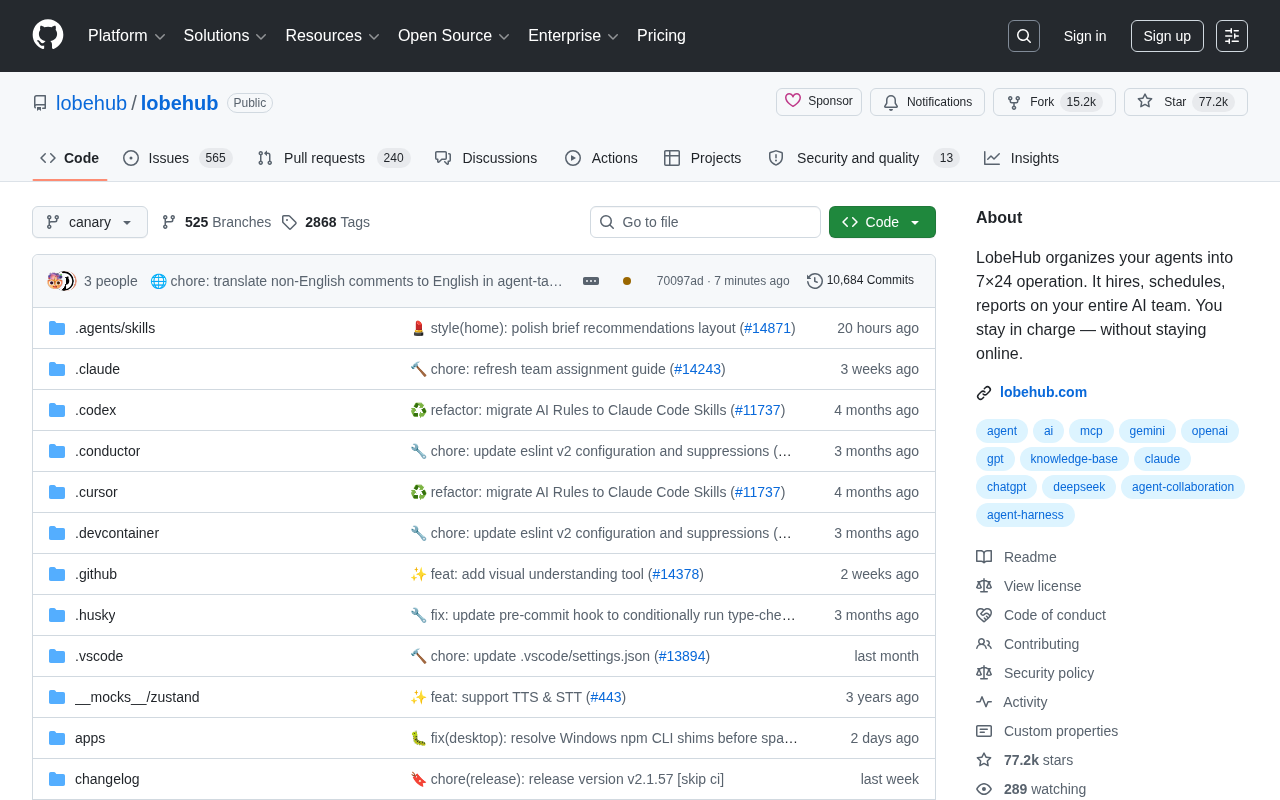
LobeHub is a 76K-Star open-source multi-agent collaboration platform pioneering a new human-AI teamwork paradigm.
LobeHub is an open-source AI Agent collaboration platform built with TypeScript, boasting 76K+ GitHub Stars. Its core philosophy elevates AI Agents from tools to collaboration partners, supporting multi-agent team design and collaboration—differentiating it from LangChain, AutoGPT, and similar solutions. The TypeScript choice reflects a frontend-first strategy, aligning with the 2024-2025 industry shift toward multi-agent systems, while facing challenges in communication standardization, reliability, and commercialization.
Project Overview: The AI Collaboration Platform Behind 76K Stars
LobeHub is an open-source AI Agent collaboration platform built with TypeScript, positioning itself as "the ultimate space for work and life." As of now, the project has amassed over 76,000 Stars and 15,000+ Forks on GitHub, firmly establishing itself in the top tier of open-source AI Agent projects.
Its core philosophy is clear: enable users to discover, build, and collaborate with AI agent teammates, creating an intelligent work environment that continuously evolves with depth of use.
It's worth first understanding what an AI Agent is. An AI Agent is a software entity capable of perceiving its environment, making autonomous decisions, and taking actions to achieve specific goals. Unlike traditional chatbots, Agents possess memory, planning, and tool-calling capabilities, allowing them to decompose complex tasks and execute them step by step. Stanford University's 2023 paper on "Generative Agents" first demonstrated the possibility of multiple AI Agents autonomously socializing and collaborating in a virtual town, directly catalyzing the entire industry's attention toward multi-agent systems. LobeHub is a representative project that emerged at the intersection of this academic breakthrough and engineering practice.
Core Positioning: Agent as the Unit of Work Interaction
From Single Assistant to Multi-Agent Team Collaboration
LobeHub's ambition extends far beyond providing a chat interface or a single AI assistant. The project team has clearly articulated three key directions:
- Multi-Agent Collaboration: Supporting coordinated work among multiple AI Agents, breaking through the limitations of traditional single-conversation models
- Effortless Agent Team Design: Dramatically lowering the barrier to building agent teams, enabling non-technical users to assemble their own AI work teams
- Agent as the fundamental unit of work interaction: This is a paradigm shift—elevating AI agents from "tools" to "collaboration partners"
This positioning means LobeHub is attempting to move beyond mainstream AI chat applications like ChatGPT and Claude, entering a more structured and systematic domain of agent orchestration.
Research on Multi-Agent Systems (MAS) actually dates back to the distributed artificial intelligence field of the 1980s. Early MAS primarily focused on agent interaction strategies within game theory frameworks, such as Nash equilibrium and auction mechanisms. In the era of large language models, multi-agent collaboration gained an entirely new technical foundation: each Agent can communicate through natural language without requiring predefined strict message formats. In 2024, two mainstream architectures emerged for multi-agent orchestration—centralized orchestration (where a "commander" Agent assigns tasks) and decentralized collaboration (where Agents communicate equally and coordinate autonomously). LobeHub's team collaboration model is closer to a hybrid of centralized and decentralized architectures, with users participating as ultimate decision-makers in the Agent team's workflow.
Differentiation from LangChain, AutoGPT, Dify, and Others
The current market of AI Agent frameworks can be roughly categorized as follows:
| Category | Representative Projects | Core Characteristics |
|---|---|---|
| Development Framework | LangChain/LangGraph | Developer-facing foundational toolchain |
| Autonomous Agent | AutoGPT | Emphasis on fully automated execution |
| Low-Code Platform | Dify/Coze | Visual workflow building |
| Collaboration Platform | LobeHub | Emphasis on human-Agent team collaboration |
LobeHub's uniqueness lies in its emphasis on "collaboration" rather than "automation"—Agents don't replace human work but participate as team members in workflows.
This concept of "Agent Teammates" shares similarities with Microsoft Copilot's "co-pilot" philosophy, but LobeHub takes it further: expanding it into a team of multiple Agents, each assuming different roles and responsibilities, forming a true multi-agent collaboration network.
Technical Ecosystem and Community Impact Analysis
GitHub Data Comparison: Strong Performance in the Open-Source Community
What does 76,000+ Stars represent among AI open-source projects? Here's a horizontal comparison:
- AutoGPT: ~170K+ Stars
- LangChain: ~100K+ Stars
- Dify: ~90K+ Stars
- LobeHub: ~76K+ Stars
LobeHub's ability to achieve such high visibility in the fiercely competitive AI open-source landscape directly reflects the community's strong demand for multi-agent collaboration platforms. The 15,000+ Fork count also indicates that a large number of developers are actively building upon this project for secondary development and customized deployments.
It's worth analyzing the community dynamics behind these numbers. While GitHub Star counts are often viewed as indicators of project popularity, they reflect more complex propagation mechanisms. A project typically grows from 1K to 10K Stars through word-of-mouth within the technical community, from 10K to 50K by crossing technical circles to reach broader user groups, and breaking through 50K often means the project has become a benchmark in its specific domain. Fork count is another key indicator—it represents the scale of developers actually participating in secondary development. LobeHub's Fork/Star ratio is approximately 20%, higher than the industry average (typically 5-10%), indicating that the project has not only attracted "spectators" but has also stimulated substantial developer participation and customization needs, showing quite healthy engineering activity in the community.
Why TypeScript Instead of Python?
The project chose TypeScript as its primary development language, which is quite unusual for AI projects (most AI frameworks default to Python). This technical decision reveals several important signals:
- Frontend-first product strategy: A strong focus on user experience and interaction design, with UI/UX as a core competitive advantage
- Full-stack JavaScript ecosystem integration: Making it easy for the vast Web developer community to quickly get started and contribute code
- Targeting end users rather than researchers: The product goal is to enable ordinary users to harness multi-agent collaboration
TypeScript is a superset of JavaScript, released by Microsoft in 2012, which significantly improves the maintainability and development efficiency of large projects through its static type system. In the AI domain, Python has long dominated thanks to frameworks like PyTorch and TensorFlow, but TypeScript has natural advantages in frontend rendering, real-time interaction, and full-stack development. Node.js/Deno runtimes enable TypeScript to efficiently handle I/O-intensive tasks (such as API calls and streaming responses), while frontend frameworks like React/Next.js provide mature component-based solutions for building complex Agent interaction interfaces. The npm ecosystem contains over 2 million packages—the world's largest software registry—meaning LobeHub can rapidly integrate various tools and services.
This technical choice defines LobeHub's differentiation path—it's not an experimental framework for AI researchers, but a productivity tool designed for real work scenarios.
Industry Trends: The Full Rise of Multi-Agent Collaboration in 2024-2025
The AI industry is undergoing a critical transition from "single large models" to "multi-agent systems." Major players' moves are very clear:
- OpenAI released the Swarm multi-agent framework
- Google launched the Agent Development Kit (ADK)
- Anthropic proposed the Model Context Protocol (MCP) for multi-agent communication
- Microsoft continues to strengthen multi-Agent capabilities in the Copilot ecosystem
OpenAI's Swarm, released in October 2024, is a lightweight multi-agent orchestration framework whose core concept is "Handoff"—one Agent seamlessly passes control and context to the next Agent after completing its own task. Swarm deliberately maintains a minimalist design without introducing complex state management or persistence mechanisms, making it more suitable as a teaching and prototyping tool. In comparison, LobeHub provides a more complete productized solution, including persistent conversation history, visual Agent configuration, and user-friendly interaction interfaces, making it more suitable for deployment and use in actual production environments.
Anthropic's Model Context Protocol (MCP) is an open standard protocol aimed at unifying the connection between AI models and external data sources and tools. MCP adopts a client-server architecture: AI applications act as MCP clients to initiate requests, while data sources and tools serve as MCP servers providing standardized interfaces. This is analogous to USB-C unifying physical interface standards—MCP attempts to unify the "digital interface" through which AI Agents access the external world. In multi-agent scenarios, MCP's value is particularly prominent: it enables different Agents to share contextual information and call the same toolsets through a unified protocol, dramatically reducing the integration complexity of inter-Agent collaboration. MCP has already gained support from major vendors including OpenAI, Google, and Microsoft, and is becoming a de facto industry standard.
These signals collectively point to one conclusion: multi-agent collaboration is becoming an industry consensus and the next technological inflection point.
LobeHub occupies a favorable position in this trend. It not only provides technical infrastructure but more importantly proposes a new work paradigm: hybrid collaboration between humans and AI Agent teams.
Imagine this scenario: every knowledge worker has a virtual team composed of multiple specialized AI Agents—one responsible for information retrieval, one specializing in data analysis, one excelling at content creation, one handling schedule management—they coordinate with each other, collectively serving the user's work objectives.
Challenges and Future Outlook
Despite the broad prospects, LobeHub and the entire multi-agent collaboration field still need to overcome several key challenges:
- Standardization of inter-Agent communication protocols: Multi-agent collaboration depends on efficient communication mechanisms, but the industry has no unified standard yet, with protocols like MCP still in early stages
- Reliability and controllability assurance: Error propagation, result consistency, and behavior predictability issues when multiple Agents collaborate urgently need resolution
- Commercialization path for open-source projects: How to achieve sustainable business development while maintaining community vitality and open-source spirit
Regarding reliability, the engineering challenges in multi-Agent collaboration are far more complex than single-model calls. First is the "error cascade" problem: when one Agent produces erroneous output and passes it to downstream Agents, errors may be amplified rather than corrected, similar to fault propagation in distributed systems. Second is the "hallucination consensus" problem: multiple Agents may reinforce each other's hallucinated content during interaction, forming seemingly reasonable but actually incorrect consensus. Additionally, the behavior space of multi-Agent systems grows exponentially, making comprehensive testing and behavior prediction extremely difficult. Solutions currently being explored by the industry include: introducing specialized "verification Agents" to fact-check other Agents' outputs, establishing sandbox isolation mechanisms for Agent behavior, and developing observability toolchains specifically for multi-agent systems.
Regarding commercialization, monetizing open-source AI projects has always been an industry challenge. Current mainstream monetization models include: open-source core plus commercial value-added features (Open Core model, like GitLab), managed cloud services (like Hugging Face's Inference API), enterprise-level support and consulting services, and marketplace ecosystems built around open-source projects (like plugin/template marketplaces). Dify chose the Open Core route, offering enterprise edition advanced features and private deployment support; LangChain achieved commercialization through the LangSmith observability platform. For LobeHub, its positioning as a multi-agent collaboration platform is naturally suited to providing value-added services for enterprise teams, such as private deployment, enterprise-grade Agent management, compliance auditing, and priority technical support. However, finding the balance between open community contributions and commercial interests, avoiding "open-source bait-and-switch" that triggers community backlash, remains a strategic issue that requires careful handling.
Conclusion
LobeHub represents an important evolutionary direction in the AI application layer. From tool to partner, from monolith to team, from passive response to active collaboration—this open-source project with 76K Stars is exploring the next frontier of human-AI collaboration.
For developers and product managers following AI Agent development trends, LobeHub's design philosophy and technical implementation are well worth in-depth study. Multi-agent collaboration is no longer a concept confined to academic papers—it's a product form that's being realized in practice.
Key Takeaways
- LobeHub has earned 76K+ Stars on GitHub, positioning itself as the ultimate workspace for multi-agent collaboration
- Its core philosophy treats Agents as fundamental units of work interaction, supporting multi-agent team design and collaboration
- The TypeScript tech stack reflects a frontend-first, end-user-oriented product strategy
- It aligns with the 2024-2025 industry transition from single large models to multi-agent systems
- It faces key challenges including Agent communication standardization, multi-agent reliability, and commercialization pathways
Related articles
 Product Reviews
The Programmer's Desk Setup Guide: Building a Workspace That Feels Like Home
Discover how programmers build productive, comfortable workspaces. From multi-monitor setups to ergonomic design, explore the desk philosophy that drives focus and flow.
 Product Reviews
Qoder vs Cursor Real-World Comparison: Which $20/Month AI IDE Is Better?
Hands-on comparison of Qoder vs Cursor AI IDEs: Agent autonomy, human interaction count, and architecture decisions. Qoder needed only 2 interactions vs Cursor's 8.
 Product Reviews
Cursor Cloud Agent Demo: Eliminating Bottlenecks Across the Entire Software Development Lifecycle
Deep analysis of Cursor's Cloud Agent demo showing how cloud VMs, automated test artifacts, and a full-chain control plane systematically eliminate human bottlenecks across the software development lifecycle.