Deep Dive into Ollama Cloud's Looping Bug: Why Cloud Inference Gets Stuck and How to Fix It

Analyzing why Ollama Cloud models get stuck in repetitive output loops and how to fix it.
Reddit users report Ollama Cloud's Deepseek v4 flash and GLM 5.3 flash models frequently getting stuck in repetitive output loops. This article analyzes the technical root causes—including sampling parameter misconfiguration, KV Cache management issues, and aggressive quantization—and argues the problem likely stems from Ollama Cloud's service architecture rather than the models themselves. Practical workarounds include adjusting inference parameters, switching to full-sized models, or falling back to local deployment.
Background: Ollama Cloud's Stability Called into Question
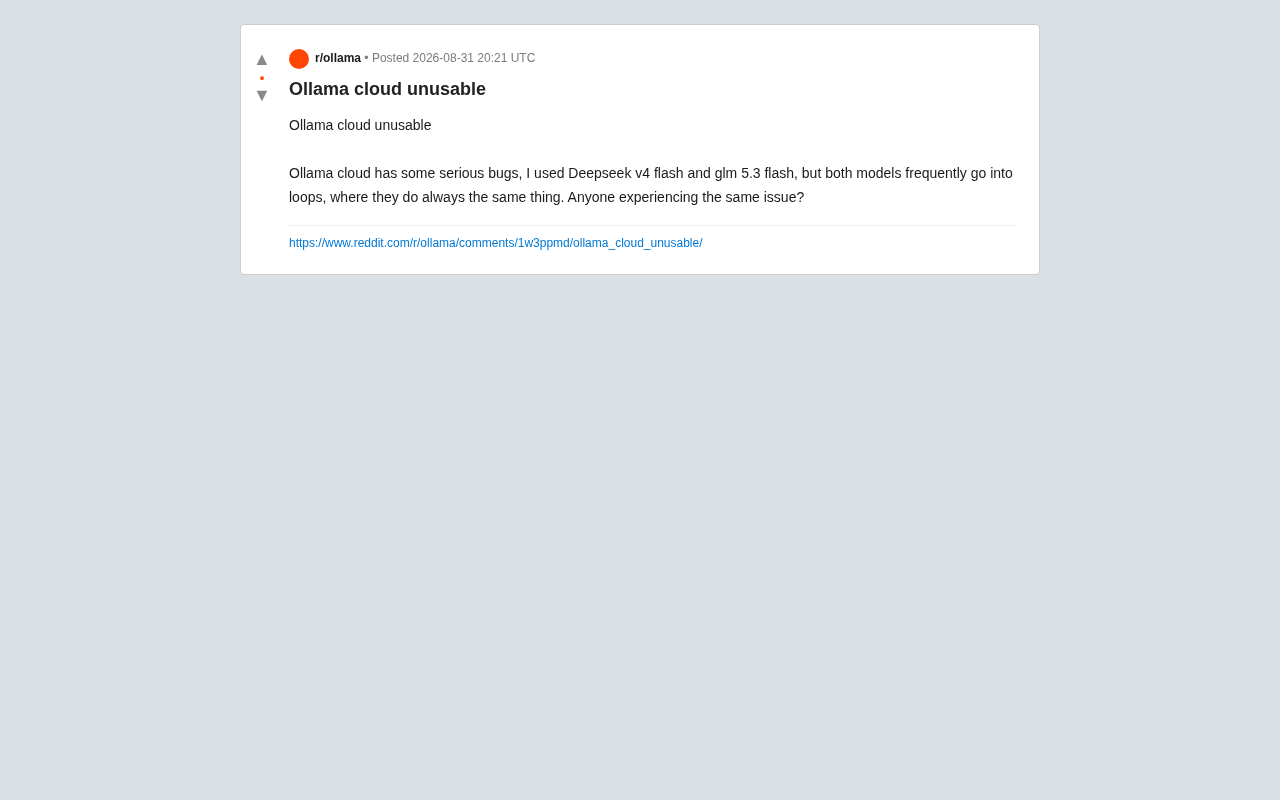
Recently, a Reddit user posted bluntly that "Ollama Cloud [is] unusable," quickly sparking widespread community discussion about the stability of this cloud inference service. The user had been calling the DeepseekAd v4 flash and GLM 5.3 flash models, only to find that they "frequently got stuck in loops, repeatedly outputting the same content," rendering the service essentially unusable.
As a leading tool for running large models locally, Ollama has amassed a large developer user base thanks to its clean command-line experience and excellent support for numerous open-source models. Ollama's core design philosophy borrows from Docker's containerization approach—users can pull and run various open-source large models with a single ollama run command, dramatically lowering the barrier to local deployment. It supports dozens of model families including Llama, Mistral, Gemma, Qwen, and DeepSeek, and achieves efficient CPU/GPU hybrid inference through the GGUF format and the llama.cpp inference engine. With the launch of Ollama Cloud, users can now call larger-scale models without consuming local compute resources, marking Ollama's strategic shift from a purely local tool to a cloud inference platform. However, judging from this user feedback, Ollama Cloud's service maturity still has considerable room for improvement.
Looping Output: A Persistent Problem in LLM Inference
What Is "Model Looping"?
The user's description of "getting stuck in loops, repeatedly doing the same thing" refers to a classic type of degeneration behavior in large language model inference. When a model loses effective tracking of context during generation, or when the sampling strategy goes awry, it can enter a repetitive generation state—continuously outputting the same words, sentences, or paragraphs, and sometimes failing to terminate the response at all.
From a technical standpoint, large language models generate text token by token using an autoregressive mechanism, where each step's output depends on the context formed by all preceding tokens. Under ideal conditions, the model progressively advances content generation based on semantic needs. But when a high-probability token is repeatedly selected, it further reinforces its own probability of appearing in subsequent positions, creating a positive feedback loop. This phenomenon is known in academia as "probability collapse" and is one of the inherent fragilities of autoregressive decoding. Additionally, the attention mechanism in Transformer architectures can exhibit "attention sink" issues when processing very long sequences, where attention weights become excessively concentrated, causing the model to "forget" key information from earlier context and further exacerbating degeneration tendencies.
This looping output phenomenon is typically closely related to several technical factors:
-
Improper sampling parameter configuration: Setting temperature too low, or having repetition_penalty missing or set to an unreasonable value, causes the model to favor repeatedly selecting high-probability repetitive tokens. Temperature is essentially a hyperparameter that scales the model's output logits: as temperature approaches 0, sampling degenerates into greedy decoding, where the model always selects the highest-probability token, making it extremely prone to repetition. When temperature is appropriately increased, the output distribution becomes smoother, giving the model the opportunity to explore more diverse expression paths. Meanwhile, repetition_penalty suppresses repetition by applying penalties to the logits of already-generated tokens, with typical values ranging between 1.0 and 1.3.
-
KV Cache management anomalies: In cloud inference services, if there are flaws in the key-value cache (KV Cache) management logic, context state corruption can occur, triggering loops. KV Cache is the core mechanism for accelerating Transformer inference: during autoregressive generation, the model doesn't need to recompute Key and Value vectors for all historical tokens for each new token—instead, it caches and reuses them, reducing inference computational complexity from O(n²) to O(n). However, in cloud multi-user concurrent scenarios, KV Cache management becomes extremely complex—the service provider needs to maintain independent cache space for each active session in memory and perform dynamic allocation and reclamation under limited GPU VRAM. If the cache is incorrectly truncated, overwritten, or suffers cross-talk between different sessions, the context information the model receives will be inconsistent with the actual conversation history, very likely causing generation logic to go haywire. In recent years, high-performance inference frameworks like vLLM have introduced PagedAttention technology to optimize KV Cache VRAM management, but engineering practices in this area are still rapidly evolving.
-
Precision loss from model quantization: To improve cloud inference efficiency, service providers typically quantize models. Excessive quantization can damage output coherence and increase degeneration risk. Quantization is the technique of converting model weights from high-precision floating-point numbers (such as FP16, BF16) to low-precision integers (such as INT8, INT4, or even INT2), significantly reducing VRAM usage and accelerating computation. Mainstream quantization methods include GPTQ (layer-wise quantization based on second-order error compensation), AWQ (Activation-aware Weight Quantization), and the k-quant series used in the GGUF format. When models are quantized to 4-bit or even lower precision, information loss in weight matrices can cause systematic biases in attention computation—particularly in scenarios requiring precise tracking of long-range dependencies, where cumulative errors from quantization make the model more likely to lose its ability to perceive repetitive content.
Why "Flash" Versions Are More Prone to Issues
Notably, both models mentioned by the user carry the "flash" suffix. These flash versions are typically streamlined or quantized versions of the original models, optimized for faster inference speed. Specifically, flash version optimization techniques usually include: model distillation, where a larger, more capable teacher model guides a smaller student model during training to retain most capabilities while dramatically reducing parameter count; layer pruning, which directly removes redundant layers from the Transformer to shorten the inference path; and more aggressive quantization strategies that compress the model to lower bit widths. While these optimizations may show seemingly modest performance losses on standard benchmarks, what they tend to weaken is the model's ability to handle edge cases—such as ultra-long text generation, highly structured output, and complex multi-turn reasoning tasks. In the trade-off of sacrificing some precision for speed, model robustness often suffers, making degeneration behavior more likely when handling long texts or complex tasks.
Is It a Model Problem or a Service Architecture Problem?
From this feedback, a core question emerges: does the looping bug originate from the models themselves, or from Ollama Cloud's service implementation?
The fact that the user encountered the same looping problem across two models from different vendors based on different architectures is quite telling. DeepSeek v4 flash is based on DeepSeek's MoE (Mixture of Experts) architecture, while GLM 5.3 flash comes from Zhipu AI's GLM series—the two differ significantly in model structure, training data, and training methodology. If only a single model exhibited looping output, it could be attributed to that model's training deficiencies. But when multiple different models on the same platform exhibit highly similar abnormal behavior, the root cause more likely lies in the service layer's inference scheduling mechanism, default parameter configuration, or cache management strategy.
Cloud inference service architecture is far more complex than local deployment. A typical cloud inference platform must handle request routing, load balancing, continuous batching, VRAM management, model hot-loading and unloading, and numerous other components. In continuous batching mode, requests from multiple users are dynamically packed into a batch and sent to the GPU for parallel computation. While this significantly improves throughput, it also introduces the risk of inter-request interference—if the padding strategy, sequence length truncation, or termination condition logic in the batching system has flaws, it can cause anomalies in certain requests' generation processes. Furthermore, to support multiple model architectures, service providers typically abstract a unified inference middleware layer that maps model-specific configuration parameters (such as EOS token IDs, maximum generation length, default sampling strategies, etc.) to a common interface. If this mapping logic doesn't adequately account for certain models' special requirements, issues like termination token failures or sampling strategy mismatches can occur.
In other words, Ollama Cloud very likely introduced unified inference configurations or middleware logic when deploying models as cloud services, and this generic logic may not play well with certain models—especially lightweight flash versions. This also reminds us that the quality of a cloud inference service depends not only on the capabilities of the underlying models but also on the service provider's engineering implementation.
Workarounds Users Can Try
For users encountering Ollama Cloud's looping output issue, here are several approaches to try while waiting for an official fix:
Adjust Inference Parameters
If Ollama Cloud supports custom inference parameters, moderately increasing the temperature value (try raising it 0.1-0.2 from the default) and enabling or increasing repetition_penalty (recommended setting between 1.1-1.2) can usually effectively suppress repetitive output. You can also try enabling top-k sampling (limiting the number of candidate tokens per step, typical values 40-100) or top-p sampling (also known as nucleus sampling, typical values 0.9-0.95)—both strategies strike a balance between diversity and coherence by truncating low-probability tail tokens. If the platform supports frequency_penalty and presence_penalty parameters, these can apply different levels of penalty to high-frequency repeated tokens and already-appeared tokens respectively, making them powerful tools against looping output. This is the most direct and effective approach to combating model loops.
Switch Model Versions or Fall Back to Local Deployment
Since the problem is concentrated in "flash" lightweight versions, trying full-sized models or models with different architectures may bypass the issue. Moreover, Ollama's core strength has always been local execution—for use cases with high stability requirements, falling back to local deployment remains the most reliable option. In a local environment, users have complete control over the inference process and can freely choose quantization precision, adjust context length, and configure sampling strategies without being constrained by the cloud service's unified configuration. For developers with mid-range GPUs (such as NVIDIA RTX 4060 and above), running 7B-14B parameter models typically delivers a smooth inference experience. Even with CPU-only inference, thanks to the extensive optimizations in llama.cpp and the GGUF format, mid-sized models can run at acceptable speeds on modern laptops.
Actively Provide Feedback to the Team
As a product still in rapid iteration, Ollama Cloud needs community feedback to drive bug fixes. Public discussions on platforms like Reddit are themselves an important force in pushing the team to take issues seriously and begin investigation. When providing feedback, users should try to include detailed reproduction information, including the specific model name and version used, the prompt content that triggered the loop, the approximate position where the loop began, and the API parameter configuration used—this information is crucial for the engineering team to locate the root cause.
Growing Pains of Cloud Inference Services
This "Ollama Cloud unusable" user complaint reflects the universal challenges currently facing cloud-based LLM inference services. Transitioning from a local tool to a cloud service means the provider must execute solid engineering across model compatibility, inference parameter tuning, cache management, and numerous other areas—any oversight in any single component can directly impact the end-user experience.
This is not a challenge unique to Ollama. Across the entire AI inference service industry, even more mature platforms like Together AI, Fireworks AI, and Groq regularly face issues with specific models producing abnormal output under specific conditions. The engineering complexity of cloud inference far exceeds what's visible on the surface—from GPU cluster scheduling and orchestration (typically relying on Kubernetes and custom GPU schedulers), to inference engine optimization (vLLM, TensorRT-LLM, TGI, etc., each with different strengths), to user-facing API layer compatibility handling—every layer contains potential failure points. This is especially true when a platform needs to simultaneously support dozens or even hundreds of open-source models with different architectures and scales; ensuring that every combination runs stably is a monumental systems engineering challenge.
For Ollama, its local ecosystem is already quite mature, but its cloud service is clearly still in the polishing phase. These kinds of stability issues are growing pains that are difficult to entirely avoid during a new product's development. For users, the most pragmatic approach is to view the problem rationally, actively provide feedback, and maintain local deployment as a reliable fallback. And for the AI infrastructure industry as a whole, this once again validates an important lesson: model capability matters, but the engineering infrastructure that supports those models is equally critical.
Related articles

Chain of Thought Isn't Just for AI: How Humans Can Use CoT to Improve Thinking Quality
Chain of Thought isn't just a prompt trick for large models. Starting from a Hacker News discussion, this article analyzes why CoT works for human thinking too, breaks down actionable ways to transfer it, and highlights the key differences between human CoT and machine CoT.
Cloudflare Teams Up with OpenAI: Closi…
Cloudflare Teams Up with OpenAI: Closing the Loop from Vulnerability Discovery to Defense with AI
Cloudflare uses OpenAI Daybreak to investigate security vulnerabilities and generate reviewable remediation plans, while developers use Codex to boost coding efficiency and quality.

Orca Multi-Agent Orchestration in Practice: A Guide to Parallel Collaboration with Claude and Codex
Orca is Stable AI's free open-source agent workbench supporting 34 agents like Claude Code and Codex in parallel. Learn its Git worktree isolation, multi-model orchestration, and mobile management.