Deep Dive into OpenAI DevDay: How Four Key Features Could Unlock a Trillion-Dollar Agent Opportunity

Greg Isenberg identifies four OpenAI DevDay features founders should bet on to capture the agent economy.
Serial entrepreneur Greg Isenberg argues that among 20+ OpenAI DevDay announcements, only four truly matter for founders: Dots (a personal agent platform reaching 1.2B weekly users), Decision API (real-time routing), Agents API (multi-agent dev framework), and ChatGPT Login (users bring their own token quota to third-party apps). He frames ChatGPT Login as a structural shift akin to Facebook Login — developers no longer bear inference costs, enabling free core apps and workflow-based monetization. He proposes a Trigger→Decision→Execution→Feedback startup framework and highlights two opportunities: connecting real-world service providers into agent platforms, and building the analytics layer for plugin discovery optimization.
Serial entrepreneur Greg Isenberg — former advisor to Reddit and TikTok — recorded an impromptu podcast after watching Sam Altman's nearly 60-minute DevDay keynote. His core take was blunt: out of the 20-plus features OpenAI announced, only three or four are actually worth betting on as a founder. Those who figure out how to leverage these capabilities — and claim a share of the massive transactions that will soon flow through the ChatGPT platform — have a real shot at building very large companies.
Here's a deep breakdown of that episode, focused on what matters most for anyone looking to build in the age of AI agents.
Dots: The Personal Agent Platform Gateway to 1.2 Billion Weekly Active Users
Isenberg called Dots one of the most significant announcements of the entire event. He frames it as OpenAI's "personal agent platform" — a direct competitor to Meta's muse and products like Instinct. Its real value lies in distribution. As he relayed from Altman, this platform will directly connect to 1.2 billion weekly active users.
The mechanics work like this: users bring real-world needs to Dots — "I need to get this permit processed" or "find me a restaurant that supplies a certain ingredient" — and ChatGPT understands the task and routes it to the right plugin to get the job done. Plugins here act as "mini apps."
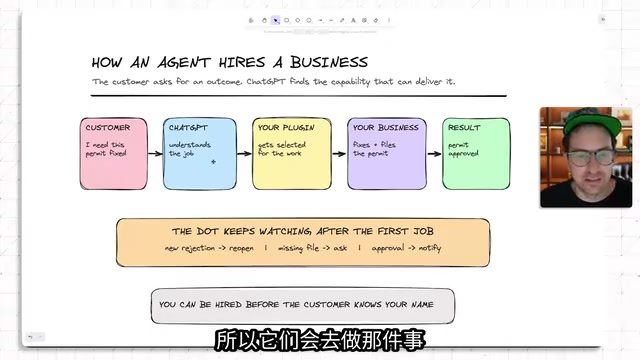
What's worth noting is OpenAI's evolving stance on plugins. Isenberg relayed that while Altman didn't say it word-for-word, he acknowledged that plugins previously had "mixed results" (essentially a failure), and that OpenAI is now doubling down — serious about making ChatGPT the app ecosystem of the AI era.
The implication for founders is clear: your product needs to fit into this chain — receive a customer request, execute the task (like submitting a permit), deliver the result. The key is building "the right plugin" — doing the right thing and producing excellent outcomes — so you get selected by the system before a customer even knows your name, with direct access to a massive user base.
Background context: OpenAI's plugin ecosystem has a bumpy history. In March 2023, OpenAI launched the ChatGPT plugin system, letting third-party developers integrate with ChatGPT — greeted with enormous hype. But due to high discovery friction, low user activation rates, and inconsistent quality, ChatGPT plugins were officially retired in April 2024 and replaced by the GPT Store. The GPT Store also underwhelmed — weak user retention and unclear monetization paths. So when Altman acknowledged at DevDay that plugins had "mixed results" and announced a doubling down on Dots, it was actually OpenAI's third attempt at building an app ecosystem. The critical difference this time: AI proactively matches plugins to users (rather than users actively choosing), and it's directly integrated with an existing base of 1.2 billion users. This "agent-driven discovery mechanism" is the core element that both previous attempts lacked.
Decision API and Agents API: From Selling Tokens to Selling Workflows
Isenberg sees the Decision API as OpenAI's answer to competitors (he mentioned Jav). Its core function is to focus the model's intelligence on a set of user-defined questions with a bounded answer space, enabling real-time decisions: developers provide context via text or images, and the system returns answers that can be used for content classification, request routing, or determining an agent's next action. It's currently in limited preview. He highlighted one underexplored use case — UI design and conversion optimization, such as using the Decision API to generate high-converting App Store screenshots or direct-response landing pages. That said, he acknowledged that whether OpenAI's Decision API is actually better or worse than competing offerings still needs hands-on testing.
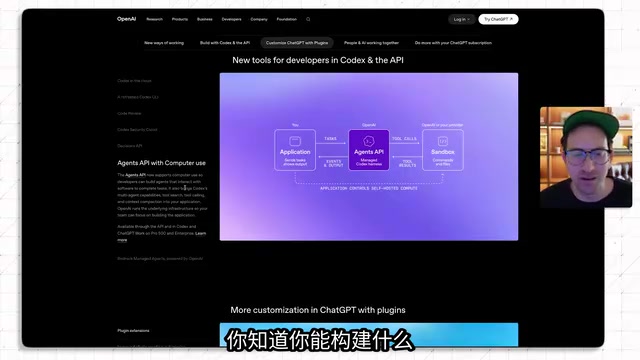
The Agents API upgrade is equally significant: it now supports Computer Use (letting agents complete tasks by interacting with software directly) and introduces Codex's multi-agent capabilities — bringing tool search, tool calling, and context compression into developers' applications. OpenAI handles the underlying infrastructure; development teams focus purely on building the app.
Isenberg sees this as an entirely new surface area. If you own high-quality data, a strong brand, or deeper understanding of a vertical than anyone else, there's a massive opportunity to build AI-native applications. He stressed that very few people are actually doing this yet.
ChatGPT Login: The Underrated "Facebook Login Moment"
The feature that got Isenberg most excited was something he described as "extremely quiet but extremely significant" — ChatGPT Login. Users can sign into third-party apps with their ChatGPT account and use their own token quota.
He draws a direct analogy to when Facebook launched its login feature: that single move spawned thousands of business opportunities and helped create many billion-dollar companies (he cites early Yelp's "Login with Facebook + social graph" as an example).
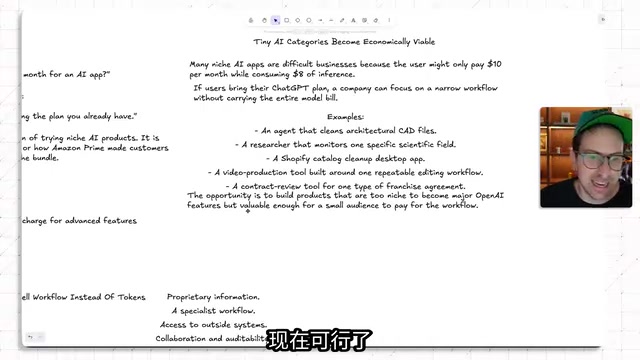
The change to business models here is structural. Previously, developers couldn't offer their core application for free because they had to bear the inference costs (token fees) themselves. Now that users pay with their own quota, developers can make the core app free — dramatically expanding the top of the funnel — then upsell with premium features, enterprise plans, team sharing, richer data, and more.
As Isenberg puts it: "Now we can focus on selling workflows, not selling tokens." This makes many previously uneconomical niche AI categories viable — agents that clean up architectural CAD files, research assistants that monitor a specific scientific domain, video production tools for a single repeatable edit workflow, contract review tools for a specific type of franchise agreement. These are too niche to ever become core OpenAI features, but charge-worthy if you have the right audience. Critically, developers also get access to user emails and potentially phone numbers, opening up email marketing and even ad monetization.
Background context: Facebook Login (originally Facebook Connect) launched in 2008, letting users sign into third-party sites and apps with their Facebook account — bypassing the friction of new registrations. Technically built on OAuth, it created powerful network effects commercially: third-party apps gained social graph data and frictionless user acquisition; Facebook cemented its account system at the center of the web. Yelp, Spotify, and early Instagram all relied heavily on Facebook Login for cold-start growth. But the system also created risks — the 2018 Cambridge Analytica scandal exploited permission loopholes in Facebook Login to harvest massive user data, ultimately triggering regulatory tightening and eroding developer trust. The fundamental difference with ChatGPT Login: what users bring isn't social relationship data, but inference compute (token quota). This changes developers' cost structure rather than their data acquisition methods — a more direct commercial logic, but one that still requires careful attention to the boundaries of user privacy and data ownership.
A Startup Framework: Trigger → Decision → Execution → Feedback
Building on this new combination of the Decisions API, ChatGPT Login, Dots, and Agents API, Isenberg proposes a four-step framework to help founders conceptualize businesses:
- Trigger: An invoice is due, inventory is low, tax season has arrived — something happens that prompts a user to turn to ChatGPT, or that an agent initiates autonomously.
- Decision: ChatGPT determines what should happen next.
- Execution: An application is called to complete a specific action (submit, correct, etc.).
- Feedback: The result — approved or rejected.
His core point: the strongest companies will own at least two or three of these four steps — especially Trigger, Execution, and Feedback. Founders brainstorming ideas should focus on these steps, while also taking inventory of their own moats: proprietary information, specialized workflows, access to external systems, collaboration and auditability, human or vendor networks, and measurable business outcomes. These are the real defensible advantages — not tokens themselves.
Two Specific Startup Opportunities
Isenberg flagged two directions worth watching:
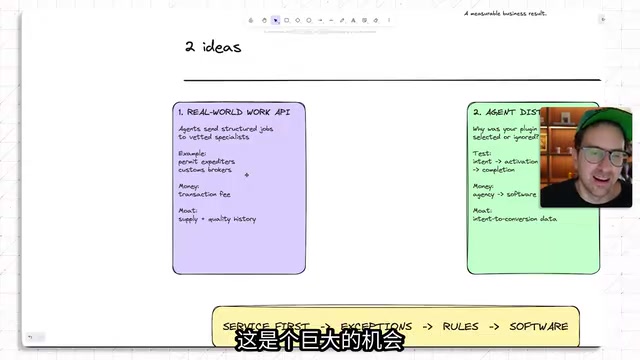
Real-world APIs. When millions of people bring requests to Dots, a significant portion will be structured real-world tasks. If someone can organize vetted professionals in a niche — permit expeditors, customs brokers, etc. — and connect these real-world "workers" into Dots or ChatGPT to complete the "last mile" of a transaction, then charge per transaction, that's a massive opportunity. Most people are focused on purely digital scenarios; the real-world connection layer is being overlooked.
Analytics and optimization for agent discovery. Right now, thousands of companies are probably thinking about how to get their plugins discovered across Dots, muse, Google platforms (like Spark), Instinct, Grok, and other personal agent platforms. Who builds the analytics layer for this? A platform that measures which plugins get selected, tracks activation share by customer intent, surfaces issues in metadata and tool definitions, and tests the impact of every plugin update would replicate the growth path of Mixpanel, Amplitude, and Google Analytics from the web era. Isenberg mentioned that Profound — a player in the AEO/GEO space — has already commanded a sky-high valuation (he estimated roughly $1–2 billion), as an early signal of this trend. His question: who becomes the Profound of the personal agent era?
Background context: The AEO/GEO space Isenberg references covers two emerging concepts. AEO (Answer Engine Optimization) refers to optimizing content and structure for AI search systems that aim to give direct answers (like Perplexity or ChatGPT search) — so that a brand or product is more likely to be cited and recommended by these systems, as opposed to traditional SEO's focus on keyword rankings. GEO (Generative Engine Optimization) is broader, encompassing how to get brand content more exposure in answers generated by large language models — including optimizing the probability of being included in training data and improving recall rates in RAG (Retrieval-Augmented Generation) systems. As AI agents become the new intermediary layer between users and services, "how to get your plugin/tool selected by an agent" will become the next multi-billion-dollar optimization category after SEO. The analytics platform opportunity Isenberg identifies is a direct extension of this logic.
Other Announcements and Takeaways
Beyond the core features above, OpenAI also announced GPT 6.1 (a meaningful upgrade to GPT-6, largely expected), Ultra Fast (dramatically faster but consuming more tokens — Isenberg's verdict: "absolutely stunning"), Private Intelligence (for enterprises hesitant to hand sensitive data to frontier AI), Codex Security Cloud, and Spaces (think cloud-based slides and documents with your own AI agent integrated for collaboration).
But for founders in the audience, Isenberg kept returning to the same four bets: Decision API, Agents API, ChatGPT Login, and Dots. Together they represent a new paradigm — shifting from selling tokens to selling workflows, from paid inference to free distribution. For idea-driven people and founders, this may be an ideal window to actually build.
A note of caution: this piece is based on Greg Isenberg's personal interpretation and retelling of the DevDay keynote. Some feature names, figures (like valuation ranges), and competitive assessments reflect his individual views. Cross-reference with OpenAI's official announcements for accuracy.
Related articles

Chain of Thought Isn't Just for AI: How Humans Can Use CoT to Improve Thinking Quality
Chain of Thought isn't just a prompt trick for large models. Starting from a Hacker News discussion, this article analyzes why CoT works for human thinking too, breaks down actionable ways to transfer it, and highlights the key differences between human CoT and machine CoT.
Cloudflare Teams Up with OpenAI: Closi…
Cloudflare Teams Up with OpenAI: Closing the Loop from Vulnerability Discovery to Defense with AI
Cloudflare uses OpenAI Daybreak to investigate security vulnerabilities and generate reviewable remediation plans, while developers use Codex to boost coding efficiency and quality.

Orca Multi-Agent Orchestration in Practice: A Guide to Parallel Collaboration with Claude and Codex
Orca is Stable AI's free open-source agent workbench supporting 34 agents like Claude Code and Codex in parallel. Learn its Git worktree isolation, multi-model orchestration, and mobile management.