Deep Dive into Qwen3.8 Flash: Impressive Capability Density, But It Doesn't Actually Feel Fast
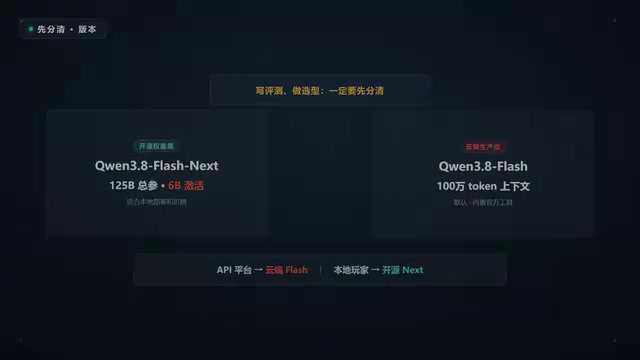
Qwen3.8 Flash packs impressive capability density but its verbose output and slow speed undercut the "Flash" name.
This article breaks down Qwen3.8 Flash's real-world performance. Despite entering the first tier on benchmarks with only 6B activated parameters (one-third of competitors), its generation speed is slow, output is verbose, and costs can spiral. Compared with GLM 5.3 Flash and DeepSeek V4 Flash, Qwen excels at office collaboration agents while GLM leads for coding. The key takeaway: benchmarks show capability, but bills and latency determine production viability.
A few days ago, the AI world seemed to coordinate a flurry of new releases: Zhipu launched GLM 5.3 Flash, and Alibaba released Qwen3.8 Flash. Both converged on the same pitch — rock-bottom cost, real-world utility. This article takes Qwen3.8 Flash as a case study to break down whether it's actually worth switching to.
The verdict upfront: despite having "Flash" in the name, it might not feel fast at all in practice.
Two Versions of Qwen3.8 Flash: Open Weights vs. Cloud Production
Many benchmarks and selection guides stumble here: Qwen3.8 Flash is actually two different products.
The first is Qwen3.8 Flash Next, an open-weights version with 125B total parameters but only 6B activated per token. It uses a MoE (Mixture of Experts) architecture — one of the most important architectural innovations in large models over the past two years. Traditional Dense models activate all parameters during inference, whereas MoE models distribute parameters across multiple "expert" sub-networks, with a routing mechanism selecting only a small number of experts per inference pass. This means it can have 125B total parameters (representing the model's knowledge capacity) while only activating 6B parameters per token (representing actual compute cost). DeepSeek V3 first validated this approach, and Qwen 3.8 Flash pushes the activation ratio even lower, further challenging the limits of "capability density." This version is suited for local deployment, tinkering, and custom development — it's the one most local enthusiasts are seeing.
The second is the cloud production version, Qwen3.8 Flash, which offers a default 1-million-token context window and comes with an official toolchain. When regular users call the API on the platform, they're typically using this cloud version.
When writing evaluations or making model selections, always distinguish between these two first — otherwise it's easy to misattribute the local version's performance to the cloud version and draw wrong conclusions.
Benchmark Performance: The Win Isn't Absolute Scores — It's Capability Density
On the AA (Artificial Analysis Intelligence Index), the models scored as follows:
- Qwen3.8 Flash Next: 56 points
- Qwen3.8 Flash (cloud): 57 points
- GLM 5.3 Flash: same tier
- DeepSeek V4 Flash: 52 points
The AA index (Artificial Analysis Intelligence Index) mentioned here is a comprehensive model capability scoring system published by the independent evaluation organization Artificial Analysis. It aggregates results from multiple mainstream benchmarks including MMLU, GPQA, HumanEval, MATH, and others, computing a weighted composite score from 0–100 to provide a cross-model comparable metric. Since individual benchmarks can be gamed through targeted optimization, composite indices like this help reduce distortion from "benchmark hacking" to some extent, though they still have limitations such as subjective weight assignments and inability to cover all real-world scenarios.
Looking at absolute scores alone, Qwen isn't number one. But the key is activation size: it only needs to activate 6B parameters — roughly one-third of GLM's.
In other words, it uses less compute to squeeze into the same capability tier. The win here isn't absolute score, but how much work can be done per unit of compute — that's "capability density." This is the real competitive logic behind the Flash series.
Clear Differences in What Each Model Excels At
Alibaba's official benchmarks are quite revealing:
- SWE-Bench Pro: 62.5, leading Claude Opus 4.6 by about 9 points
- Cowork Bench (collaborative office work): 73.9, far ahead of DeepSeek's 45.1
- Job Bench (professional tasks): 55.7, exceeding Opus 4.6 by about 20 points
SWE-Bench is a software engineering benchmark developed by a Princeton University team that requires models to locate and fix real bugs in actual GitHub repositories. SWE-Bench Pro is its advanced version with harder tasks that more closely approximate production-level code repair scenarios, and it has become one of the core metrics for measuring the practical capabilities of AI coding agents. Alongside it, Cowork Bench and Job Bench focus on collaborative office and professional task scenarios respectively, forming a multi-dimensional coordinate system for evaluating agent performance across different verticals.
The clear takeaway from these results: GLM excels at coding agents, while Qwen excels at office-type semi-autonomous agents — their strengths are entirely different. When selecting a model, first clarify whether your core scenario is programming or office collaboration.
Real Project Testing: Half Seawater, Half Flame
Benchmarks are benchmarks, but real projects tell a better story.

A Japanese developer used the open-weights version to run a complete development loop on a real open-source repository: reading issues, searching code, modifying code, running builds, committing, drafting PRs, reading reviews, and iterating. Across two tasks, it triggered 194 tool calls with zero errors. One task was delivered in about 58 minutes, while the previous-generation model couldn't even submit after 6.5 hours.
The "tool calls" here involve the core working mode of modern AI agents. Today's AI agents are no longer simple Q&A systems — they're automated systems capable of autonomously planning tasks, calling external tools (such as code search, file editing, terminal commands, API requests, etc.), and iteratively adjusting strategies based on execution results. Typical agent frameworks like OpenAI's Function Calling, LangChain's Agent module, and recently popular coding agents like Claude Code and Cursor all follow a "Think → Act → Observe → Think Again" loop (the ReAct paradigm). The success rate and orchestration efficiency of tool calls directly determine an agent's practical value, and this is an independent dimension from the model's generation speed.
However, note that this is only a two-task sample and shouldn't be taken as a universal conclusion.
On the flip side, a Chinese user had it generate a webpage — quality scored at 95, but it took a full 19 minutes and 37 seconds. Generating an SVG also took 10 minutes, with long periods of unresponsiveness and execution failures along the way.

So the gap between the "Flash" name and the actual experience is quite real. Here we need to distinguish three different things:
- Capability: Can the model complete the task?
- Generation speed: How fast is each response?
- Agent framework orchestration: How efficient is multi-turn tool call scheduling?
These three are not equivalent. A capable model doesn't necessarily mean a fast experience.
Cost Analysis: Cheap Per-Token Price Doesn't Mean a Cheap Bill
Cost is a critical factor for production deployment. Here's the price comparison on OpenRouter:
OpenRouter is a model API aggregation platform that wraps models from multiple providers into OpenAI-compatible API interfaces, allowing developers to switch between models on demand from a single platform. Pricing is typically per million tokens, split into input (Prompt) and output (Completion) prices. Notably, for MoE models, cloud providers typically price based on activated parameters rather than total parameters — this is the core commercial advantage of MoE architecture: users pay for actual compute consumed, not the model's full capacity.
| Model | Input (USD/million tokens) | Output (USD/million tokens) |
|---|---|---|
| Qwen | 0.16 | 0.47 |
| DeepSeek | 0.14 | 0.28 |
| GLM | Lower during promo | Lower during promo |
For a typical agent task, the most expensive and cheapest options can differ by up to 7x.
But there's a hidden catch: real-world testing reveals that Qwen's output volume is noticeably higher than the platform median. The more verbose the model, the more likely your final bill will exceed your intuitive estimate based on unit price.
Models being "chatty" isn't accidental — it's closely related to training data distribution and RLHF (Reinforcement Learning from Human Feedback) strategies. During alignment training, if annotators tend to rate more detailed answers higher, the model learns that "writing more is safer." In agent scenarios, this problem is amplified: if the Chain of Thought for each tool call round is excessively verbose, it not only increases token consumption but also eats into the limited context window, causing subsequent rounds to lose critical information.
Therefore, in production environments, always set clear completion conditions and output limits — otherwise, seemingly cheap per-token pricing can turn into runaway total costs. Common mitigation strategies include setting max_tokens limits, explicitly requiring concise output in system prompts, and using structured output formats (like JSON Schema) to constrain response formatting.
Selection Advice: Choosing a Model Isn't About Scores — It's About Scenarios

So is Qwen3.8 Flash actually worth it? The answer doesn't lie in whether it's number one, but in what you're using it for.
Its real value is achieving first-tier office-type agent performance with one-third the activated parameters. That's its most compelling competitive advantage.
But its weaknesses are equally clear:
- Not actually fast — the "Flash" name doesn't deliver
- Overly verbose — long outputs drive up costs
- Requires human oversight — may fail or become unresponsive during execution
One-line selection logic: Benchmarks determine if it can do the job; the bill and wait time determine if it can go to production.
If your core scenario is office collaboration agents, and you can tolerate some wait time while implementing output length constraints, Qwen3.8 Flash is worth trying. If you're after the ultimate coding agent experience or the fastest response times, proceed with caution — GLM or DeepSeek might be a better fit.
Choosing a model has never been about choosing a score — it's about choosing a scenario.
Related articles
Qwen3 Next Flash Hands-On Review: An In-Depth Evaluation of the Qwen4 Architecture Preview Model
In-depth review of Alibaba's Qwen3 Next Flash preview model covering pixel-level visual replication, C++ 3D game generation, Blender+Godot tool invocation, and analysis of its Ngram embedding MoE architecture and local 4-bit quantized performance.
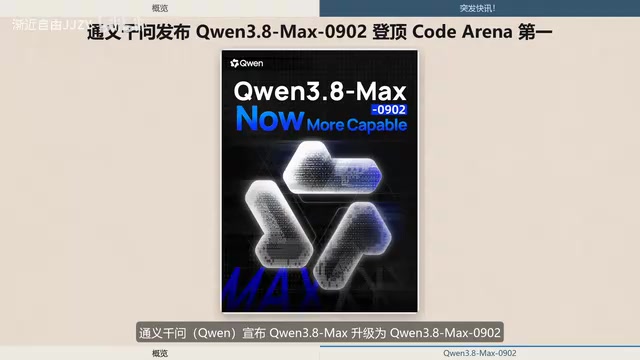
Alibaba's Qwen3.8-Max-0902 Tops Code Arena Leaderboard
Alibaba's Qwen3.8-Max-0902 tops Code Arena with 1691 points, featuring a 2.4T MoE architecture, 128K context, surpassing Claude Opus 3.5 in coding and cost-efficiency.
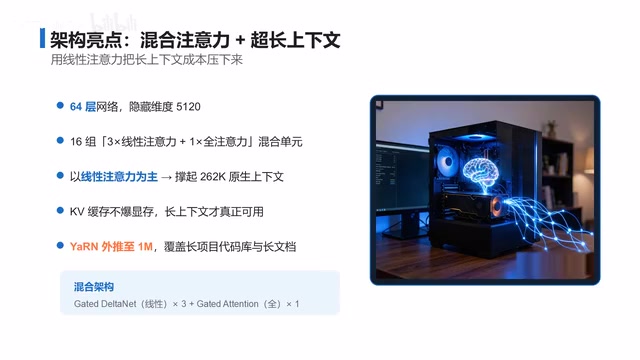
Qwen3 27B Open-Sourced: A Multimodal Agent Model That Runs on a Single GPU
Alibaba open-sources Qwen3 27B dense multimodal model with image/video understanding and GUI control. 4-bit quantized needs only 17GB VRAM. Apache 2.0 licensed.