Deep Dive into RuoYi-Vue-Pro: A 36K Star Enterprise-Grade Java Development Platform

RuoYi-Vue-Pro is a Spring Boot + Vue enterprise open-source admin platform with 36K+ GitHub Stars.
RuoYi-Vue-Pro is a Java enterprise development platform built on Spring Boot + MyBatis Plus + Vue, with 36,900+ GitHub Stars. It supports RBAC dynamic permissions, SaaS multi-tenant architecture, and Flowable workflow engine. Business modules cover e-commerce, CRM, ERP, MES, AI LLM integration, and IoT, addressing virtually all SME digital transformation needs. It's ideal for enterprise secondary development and developers learning architecture design.
Project Overview: Why Has RuoYi-Vue-Pro Earned 36K Stars?
RuoYi-Vue-Pro is the Pro version built upon the classic RuoYi-Vue framework, primarily developed by YunaiV (芋道源码). As of now, the project has garnered over 36,900 Stars and nearly 8,000 Forks on GitHub, firmly establishing itself in the top tier of the most popular Java open-source admin management systems in China.
RuoYi-Vue was originally created by a developer known as "若依" (RuoYi) as a front-end/back-end separated admin management system built on Spring Boot and Vue.js. With "rapid development" as its core philosophy, it provides out-of-the-box features including permission management, code generation, and system monitoring. Thanks to its low barrier to entry and comprehensive documentation, it quickly gained popularity in the Chinese Java development community, spawning multiple derivative versions including RuoYi-Cloud (microservices edition) and RuoYi-Vue-Pro (enhanced edition), forming a massive RuoYi ecosystem.
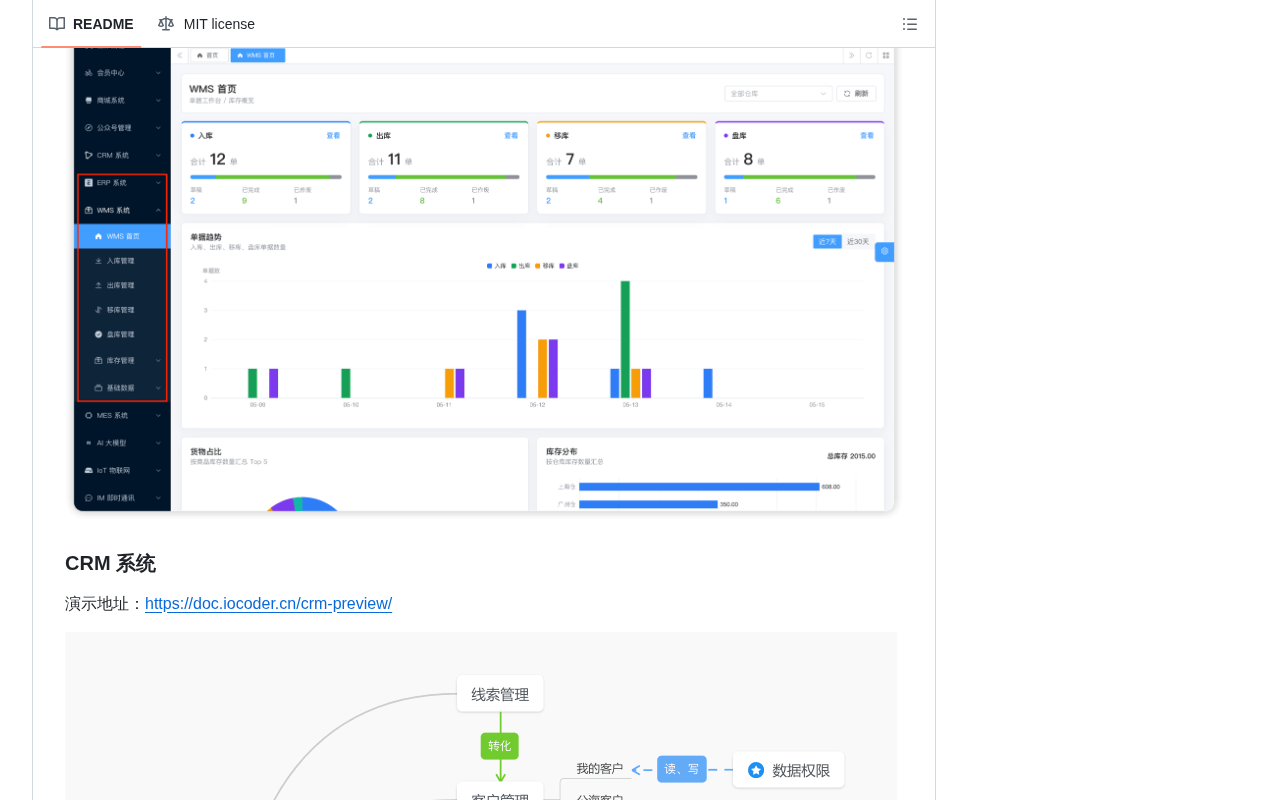
Compared to the original RuoYi-Vue, the Pro version has optimized and refactored all features while significantly expanding enterprise-level application scenarios—from basic permission management to CRM, ERP, MES, and even AI large language model integration, covering virtually every aspect of digital transformation for small and medium-sized enterprises.
Technical Architecture: Engineering Practices with Spring Boot + Vue
Backend Stack: Spring Boot + MyBatis Plus
The project backend is built on Spring Boot + MyBatis Plus, currently the most mainstream and production-proven technology combination in Java enterprise development.
- Spring Boot provides ready-to-use microservice infrastructure with auto-configuration, embedded containers, and Actuator monitoring
- MyBatis Plus further simplifies database operations on top of MyBatis, with built-in code generators, pagination plugins, optimistic locking, and performance analysis utilities
Spring Boot's core design philosophy is "Convention over Configuration." Through its Auto-Configuration mechanism, it automatically infers and configures Beans based on project dependencies, eliminating the need for extensive XML or Java Config. Embedded containers (such as Tomcat or Undertow) allow applications to be packaged as standalone JAR files that run directly without external application servers. The Actuator module provides production-grade monitoring endpoints including health checks, metrics collection, and environment information exposure—fundamental components for microservice observability.
MyBatis Plus (MP) follows the core principle of "enhance without change." It wraps common CRUD operations on top of MyBatis, allowing developers to perform single-table operations without writing basic SQL. Its built-in code generator can generate Entity, Mapper, Service, and Controller layered code from database table structures with one click. The pagination plugin supports physical pagination across multiple database dialects, the optimistic locking plugin resolves concurrent update conflicts through version numbering, and the performance analysis plugin can intercept slow SQL during development to help developers identify performance bottlenecks early.
The core advantage of this technology selection lies in its mature ecosystem, active community, and abundant learning resources. For enterprise teams, recruiting Spring Boot developers is far easier than for other frameworks, and long-term maintenance costs are more manageable.
Frontend Stack: Vue + Element UI for Full-Platform Coverage
The frontend uses the classic Vue + Element UI combination, delivering a fully-featured admin management interface.
Vue.js's component-based development model breaks the UI into independent, reusable components, each encapsulating its own template (HTML), logic (JavaScript), and styles (CSS), communicating between parent and child through Props and Events. Element UI (and its Vue 3 version, Element Plus) is an enterprise-grade UI component library open-sourced by Ele.me's frontend team, offering over 60 high-quality components including tables (with sorting, filtering, and tree data support), forms (with built-in validation rule engines), date pickers, and dialogs—particularly suited for data-intensive admin scenarios. Its unified design language and customizable theming have made it the de facto standard UI framework for Vue admin projects in China.
This combination enables rapid construction of forms, tables, charts, and other management pages, significantly boosting frontend development efficiency.
Additionally, the project supports WeChat Mini Program development, achieving full-chain coverage from admin backend to C-end users—something rarely seen among similar open-source projects.
Core Feature Modules in Detail
RBAC Dynamic Permissions & SaaS Multi-Tenant Architecture
The permission system is the cornerstone of any admin management system. RuoYi-Vue-Pro implements a complete RBAC (Role-Based Access Control) dynamic permission system and fine-grained data permission control, supporting button-level access control.
RBAC (Role-Based Access Control) is one of the most classic permission models in information security, formally proposed by NIST (National Institute of Standards and Technology) in 1992. Its core concept assigns permissions to roles, then assigns roles to users, forming a three-tier mapping of "User-Role-Permission." Compared to ACL (Access Control List) models that directly assign permissions to users, RBAC significantly reduces permission management complexity—when organizational structures change, only role permission configurations need modification rather than individual user updates. RBAC has also evolved into extensions like RBAC1 (role inheritance), RBAC2 (role constraints), and RBAC3 (unified model), supporting more complex enterprise permission scenarios.
More noteworthy is its SaaS multi-tenant architecture support. A single system can simultaneously serve multiple tenants (enterprise customers) with complete data isolation between each tenant. This is crucial for products delivered in SaaS mode—you don't need to deploy a separate system for each customer, dramatically reducing operational costs.
The core challenge of SaaS multi-tenant architecture lies in ensuring data isolation between tenants while sharing infrastructure. The industry has three mainstream implementation approaches: The first is "separate databases," where each tenant has an independent database instance—strongest isolation but highest cost. The second is "shared database, separate schemas," where tenants share a database instance but use different schemas (namespaces), balancing isolation and cost. The third is "shared database, shared schema," distinguishing tenant data by adding a tenant_id field to tables—lowest cost but requiring strict data access boundary control at the application layer. RuoYi-Vue-Pro primarily adopts the third approach, using MyBatis Plus's multi-tenant plugin to automatically append tenant filter conditions before SQL execution, making it nearly transparent to business code.
Flowable Workflow Engine Integration
The project integrates the Flowable workflow engine with out-of-the-box support for:
- Visual process designer (drag-and-drop modeling)
- Multi-level process approval
- Process monitoring and history tracking
Flowable was born in 2016, forked from Activiti 6 by core Activiti developers including Tijs Rademakers. The fork occurred after Alfresco's acquisition of the Activiti project led to disagreements among the core team about project direction. Flowable complies with the BPMN 2.0 (Business Process Model and Notation) international standard, supporting complete workflow capabilities including process definitions, task assignments, gateway routing, event listeners, and timers. Compared to Activiti, Flowable iterates more frequently (maintaining a monthly release cadence) and leads in support for CMMN (Case Management) and DMN (Decision Model) standards. Its lightweight embedded design allows it to be integrated directly into Spring Boot applications as a JAR package without deploying a separate process server.
For high-frequency enterprise scenarios such as OA approvals, contract approvals, and expense reimbursement workflows, this module can be deployed directly into production.
Business Function Matrix: One-Stop Enterprise Digitalization Solution
RuoYi-Vue-Pro covers an extremely rich set of business modules, serving as a near-complete one-stop solution for SME digital transformation:
| Module | Description |
|---|---|
| Payments & E-commerce | Integration with WeChat Pay, Alipay, and other mainstream payment channels, providing a complete e-commerce solution |
| CRM | Full-process coverage of customer leads, opportunity tracking, and contract management |
| ERP | Core business management including inventory, procurement, and warehousing |
| MES | Production planning and execution management for manufacturing |
| IM (Instant Messaging) | Internal enterprise communication and collaboration tools |
| AI LLM Integration | Integration with large language model capabilities, keeping pace with AI application trends |
| IoT | Device connectivity, data collection, and device management |
From a system positioning perspective, CRM focuses on the entire lifecycle of enterprise-customer interaction, with core processes including lead acquisition, opportunity conversion, contract signing, and after-sales service—representative products include Salesforce and HubSpot. ERP is the core system for internal enterprise resource management, integrating finance, procurement, inventory, production, and HR modules—representative products include SAP and Oracle ERP. MES sits in the execution layer between ERP and shop floor equipment, responsible for converting production plans into specific shop floor work orders while collecting real-time production data and feeding it back to ERP. These three systems respectively cover the enterprise's "customer side," "management side," and "production side," forming the core triangle of manufacturing enterprise digitalization. RuoYi-Vue-Pro integrates all three systems on a unified technology foundation, avoiding the integration challenges that come with procuring multiple heterogeneous systems.
Common Infrastructure Modules
Beyond business modules, the project includes a series of foundational capabilities frequently needed during development:
- Third-party login: WeChat, DingTalk, WeCom, and other mainstream platforms
- SMS services: Integration with Alibaba Cloud, Tencent Cloud, and other SMS channels
- File storage: Support for local storage, OSS, MinIO, and other storage solutions
- Code generator: Automatic generation of frontend and backend code based on database table structures
These modules save developers significant time that would otherwise be spent reinventing the wheel.
Value Analysis: Who Should Use RuoYi-Vue-Pro?
Java Developers: A Quality Reference for Learning Architecture Design
For Java developers, RuoYi-Vue-Pro is not just a ready-to-use development scaffold but also high-quality architecture study material. The project features standardized code, thorough comments, and covers core enterprise development challenges including permission design, multi-tenant data isolation, workflow integration, and distributed transactions.
Distributed transactions are among the most challenging problems in microservice architecture. In modular architectures, a single business operation often needs to span multiple services or databases (e.g., placing an order while simultaneously deducting inventory, deducting balance, and generating a logistics order). Traditional single-machine transactions (ACID) cannot work across service boundaries, necessitating distributed transaction solutions. Common strategies include: Two-Phase Commit (2PC—strong consistency but poor performance), TCC (Try-Confirm-Cancel—high business intrusiveness but flexible), Saga (long transaction orchestration achieving eventual consistency through compensation mechanisms), and message queue-based eventual consistency approaches. Seata, a popular distributed transaction framework in China (open-sourced by Alibaba), offers AT, TCC, Saga, and XA modes. RuoYi-Vue-Pro needs to consider the selection and implementation of these approaches in scenarios involving cross-module data consistency.
If you're preparing for architect interviews or want to systematically improve your engineering capabilities, reading through this project's source code will yield significant insights.
SMEs: A Powerful Tool for Reducing System Development Costs
For small and medium-sized enterprises, secondary development based on RuoYi-Vue-Pro can dramatically compress system development timelines and costs. The modular design allows enterprises to tailor as needed—only need permission management and workflows? Remove the CRM and ERP modules. Need e-commerce capabilities? The mall module works out of the box.
The 36,000+ Star community size also means that when you encounter problems, someone has likely already hit the same issue and provided a solution.
Ecosystem Position: A Benchmark for Domestic Open-Source Admin Systems
In the competitive landscape of Chinese Java open-source admin management systems, RuoYi-Vue-Pro has become the de facto benchmark project thanks to its breadth of feature coverage and active update cadence. Its expansion from basic permission management into cutting-edge areas like AI large models and IoT demonstrates the project team's continuous tracking of technology trends.
Conclusion
RuoYi-Vue-Pro is no longer just an admin management template—it's a comprehensive enterprise-grade development platform covering multiple business scenarios. The Spring Boot + Vue technology foundation is mature and stable, while modules like SaaS multi-tenancy, Flowable workflows, and CRM/ERP directly address core enterprise needs.
If your team is looking for an enterprise-grade solution based on the Java technology stack, or if you want a high-quality open-source project to study enterprise architecture design, RuoYi-Vue-Pro is well worth serious evaluation.
Key Takeaways
- RuoYi-Vue-Pro is built on Spring Boot + MyBatis Plus + Vue, earning 36,900+ Stars on GitHub as one of China's most popular Java open-source admin systems
- Supports RBAC dynamic permissions, data permissions, and SaaS multi-tenant architecture for enterprise-grade security and commercial deployment needs
- Business modules span e-commerce, CRM, ERP, MES, IM, AI LLM, and IoT, covering virtually all SME digital transformation requirements
- Integrates Flowable workflow engine, third-party login, payments, SMS, and other infrastructure, significantly reducing enterprise system development costs
- The project remains actively maintained, expanding from basic permission management into cutting-edge AI and IoT territories, demonstrating keen awareness of technology trends
Related articles
 Product Reviews
The Programmer's Desk Setup Guide: Building a Workspace That Feels Like Home
Discover how programmers build productive, comfortable workspaces. From multi-monitor setups to ergonomic design, explore the desk philosophy that drives focus and flow.
 Product Reviews
Qoder vs Cursor Real-World Comparison: Which $20/Month AI IDE Is Better?
Hands-on comparison of Qoder vs Cursor AI IDEs: Agent autonomy, human interaction count, and architecture decisions. Qoder needed only 2 interactions vs Cursor's 8.
 Product Reviews
Cursor Cloud Agent Demo: Eliminating Bottlenecks Across the Entire Software Development Lifecycle
Deep analysis of Cursor's Cloud Agent demo showing how cloud VMs, automated test artifacts, and a full-chain control plane systematically eliminate human bottlenecks across the software development lifecycle.