Deep Dive into RuoYi-Vue-Pro: A 37K Star Enterprise-Grade Java Full-Stack Development Framework

RuoYi-Vue-Pro is China's most popular enterprise-grade Java full-stack open-source development platform.
RuoYi-Vue-Pro is built on the Spring Boot + MyBatis Plus + Vue stack with over 36,900 GitHub Stars, making it one of the most popular Java backend management open-source projects in China. It provides enterprise-grade foundations including RBAC permissions, multi-tenancy, and workflow engines, with business modules spanning e-commerce, CRM, ERP, and MES. With forward-looking AI LLM and IoT integration, it has evolved from a backend management framework into a comprehensive enterprise-grade full-stack development platform.
Project Overview: What is RuoYi-Vue-Pro?
RuoYi-Vue-Pro is a brand-new Pro edition built upon the classic RuoYi-Vue framework, primarily maintained by developer YunaiV (芋道源码). As of now, the project has garnered over 36,900 Stars and nearly 8,000 Forks on GitHub, firmly establishing itself as one of the most popular open-source projects in the domestic Java backend management system space.
RuoYi (若依) was originally released around 2018 by its namesake developer. It's a backend management system based on Spring Boot and MyBatis, with its name drawn from the Book of Songs (诗经), evoking elegance and agility. The original RuoYi offers multiple branches including a monolithic version, a frontend-backend separated version (RuoYi-Vue), and a microservices version (RuoYi-Cloud), collectively accumulating hundreds of thousands of Stars across GitHub and Gitee. This makes it one of the most influential backend management framework families in China's Java open-source community. As a community-derived Pro enhancement, RuoYi-Vue-Pro retains the original's simplicity and ease of use while significantly expanding enterprise-grade functional modules and technical depth.
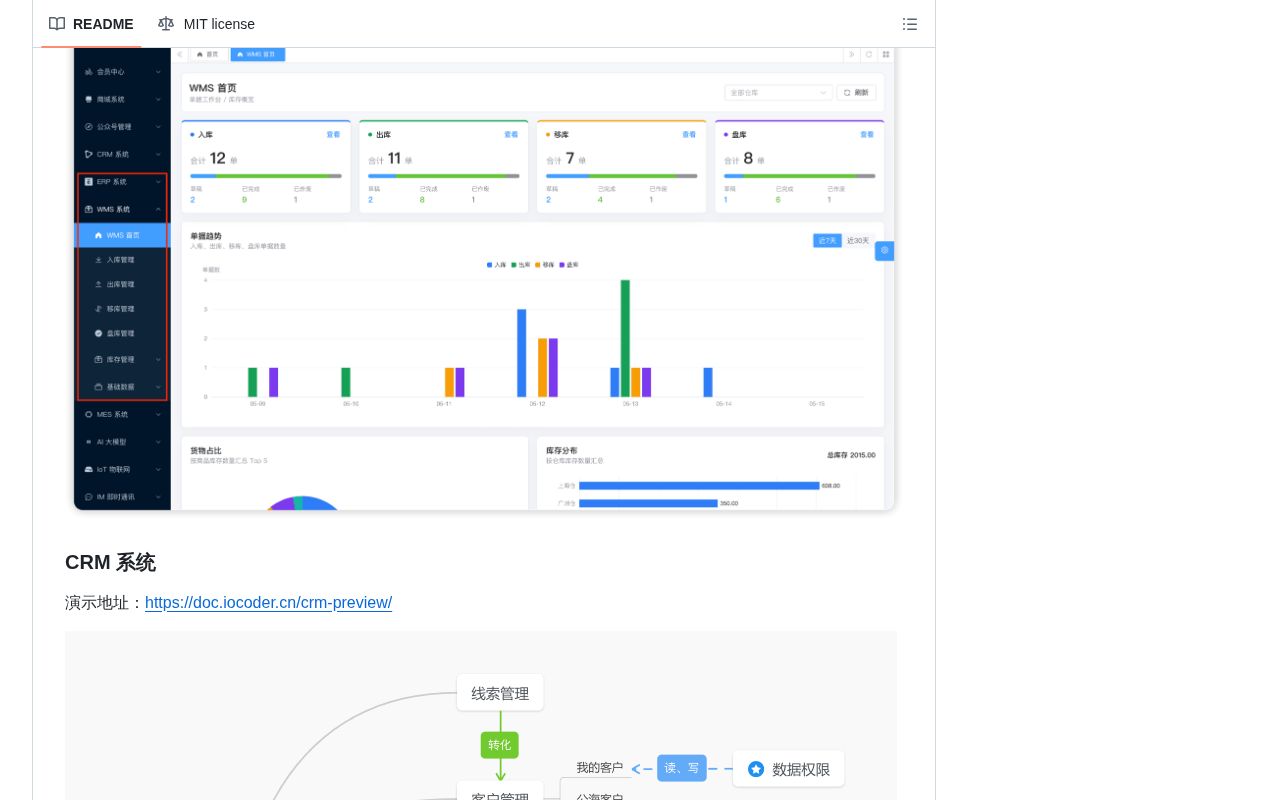
The project uses Spring Boot + MyBatis Plus + Vue & Element as its core technology stack. It optimizes and refactors all features from the original RuoYi while dramatically expanding business module coverage—from basic permission management to workflow engines, payment systems, e-commerce, CRM, ERP, and even AI large language models and IoT, covering virtually every aspect of enterprise application development.
Core Technical Architecture Analysis
Backend Stack: Spring Boot + MyBatis Plus
The backend is built on Spring Boot paired with MyBatis Plus as the ORM framework—one of the most mainstream technology combinations in Java enterprise development today. MyBatis Plus (abbreviated as MP) is a MyBatis enhancement toolkit maintained by the Baomidou team in China. Its core philosophy is "enhance without changing." On top of MyBatis, MP provides generic CRUD interfaces, Lambda expression-based condition constructors, automatic pagination plugins, logical deletion, optimistic locking, and multi-datasource support, enabling developers to handle over 80% of database operations without writing extensive XML mapping files. Compared to the heavyweight ORM approach of JPA/Hibernate, MyBatis Plus preserves SQL flexibility while significantly reducing boilerplate code—a key reason why its adoption rate far exceeds JPA in China's Java development community.
Regarding the permission system, the project implements a dual-control mechanism of RBAC dynamic permissions and data-level permissions. RBAC (Role-Based Access Control) is one of the most classic permission models in information security, formally proposed by the U.S. National Institute of Standards and Technology (NIST) in 1992. Its core concept is assigning permissions to roles and then assigning roles to users, achieving indirect permission management. RBAC is typically divided into four levels: RBAC0 (base model), RBAC1 (role hierarchy), RBAC2 (constraint model), and RBAC3 (unified model). Data-level permission serves as a crucial complement to RBAC—rather than controlling "whether you can access a function," it controls "which data you can see." For example, two users who both have "view orders" permission might see different data: a department manager can see all orders within the department, while a regular employee can only see their own. This row-level data filtering is typically implemented by dynamically appending data scope conditions to SQL queries. Used together, these two mechanisms satisfy the fine-grained permission control needs of most enterprises.
Frontend Stack: Vue + Element UI with Full-Platform Coverage
The frontend adopts the classic Vue + Element UI combination, which is the most widely used frontend solution for mid-to-back-office systems in China. Vue.js was released in 2014 by Evan You, a former Google engineer. With its progressive architecture, low learning curve, and excellent Chinese documentation, it quickly became the framework of choice for frontend development in China. Element UI is a Vue component library open-sourced by the Ele.me frontend team in 2016, offering over 60 enterprise-grade UI components including tables, forms, dialogs, and navigation—making it virtually the standard for Vue-based mid-to-back-office projects in China. Notably, as Vue 3 gained popularity, Element UI evolved into Element Plus, and RuoYi-Vue-Pro has kept pace with this technology upgrade. In the international market, the React + Ant Design combination is more popular, but in China's mid-to-back-office development space, Vue + Element dominates due to its lower learning barrier and design that aligns more closely with domestic development practices.
Additionally, the project supports WeChat Mini Programs, allowing developers to serve both a web-based admin panel and a mobile mini program from the same backend service, achieving true full-platform coverage.
Complete Feature Module Overview
Core Platform Capabilities
RuoYi-Vue-Pro's foundational platform capabilities are quite robust, primarily including:
-
SaaS Multi-Tenant Architecture: One system serving multiple customers—critical for SaaS deployments. SaaS (Software as a Service) multi-tenant architecture is one of the core technical paradigms of the cloud computing era. The essence of multi-tenancy is enabling a single application instance to simultaneously serve multiple customers (tenants) with isolated data and configurations. The industry has three mainstream data isolation strategies: independent databases (strongest isolation but highest cost), shared database with independent schemas (a compromise), and shared database with shared schema (distinguishing tenant data via a
tenant_idfield—lowest cost but weakest isolation). RuoYi-Vue-Pro supports multiple tenant isolation strategies, allowing developers to choose flexibly based on business scale and security requirements. -
Flowable Workflow Engine: Supports complex process orchestration including approval flows and business processes. Flowable is a lightweight Business Process Management (BPM) and workflow engine that originated from the core development team of the Activiti project, which itself was born from the earlier jBPM project—forming the main lineage of Java workflow engines. Flowable follows the BPMN 2.0 (Business Process Model and Notation) international standard and supports rich process elements including user tasks, service tasks, gateways, sub-processes, and events. Compared to hard-coding approval logic, using a workflow engine allows flexible adjustment of process rules through visual process designers, significantly reducing development costs when business processes change. Flowable offers notable improvements over Activiti in performance optimization, CMMN (Case Management), and DMN (Decision Management) support.
-
Third-Party Login Integration: Supports OAuth login from platforms like WeChat and DingTalk. OAuth 2.0 is the most widely used authorization protocol on the internet today, published by the IETF as RFC 6749 in 2012. Its core concept allows users to authorize third-party applications to access their resources on a platform without directly providing their credentials to the third party. When integrating WeChat, DingTalk, and other third-party logins, the authorization code flow is typically used: after the user completes authentication on the WeChat/DingTalk page, the platform sends an authorization code back to the application backend, which then exchanges it for an Access Token, and finally uses the token to retrieve user information to complete the login.
-
Payment and SMS Services: Built-in payment gateway and SMS integration, eliminating the need to reinvent the wheel.
Business Domain Module Extensions
The project's most outstanding highlight is the breadth and depth of its business modules. CRM (Customer Relationship Management), ERP (Enterprise Resource Planning), and MES (Manufacturing Execution System) are three core system types in enterprise informatization, each corresponding to different aspects of business operations. Traditionally, these three system types are provided by different specialized software vendors. RuoYi-Vue-Pro integrates them into a unified platform—while the functional depth may not match specialized products like Salesforce or SAP, it provides small and medium-sized enterprises with a low-cost integrated solution.
- E-Commerce System: Complete online shopping functionality including product management, order processing, and other core workflows
- CRM (Customer Relationship Management): Covers the entire sales pipeline including customer management, opportunity tracking, and contract management, focusing on interactions between the enterprise and its customers across marketing acquisition, sales follow-up, and customer service
- ERP (Enterprise Resource Planning): Encompasses core business management including procurement, inventory, and finance. ERP serves as the central nervous system for internal resource management, integrating core modules like purchasing, inventory, production, and accounting
- MES (Manufacturing Execution System): A production management module for manufacturing, positioned between ERP and shop-floor automation control systems. It handles real-time production monitoring, scheduling, and data collection—a key component of smart manufacturing and Industry 4.0
- IM (Instant Messaging): Built-in instant messaging functionality for internal enterprise communication
AI Large Language Model and IoT Integration
Notably, the project keeps pace with technology trends by integrating AI Large Language Model and IoT modules.
AI Large Language Model (LLM) integration is typically implemented through API calls. Leading large language models—including OpenAI's GPT series and domestic models like Tongyi Qianwen and Wenxin Yiyan—all provide standardized RESTful API interfaces. Developers can send prompts via HTTP requests and receive generated results from the model. In enterprise management systems, typical LLM application scenarios include: intelligent customer service chatbots, automatic document summarization, data analysis report generation, code assistance, and knowledge base Q&A. More advanced integration approaches include RAG (Retrieval-Augmented Generation), which combines enterprise internal knowledge bases with large models, enabling AI to provide precise answers based on private enterprise data. RuoYi-Vue-Pro's AI module provides developers with a foundational framework and UI interface for LLM invocation, lowering the technical barrier to embedding AI capabilities into business systems.
IoT (Internet of Things) device management involves multiple technical aspects including device onboarding, protocol parsing, data collection, command dispatching, and rule engines. IoT devices typically communicate with servers using the MQTT (Message Queuing Telemetry Transport) protocol—a lightweight publish/subscribe messaging protocol designed specifically for low-bandwidth, high-latency, or unreliable network environments. A complete IoT platform typically includes device registration and authentication, thing model definition (describing device properties, events, and services), data storage and time-series analysis, rule engines and alerting, remote control, and OTA upgrades. RuoYi-Vue-Pro's IoT module provides foundational device management capabilities, enabling developers to quickly implement device onboarding and data management without building an IoT platform from scratch.
This forward-looking feature layout demonstrates the maintenance team's keen judgment of technology trends.
Why Choose RuoYi-Vue-Pro?
For Java developers, RuoYi-Vue-Pro's value is primarily reflected across three dimensions:
Outstanding learning reference value. The project features clear code structure and thorough comments, making it excellent material for learning Spring Boot enterprise development. From permission design to multi-tenant architecture, from workflow integration to payment gateway connectivity—each module represents production-grade engineering practice.
Significant development efficiency gains. When used as a scaffold, developers can rapidly build business systems on the existing foundation without constructing infrastructure from scratch. According to community feedback, using this framework can reduce initial project setup time from weeks to days.
One-stop technology ecosystem coverage. From backend to frontend, from web to mini programs, from basic permissions to complex business modules—the all-in-one solution significantly reduces the costs of technology selection and system integration.
Typical Use Cases
RuoYi-Vue-Pro is particularly well-suited for the following scenarios:
- Small and medium enterprises rapidly building internal management systems or business platforms
- Software outsourcing companies using it as a base framework for project delivery
- Java developers learning best practices for enterprise-grade full-stack development
- Startup teams quickly validating SaaS product prototypes and MVPs
Community Ecosystem and Future Development
With nearly 37K Stars, RuoYi-Vue-Pro has fostered a highly active developer community. Nearly 8,000 Forks indicate that a large number of developers are conducting secondary development and business customization on this foundation.
Looking at the feature evolution trajectory, the project has progressively expanded from an initial backend management system to vertical business domains like e-commerce, CRM, and ERP, and more recently to AI large model and IoT integration—demonstrating continuous evolutionary vitality. This "platformization" development path has transformed it from a backend management template into an enterprise-grade development platform covering multiple business domains.
Conclusion
RuoYi-Vue-Pro represents a high-level benchmark for domestic open-source Java enterprise frameworks. It's not just a backend management template—it's a feature-rich, well-architected, and continuously evolving full-stack development platform. Whether you want to learn Spring Boot enterprise development or need a reliable production-grade scaffold, RuoYi-Vue-Pro is well worth exploring in depth.
Key Takeaways
- RuoYi-Vue-Pro is built on the Spring Boot + MyBatis Plus + Vue stack with over 36,900 GitHub Stars, making it one of the most popular Java backend management open-source projects in China
- The project implements enterprise-grade foundational capabilities including RBAC dynamic permissions, data-level permissions, SaaS multi-tenancy, and Flowable workflow, with support for both Web and WeChat Mini Program platforms
- Business modules span multiple vertical domains including e-commerce, CRM, ERP, MES, and IM, with forward-looking integration of AI large language models and IoT functionality
- Suitable for various scenarios including internal systems for SMEs, base frameworks for outsourcing projects, and learning resources for Java enterprise development
- The project has evolved from a backend management framework into an enterprise-grade full-stack development platform covering multiple business domains, demonstrating sustained ecosystem vitality
Related articles
 Product Reviews
The Programmer's Desk Setup Guide: Building a Workspace That Feels Like Home
Discover how programmers build productive, comfortable workspaces. From multi-monitor setups to ergonomic design, explore the desk philosophy that drives focus and flow.
 Product Reviews
Qoder vs Cursor Real-World Comparison: Which $20/Month AI IDE Is Better?
Hands-on comparison of Qoder vs Cursor AI IDEs: Agent autonomy, human interaction count, and architecture decisions. Qoder needed only 2 interactions vs Cursor's 8.
 Product Reviews
Cursor Cloud Agent Demo: Eliminating Bottlenecks Across the Entire Software Development Lifecycle
Deep analysis of Cursor's Cloud Agent demo showing how cloud VMs, automated test artifacts, and a full-chain control plane systematically eliminate human bottlenecks across the software development lifecycle.